Thursday, March 26, 2026

Apostasy to Restoration: Lesson 7 - Religion in the Roman Empire

Apostasy to Restoration: Lesson 7 - Religion in the Roman Empire

When T. Edgar Lyon first penned Lesson 7 of Apostasy to Restoration in 1960, he invited Latter-day Saints to step into a world where religion was not just a private conviction but a fundamental component of the machinery of empire. This bold assertion set the stage for a deeper exploration of the intricate interplay between faith, culture, and politics. Sixty years later, the landscape of scholarship has transformed dramatically, yet Lyon’s central insight remains strikingly relevant: to truly understand the need for a Restoration, we must first immerse ourselves in the complex milieu that shaped the early Christian Church.

This updated lesson builds upon Lyon’s foundational work, integrating modern archaeological discoveries, peer-reviewed historical research, and contemporary Latter-day Saint scholarship to form a more nuanced understanding of the context in which early Christianity emerged. What emerges from this scholarly synthesis is a clearer, richer, and more compelling picture of the Roman religious world—a world that was teeming with a pantheon of gods, replete with elaborate rituals, and governed by a political theology that made the act of Christian discipleship both radical and perilous.

In a society where loyalty to the state was intricately tied to acts of sacrifice and devotion, where citizens adeptly navigated multiple cults without a hint of contradiction, and where the pursuit of salvation was often sought through clandestine mystery rites and the favor of emperors, the Christian proclamation of “one Lord, one faith, one baptism” represented a profound challenge to the status quo—it was nothing less than a revolutionary stance. This declaration was, in essence, a radical reformation of the religious landscape, directly opposing the established norms that dictated the relationship between the individual, the divine, and the state.

Understanding that world is essential for grasping why the early Church fractured amidst various pressures and why a Restoration was not merely desirable but indeed inevitable. The tensions between emerging Christian beliefs and the entrenched systems of power were not just obstacles to be overcome; they underscored the urgent need for a return to core principles that could unify and reinvigorate the faith community. Lyon’s insights encourage us to reflect on our own circumstances in today’s religious environment, prompting critical questions about the nature of faith, the role of community, and the ongoing quest for spiritual authenticity in an increasingly complex world. As we navigate the remnants of an ancient tapestry interwoven with faith and politics, we find ourselves inspired to reconsider the implications of our shared history and the enduring quest for a true Restoration.

Saturday, March 21, 2026

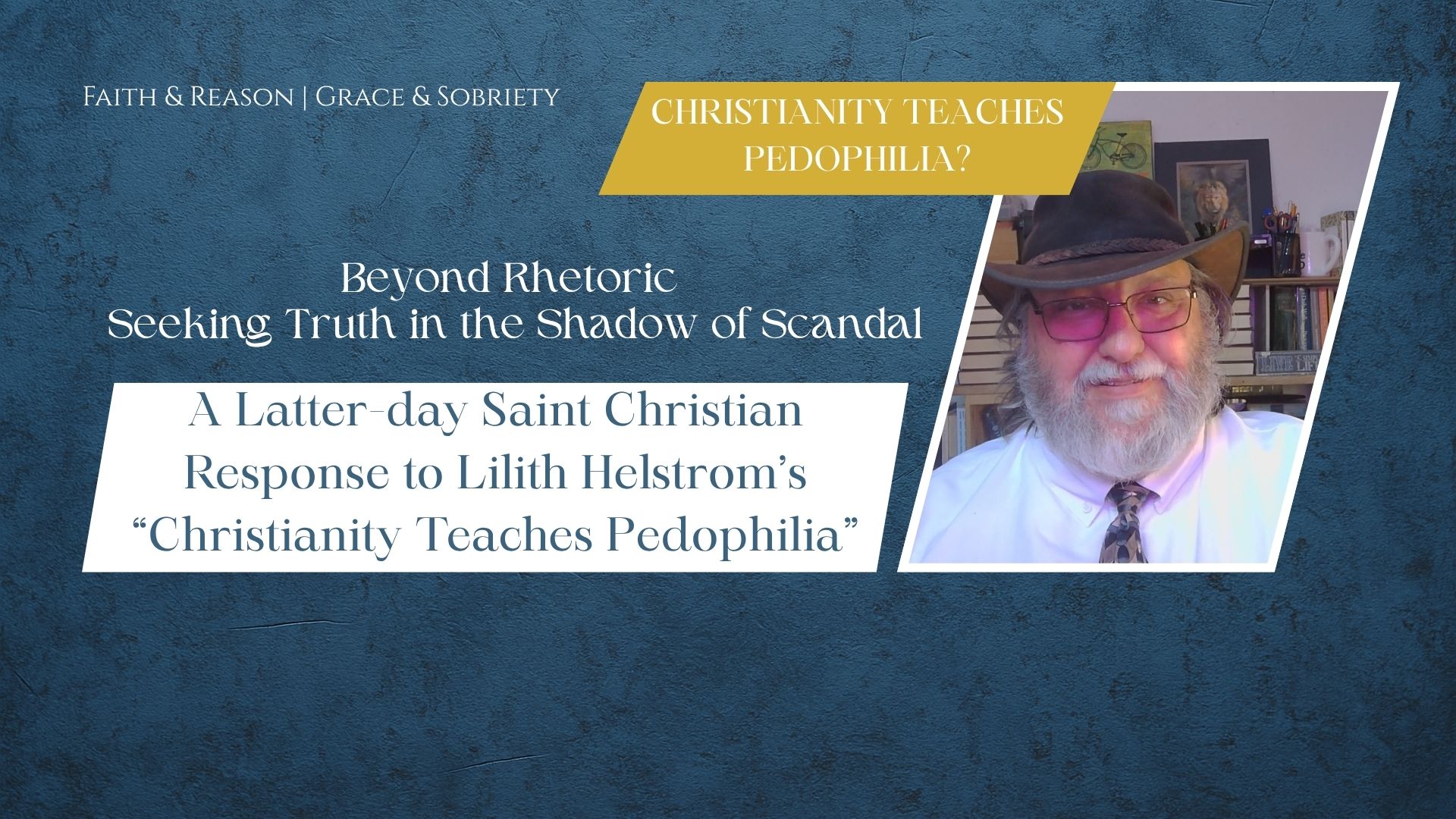
Christianity Does Not Teach Pedophilia: A Scholarly Response to Lilith Helstrom’s “Christianity Teaches Pedophilia”

Christianity Does Not Teach Pedophilia: A Scholarly Response to Lilith Helstrom’s “Christianity Teaches Pedophilia”

Introduction: Beyond Rhetoric—Seeking Truth in the Shadow of Scandal

In the modern digital landscape, the weight of a claim is often measured by its volume rather than its veracity. When an assertion is bold enough, it possesses a certain gravity that can feel persuasive to the casual observer, even when it begins to collapse under the slightest empirical scrutiny. Lilith Helstrom’s recent article, Christianity Teaches Pedophilia, is a prime example of this phenomenon. It is a piece built upon a premise that is intentionally incendiary, deeply emotionally charged, and—as the data will show—profoundly misleading.

The reality of sexual abuse is a global crisis and a harrowing human tragedy that leaves a wake of devastation in every corner of society. Because of the gravity of this issue, it demands an honest, evidence-based analysis that prioritizes the safety of the vulnerable over the scoring of ideological points. To address such a sensitive topic with sweeping generalizations is to do a disservice to survivors; it collapses complex, ancient faith traditions into flat caricatures, obscuring the very nuances that are required to build effective systems of protection.

When rhetoric is allowed to replace research, the casualties are the victims themselves. Truth is not served by inflammatory headlines that misidentify the source of a systemic problem. This response seeks to move the conversation back toward a standard of intellectual integrity. By drawing on a multi-disciplinary framework—including peer-reviewed scholarship, empirical criminology, historical biblical studies, and modern sexual-integrity research—we will evaluate Helstrom’s argument with a commitment to fairness.

Our goal is not merely to offer a rebuttal, but to "steelman" her strongest points regarding institutional failure and then provide the necessary factual and logical corrections to the errors that undermine her ultimate conclusion. In doing so, we aim to uphold a higher standard of dialogue—one where the protection of children and the pursuit of truth are held as the highest priorities.

Thursday, March 19, 2026

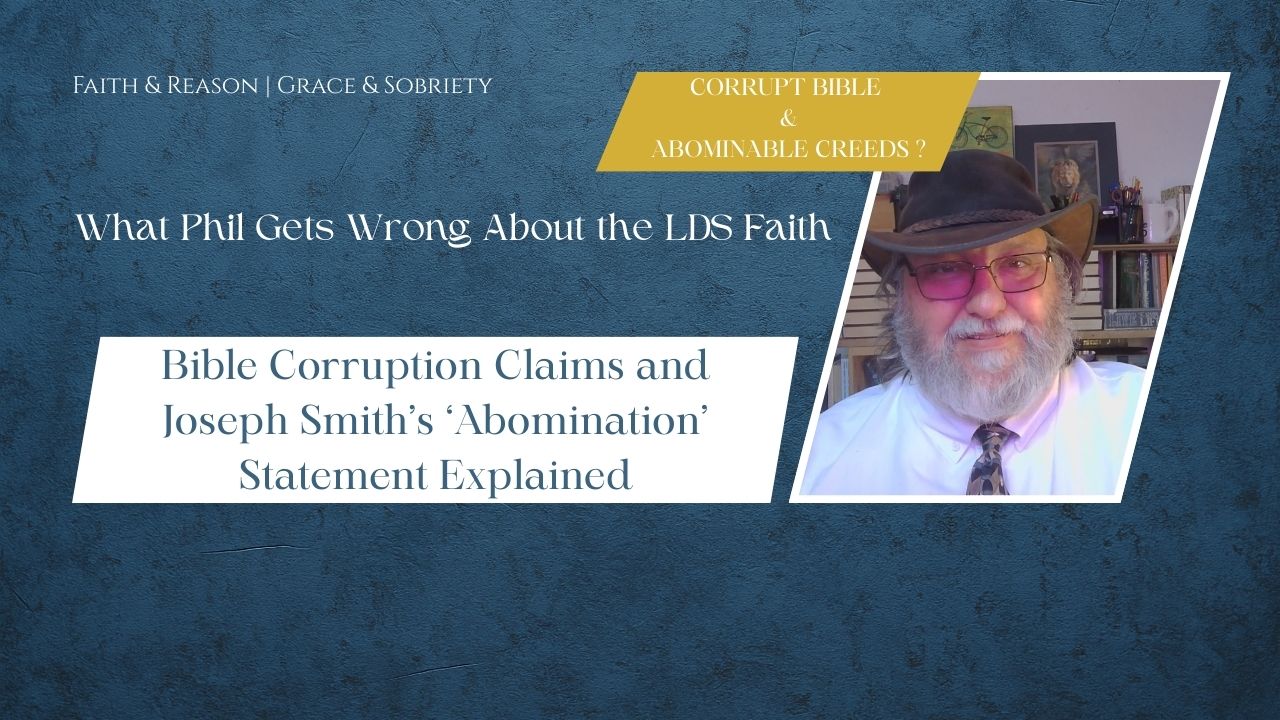
What Phil Gets Wrong About the LDS Faith: Bible Corruption Claims and Joseph Smith’s ‘Abomination’ Statement Explained

What Phil Gets Wrong About the LDS Faith: Bible Corruption Claims and Joseph Smith’s ‘Abomination’ Statement Explained

For years, critics have repeated the same two accusations: that Latter‑day Saints “claim the Bible is corrupted,” and that Joseph Smith condemned all Christian ministers as “abominable.” These claims sound alarming—until you actually examine them closely. What becomes clear, very quickly, is that the real issue isn’t Mormonism at all. It’s the fragile framework of biblical infallibility and inerrancy that many critics bring to the conversation. When that framework is held up to the light of mainstream biblical scholarship, it collapses under its own weight, revealing the complexities and nuances that are often overlooked in the heated discourse surrounding religious beliefs.

The truth is far more grounded and far less sensational than the accusations imply. Latter‑day Saints simply affirm what conservative, moderate, and liberal scholars have acknowledged for more than a century: the Bible has a complex transmission history, contains missing writings, and reflects genuine human processes of preservation. This acknowledgment isn’t fringe thinking, nor is it merely “Mormon doctrine.” It represents the academic consensus that has emerged from rigorous study and analysis. Once you grasp this broader context, the accusations directed at Joseph Smith and the Restoration begin to appear less like informed critique and more like a double standard rooted in presuppositional inerrancy—a lens through which some critics view scripture without truly considering the historical and scholarly evidence that informs our understanding of biblical texts.

My goal in this analysis is simple yet profound: to cut through the rhetoric that often obscures fruitful dialogue, examine the evidence with an open mind, and demonstrate why the claims repeated by critics don’t hold up—not because of LDS apologetics, but because of the very scholarship on which his own tradition depends. When we follow the data, explore the history, and apply logic, a far clearer picture begins to emerge—one that not only restores trust but also deepens understanding. This deeper comprehension invites a more honest and constructive conversation about scripture, revelation, and the Restoration. Engaging in this dialogue can lead to better mutual respect and a recognition of the shared elements found within our diverse faith traditions, fostering an environment where questions can be asked, and insights can be exchanged without the burden of past misconceptions.

Tuesday, March 17, 2026

When a Lie Is Repeated Enough: Exposing Modern Misreadings of LDS Grace and Covenant Theology

When a Lie Is Repeated Enough: Exposing Modern Misreadings of LDS Grace and Covenant Theology

When Misreadings Become “Truth”

What if the most dangerous lie about Latter-day Saint belief isn’t what critics say — but how often they repeat it?

Because when a misreading of scripture is repeated often enough, it stops sounding like an opinion… and starts sounding like truth. This phenomenon reveals the power of repetition in shaping perceptions and beliefs. Misinterpretations or half-truths can gain traction, leading to misconceptions that overshadow the actual teachings and principles of the faith. Critics may not always engage with the actual texts or doctrines but instead rely on sound bites or misrepresentations, creating a narrative that can feel authoritative simply due to its frequency.

Today, we’re not responding with outrage. We’re responding with scripture. It is essential to turn to the foundational texts of our faith to clarify the misunderstandings surrounding our beliefs. By examining the scriptures in their full context, we can counteract the false narratives that may circulate. The goal is not to engage in heated arguments, but rather to educate ourselves and others about the true tenets of our faith, promoting a dialogue rooted in understanding rather than controversy. We seek to illuminate the principles that guide Latter-day Saint belief, fostering a more informed and respectful conversation about what we truly stand for.

The Pattern Behind the Critique

For years, a familiar pattern has circulated through online critiques of the Book of Mormon:

A verse is isolated, often taken out of context to fit a specific critique or interpretation.

A modern theological framework is then imposed onto this ancient covenantal text, creating a disconnect between the original intent of the scripture and the contemporary understanding of concepts like grace, salvation, and the gospel.

Latter-day Saints frequently encounter assertions that they “don’t understand grace,” “don’t understand salvation,” or “don’t understand the gospel.” Such statements are heavy with condemnation and carry a tone of authority that can make them seem credible.

It sounds authoritative. It sounds confident. It sounds convincing — until you actually read the text the way it was written, with its historical and cultural context in mind.

This isn't just a misrepresentation; it's a fundamental misunderstanding of the text itself. What is often dismissed as naive or simplistic faith may, in fact, be rooted in a deeper comprehension of the intricate relationships and themes woven throughout the Book of Mormon.

This isn’t exegesis, which seeks to draw out the meaning from the scripture itself. Instead, it’s eisegesis — meaning interpretations and meanings are inserted into scripture instead of being derived from it. This approach fails to honor the complexity of the original text and the beliefs it articulates, leading to conclusions that may be misleading or inaccurate.

Understanding the Book of Mormon requires more than surface-level readings or preconceived notions; it necessitates an open heart and a willingness to engage with the text on its own terms, allowing its messages to unfold in their intended manner. Only through such an approach can a true appreciation of its teachings and doctrines be attained, along with a richer understanding of the faith it represents.