Showing posts with label LDS Apologetics. Show all posts

Wednesday, November 18, 2026

Does Hebrews End Prophecy? A Scholarly Response to Bill Young on Hebrews and Continuing Revelation

YOUTUBE PREMIERE • 3:30 PM PST • LIVE CHAT

DOES HEBREWS
END PROPHECY?

68 MINUTES  •  103 PAGES  •  30 QUESTIONS

A historical, Greek-exegetical, and theological response to Bill Young's Thoughts on Hebrews and Mormonism—and an invitation to investigate Scripture for yourself.

▶ WATCH THE PREMIERE + JOIN THE CHAT ⬇ DOWNLOAD THE FREE 103-PAGE PDF

FAITH & REASON | LDS COVENANTAL APOLOGETICS
Scripture | Restoration | Covenantal Discipleship

Does Hebrews Prove There Can Be No More Prophets or Apostles?

Does the Epistle to the Hebrews establish that the Latter-day Saint faith is false? Does Jesus Christ’s supremacy mean that he can never again commission apostles or prophets, or that additional divine revelation is impossible? And should the warnings against hardened hearts in Hebrews 3–4 be applied specifically to Latter-day Saints who disagree with a particular Protestant interpretation? These are the claims at the center of my video response to Bill Young of Truth to Mormons.

My purpose is not to diminish the unique authority of Jesus Christ. Hebrews declares him the supreme revelation of God, the eternal High Priest, and the mediator of a better covenant. His once-for-all sacrifice cannot be repeated or replaced. The question is whether these truths also establish a permanent prohibition against all subordinate prophetic and apostolic ministry—a distinct conclusion that must be demonstrated rather than assumed.

To explore that question, I examine the original setting of Hebrews; its Greek language and high Christology; the priesthood and Abrahamic covenant; the testimony of John, Acts, Colossians, and Ephesians; first-century eschatology; and the arguments of J. Stuart Russell and R. C. Sproul about Jerusalem’s destruction in AD 70. I also ask what Latter-day Saint scripture actually says about the law of Moses, Christ’s completed sacrifice, and the gathering of Israel.

This post includes the full presentation transcript, chapter-linked video, and an embedded preview of the expanded 103-page study. The paper includes thirty substantive questions for Bill Young and an annotated Chicago-style bibliography. I welcome careful examination by Latter-day Saints, Protestants, Catholics, Orthodox Christians, and all serious students of Scripture.

Thursday, November 12, 2026

The Trinity Debate: Scripture, Exegesis, and the Burden of Proof


Does rejecting the Nicene doctrine of the Trinity place someone outside Christianity? That question came up in a Facebook reel from Inspire.w.Olivia, who asked whether Christians who reject the Trinity are automatically disqualified from calling themselves Christian. Cole Roakes answered yes. In his view, the doctrine is so clear in Scripture that anyone who truly reads the Bible will recognize it. That claim prompted a longer exchange about what Scripture teaches, how we draw doctrinal conclusions from it, and what happens when we use those conclusions to judge another person’s Christian identity.

What Did Each of Us Have to Show?

Roakes appealed to the oneness of God, the distinction between the Father, Son, and Holy Spirit, and Jesus’ statement that whoever has seen Him has seen the Father (John 14:9). I responded broadly and said that Christ Himself rejected the Trinity. Roakes was right to ask me for a specific verse. My opening language was stronger than the argument I went on to make. The question I could put directly to the text was whether Jesus’ statements about His Father require the classical formulation of three distinct, coequal, coeternal persons sharing one indivisible divine essence. Roakes had a corresponding burden because he had claimed that Scripture clearly establishes that formulation and that accepting it is a condition of Christian identity.

What Jesus Says About His Father

In John 17:3, Jesus addresses the Father as “the only true God” and identifies Himself as the one the Father sent. In John 20:17, the risen Jesus speaks of ascending to “my Father, and your Father; and to my God, and your God.” The timing matters because Jesus calls the Father His God after the resurrection. In John 14:28, Jesus tells His disciples that the Father is greater than He as He speaks of returning to the Father. A Trinitarian reading can understand that statement in light of the Son’s incarnate mission. That reading still has to explain how the language of sending, returning, and calling the Father “my God” fits the equality it affirms.

John 17:20–23 brings the meaning of divine oneness into focus. Jesus prays that His disciples may be one as He and the Father are one. What aspect of the Father and Son’s unity is Jesus asking His disciples to share? The analogy gives us a reason to examine the relational meaning of oneness in the prayer. John 1:1 also belongs in the discussion. John speaks of the Word as both with God and as God, holding personal distinction and the divinity of the Word together. Any account of the Godhead has to make sense of both the prologue and the way Jesus speaks to and about His Father.

When the Discussion Turned to Church History

After I offered specific passages, Roakes appealed to early Christian writers as defenders of the Trinity. I looked at two examples. In Dialogue with Trypho 56, Justin Martyr presents the preexistent Christ as divine, distinct from the Father, and subject to the Maker of all things. In Against Praxeas 2 and 9, Tertullian speaks of distinction and unity of substance while using language that gives the Father priority. These writers help explain how Christians came to articulate divine unity and distinction, and the councils of Nicaea and Constantinople mark later stages in that history. An appeal to the Fathers therefore calls for the same care as an appeal to Scripture. Which writer, which passage, and which part of the later doctrine does it support?

What Would a First-Time Reader Conclude?

In his final comment, Roakes argued that a reader with no prior theological instruction would see that God is one, find three distinct persons called God, and conclude that they are equal. That argument draws several claims together and assigns a specific meaning to divine oneness. That is an act of interpretation, even when the conclusion seems obvious to the reader. If the creed is offered as the necessary conclusion of Scripture, the argument has to show how the relevant passages establish equality and a shared divine essence. It also has to explain the passages that prompted the questions in the first place.

As the exchange continued, the discussion shifted to accusations that I was twisting Scripture or denying Christ’s divinity. Those accusations left the textual questions unanswered, so I ended my participation. My conclusion concerns the argument made in that thread. Roakes asserted that the Nicene reading was self-evident, and his replies left its central inference undefended against the passages I raised.

Back to the Question of Christian Identity

Catholic, Eastern Orthodox, and many Protestant churches regard Nicene Trinitarianism as foundational to their understanding of Christian orthodoxy. As a Latter-day Saint, I affirm Jesus Christ as the divine Son of God, the Redeemer who atoned for us, and the risen Lord. Our disagreement concerns how the Father, Son, and Holy Ghost are one and what authority the later creeds have in defining that unity. If we intend to use agreement with the creed as the test of whether another person can call themselves Christian, we owe that person a clear account of why the test follows from the teachings of Christ and His apostles.

I examine the exchange in greater detail in my 54-page study, The Trinity Debate: Scripture, Exegesis, and the Burden of Proof.

Read the Full Study

Read the complete study below or download a PDF copy for your own study.

Download as PDF Open study in a new tab

Support Faith & Reason

If this discussion has helped you study Scripture or think more carefully about Christian doctrine, please consider supporting Faith & Reason | LDS Covenantal Apologetics. Your support helps sustain the research, writing, and biblical teaching shared through this ministry.

Support through PayPal  |  Support through Stripe

Wednesday, October 14, 2026

False Roots of Anti-Mormonism | What's Beneath Edwin's Boehlke's Claims?


Responding to Edwin Boehlke’s Facebook Post: “The Dark Roots of Mormonism”


What’s Beneath Edwin Boehlke’s Claims?

Edwin Boehlke recently posted in the Latter Day Saints (All Members) Facebook Group the following: The Dark Roots of Mormonism: What’s Beneath the Polished Image. Today, let’s take a moment to examine what is presented, determine what is accurate, and call out what is inaccurate. Because we want to weigh the evidence and determine if there is any credibility to Boehlke’s claims or he is merely engaging in the typical logical fallacies that does nothing more than regurgitate the same tiresome Anti-LDS tropes.


Now, before anyone gets offended, understand one thing - I am definitively attacking Boehlke’s argument, calling out the logical fallacies that are apparent, and providing the necessary documentation and rational arguments that address each of the points he brought up. And the reality is - Facebook only allows so many characters to respond to one post. Furthermore, this is one post that is an apparent Gish Gallop of ongoing indictments, judgments, and criticisms that are going to be under microscopic examination.

Let’s begin the examination shall we?

“Before anyone gets offended, understand something: I’m not attacking Mormon families, their kindness, or their charitable works.”

No matter how you say this - it is merely rationalizing and justifying what you actually are wanting to do. Attack our faith, our doctrine, our heritage, our leaders, and then draw a conclusion of an indictment against members of the Church of Jesus Christ of Latter-day Saints. That is all this is: attempting to rationalize and justify what you are going to do. Which is quite evident by the very next statement:

“I’m examining the FOUNDATION of the religion.”

Since you are wanting to examine the foundation of what the LDS Faith teaches, let’s see if that examination proves to be quite fruitful, beneficial, and relies on intellectually honesty and integrity without slipping into typical tropes and caricatures of what people have consistently assumed we believe. This includes examining how you are approaching scripture, specific quotes, and if the sources bear the full weight of your presuppositional apologetics and framework.

And for the first point of correction - a tree with corrupted roots cannot produce any good fruit because if you are attempting to quote scripture here, you missed the full comprehension of what Christ was actually teaching on how to recognize “false prophets”, one of the many New Testament verses critics of the LDS faith typically eisegete and weaponize against the LDS Church by declaring, “See, Jesus warned of False Prophets. Joseph Smith is a false prophet, therefore Jesus warned about Joseph Smith.”

So, let’s look at what Christ is teaching here because it is part of the Sermon on the Mount and gives this instruction:

Beware of false prophets, who come to you in sheep's clothing but inwardly are ravenous wolves. You will know them by their fruits. Are grapes gathered from thorns or figs from thistles? In the same way, every good tree bears good fruit, but the bad tree bears bad fruit. A good tree cannot bear bad fruit, nor can a good tree bear good fruit. Every tree that does not bear good fruit will be cut down and thrown into the fire. Thus you will know them by their fruits. (Matthew 7:15-20, NRSVUE).

Given these verses, the context of Matthew 7 gives several instructions: Do not judge hypocritically (vv. 1-4), do not profane the Holy (v. 6), Ask, search, and Knock (vv. 7-11), the Golden rule (v. 12), the narrow gate (vv. 13-14), The tree and its fruit (vv. 15-20), Regarding Self-deception (vv. 21-23), being hearers and doers (vv. 24-29).

Monday, October 12, 2026

Are you studying with the Anti-Mormons or thinking of leaving the Mormon Faith?

A response to Matt Slick of Christian Apologetic Research Ministries "Are you studying with the Mormons or thinking of Joining the Mormon Faith?"


(Updated and Expanded)

Reader Note: This post is an expanded update from the original 2008 archives of CARMA - Challenging Anti-Mormon Research Ministries & Apologetics. It addresses Matt Slick's article, "Are you studying with the Mormons or thinking of joining the Mormon church?", which remains active and unedited on the modern CARM website, even though the site's message forums are no longer part of the platform. I have expanded this original response with modern peer-reviewed scholarship, including insights from Dr. Michael Heiser, Mark S. Smith, Margaret Barker, and early Christian historical contexts to provide a robust defense against outdated counter-cult caricatures.

Matt Slick, founder of the website CARM (Christian Apologetic Research Ministries), attempts to convince his visitors that "Mormonism is considered a non-Christian cult by all of Christianity". He is basing this on the modern redefinition of what a cult is and what type of Church is deemed worthy of being called a "Christian Church."

The Evolution of "Cult" and the Language of Exclusion

See, prior to the rise of the counter-cult movement, the term cult was defined in the sense of worship. This stems from the 17th-century usage of the term culte, meaning "worship," which held a more neutral association with "religious devotion." It is also where one derives the term culture from, and it has taken on a variety of usages within the 20th century. Many are familiar with the term pop culture and specifically with the use of the term cult in reference to specific aspects of pop culture, merely assigning the term to a neutral and nuanced understanding of a culture centering around specific devotion toward aspects of modern society and culture.

However, it was not until the 1930s to 1940s that the term began to undergo its own redefining moment. Sociologists of religion began to use this neutral and more nuanced word, one that has consistently been used to this date within scholarly and academic circles, to describe and define small groups with novel beliefs, particularly without any inherent moral judgment upon a said group of individuals.

By the 1940s, with the early rise of the Christian countercult movement, the term began to adopt a more pejorative meaning. Meaning, it took on a moral and theological indictment of any religious faith tradition that appeared to reject key historic Christian beliefs. One core theological contention is that a religious faith tradition and movement will be deemed a cult if it denies the central and core tenet of Historic Christian tradition, sometimes referred to as orthodox Christian tradition—namely, the doctrine of the Trinity as established throughout the creeds of Christendom.

Given this understanding, it was not until the 1960s–1970s that the term expanded toward more secularized movements. These were the unusually small religious groups, like the Moonies, whose aggressive campaigns in recruiting people led to a more negative societal image. And by the 1970s, the secular anti-cult movement expanded the term to a broader scope that incorporated groups accused of "brainwashing" individuals. This shifted the focus from merely doctrinal error to potential psychological harm.

We know this from the Jonestown massacre of 1978, which seemed to cement the public image of a leader-controlled group as being "cult-like." Even in our recent time, many of us recall the incident that happened in Waco, Texas, between February 28 and April 19, 1995. The religious group known as the Branch Davidians (aptly referred to as a "religious cult" by mere definition) had a standoff with the United States Government that ended tragically.

Another notable incident involved the Heaven's Gate religious group, whose young men and women committed mass suicide under the belief that the comet Hale-Bopp was a specific sign that inaugurated a supposed close encounter with an alien ship. This occurred in 1997, and the religious movement was founded by Marshall Applewhite and Bonnie Nettles in 1974.

For me, I also want to point out another familiar New Age movement that may fall under the classification of a religious cult. That is one located in Yelm, Washington, and I used to drive by the compound every day when I lived in Yelm. Most know it through its founder, J. Z. Knight, as the School of Enlightenment or Ramtha's School of Enlightenment. Knight describes herself as a medium of sorts who channels a 3,500-something-year-old ancient Atlantean society.

Noting these and other so-called pockets of religious movements, I agree with the proper use of the term "Cult" in that there is a culture of worship and devotion.

Given that statement, however, Evangelical Christians, and even those who become Ex-Mormons by leaving the Mormon faith, typically use the term in a more pejorative way. Meaning, it is used in a theological and judgmental manner that evokes a condescending judgment.

Given the usage of this term toward members of the Church of Jesus Christ of Latter-day Saints, Matt Slick and other Christian ministry groups that are part of the growing Christian countercult movement have determined beforehand that the Mormon faith is not historical Christianity, nor Orthodox Christianity, because Mormons do not subscribe to the "core doctrines of Historic and Orthodox Christian Faith."

Sunday, October 4, 2026

Why the Resurrection of Jesus Christ Matters Now

Why the Resurrection of Jesus Christ Matters Now

Doctrinal Lesson 8 · Resurrection
By Timothy R. Berman · Faith & Reason

Reader’s note: This is an expanded, conversational study of “Resurrection—Is the Reality of the Resurrection Important to You Now?” from the 1974–75 Melchizedek Priesthood study guide. It follows the lesson’s progression while bringing its questions into our lives today. Historical references are identified in the endnotes; the reflections and updated discussion questions are my own.

The Reality of the Resurrection

The gospel does not ask us to pretend death is painless. It teaches us that death is not the end because Jesus Christ rose from the grave. Still, there is a difference between saying we believe that and allowing it to settle into the places where we carry grief, fear, and unanswered questions. I want this to be something each one of us wrestles with. If Christ truly suffered, was crucified, and rose again, what does that mean for the way you and I live today?

And here is the question I want to put before you: What purpose did Christ have in coming into mortality? We can give the familiar answers about salvation and eternal life, and those answers are true. But I want us to slow down enough to consider what they cost Him and what they offer us. For me, the hymn “I Stand All Amazed” expresses something I struggle to put into my own words.

I stand all amazed at the love Jesus offers me,
Confused at the grace that so fully he proffers me.
I tremble to know that for me he was crucified,
That for me, a sinner, he suffered, he bled and died.

Oh, it is wonderful that he should care for me
Enough to die for me!
Oh, it is wonderful, wonderful to me!

Charles H. Gabriel, “I Stand All Amazed,” Hymns, no. 193.[1]

What catches me is how personal those words are. Christ’s sacrifice reaches the whole human family, yet the hymn asks me to consider that He also suffered for me. That includes the parts of my life I wish I could take back and the burdens I cannot resolve by willpower alone. His love is not an abstract idea once I begin to understand my own need for His grace.

Paul places the promise before us plainly: “For as in Adam all die, even so in Christ shall all be made alive” (1 Corinthians 15:22). The original lesson begins with that certainty: because Christ lives, we will live again and stand before God. That gives us both comfort and something serious to consider. If I know I will stand before my Redeemer, how should that shape the person I am becoming?

Thursday, October 1, 2026

Apostasy to Restoration, Lesson 8: Why Were Early Christians Persecuted?


Rome could make room for another god. The crisis came when Christians refused to worship the gods already there. To their neighbors, that refusal could appear to threaten a household, a city, or the protection of the empire itself. To Christians, participation could mean betraying Jesus Christ. The collision was never simply a contest between religious people and an irreligious government: it was a struggle over worship, belonging, authority, and the limits of obedience.

Imagine being asked to demonstrate your loyalty through a religious act you believed violated your covenant with God. Your refusal might cost you friendships, income, legal protection, or your life. Yet understanding that danger requires more than repeating stories of Christians hiding underground for three uninterrupted centuries. We must ask who accused them, what officials actually required, when imperial policy changed, and how Christians themselves described their suffering.

This lesson brings ancient witnesses into conversation with Latter-day Saint scholarship, modern historical research, and biblical commentary. Its purpose is to strengthen an informed Restoration perspective by distinguishing what the evidence establishes from what remains debated. A defensible account of apostasy does not require exaggerating persecution, blaming an entire people, or denying the sincere faith of Christians who endured it.

Reader’s note: This is a substantial revision of the supplied Lesson 8, “Reasons Why the Christians [Were] Persecuted.” It retains the lesson’s five principal categories of accusation while correcting outdated generalizations and incorporating later scholarship. Ancient testimony, historical reconstruction, and Latter-day Saint theological interpretation are identified as distinct kinds of evidence.

To Contend or Not to Contend? Jude 3 and 3 Nephi 11 Explained


Reader’s note:
This is an updated and expanded apologetic response to Sharon Lindbloom’s original Mormon Coffee article, “To Contend or Not to Contend…”, dated January 6, 2006, and now preserved on the Mormonism Research Ministry website. This revision brings the earlier discussion together, clarifies scriptural references, checks the available sources, and distinguishes recoverable evidence from material that can no longer be examined through its original link. It is a present-day reassessment of that historical exchange, not a claim that this revised article appeared in 2006. Updated October 1, 2026.1

Can a Christian contend for the faith without cultivating a spirit of contention? That, my friends, is the million-dollar question behind an old Mormon Coffee post that still deserves a careful answer. If defending a belief and stirring people to anger mean exactly the same thing, then the objection has force. But if scripture distinguishes those activities, we ought to respect that distinction before announcing a contradiction.

Personally, I believe this is where Sharon Lindbloom’s argument misses the mark. Her January 2006 article places Jude’s call to defend the faith beside the Book of Mormon’s condemnation of contention and treats the shared vocabulary as evidence of inconsistency. Yet Jude 3 and 3 Nephi 11:29–30 need to be read in their respective contexts. The question is whether they address the same conduct in the same sense, not whether an English word appears in both.

Let us examine the argument in the order Lindbloom presents it: the article about Wilford Woodruff, the scriptural comparison, Russell M. Nelson’s conference address, the Contender Ministries correspondence, her personal experiences, and finally the dictionary definition. I am not asking readers to accept the Restoration before considering this response. I am asking that Latter-day Saint sources receive the same contextual reading that any Christian would want applied to his or her own beliefs.

Did Marion G. Romney Replace Jesus with the Church? John 14:6 in Context


Faith & Reason | LDS Covenantal Apologetics
Part One: Responding to Life After Ministry’s “Reasons Starting with W”

Historical reader’s note: This response is written retrospectively within the doctrinal and scholarly horizon of October 1, 2010. It is a newly prepared examination, not a claim that this article was published on that date. Its supporting teachings and scholarship were available by that cutoff; present-day hyperlinks provide access to those earlier sources. Biblical quotations use the King James Version.

Source correction: Marion G. Romney delivered the address considered here on Sunday afternoon, April 9, 1961, not April 10. It appears without a topical title in the Conference Report, pages 116–20; the disputed passage is on page 119. His opening reference to “The Book of Mormon—The Keystone of Our Religion” identifies a prepared talk in his pocket, not a supplied title for the address printed here. See the original conference report.

A quotation can be accurate while the conclusion drawn from it is misleading. That is the central issue in Life After Ministry’s use of Marion G. Romney’s April 1961 conference address. Romney really did apply the words “the way, the truth, and the life” to the Church. The question is whether that sentence, read alongside the rest of his sermon, teaches that an institution replaces Jesus Christ as the Savior of the world.

That question deserves more than an indignant dismissal from either side. Christians are right to protect the unique place of Jesus Christ, and Latter-day Saints should welcome careful examination of language that might appear to blur it. But careful examination must include what Romney said immediately before and after the disputed passage, what John 14:6 actually teaches, and what Latter-day Saint scripture says about the source of salvation. Those sources support a substantial response without requiring us to pretend that Romney’s wording could not have been clearer.

Wednesday, September 30, 2026

Does the Bible Condemn All Polygamy? A Latter-day Saint Response to Glenn E. Chatfield


Reader’s note: This is an expanded revision of an earlier response to Glenn E. Chatfield’s “God’s View of Polygamy.” It distinguishes biblical teaching, Latter-day Saint interpretation, and historical practice. Biblical quotations below use the King James Version; links provide the surrounding passages.

A Biblical Ideal Does Not Settle Every Historical Question

Adam had one wife. Does that establish that God never authorized a plural marriage anywhere in scripture? The question deserves more than a quick appeal to familiar verses. Genesis 2:21–24 presents the foundational union of husband and wife, and Jesus returns to that creation account when teaching about marriage. Yet the same biblical collection contains laws addressing households with more than one wife and a prophetic rebuke in which God describes giving David his master’s wives. An interpretation must account for this evidence together rather than treating one part as though the others do not exist.

For Latter-day Saints, the issue is not whether monogamy matters. It does. The question is whether the ordinary standard excludes every possible exception authorized by God, and whether a critic has accurately described the doctrine being challenged. A sound response should defend its convictions while admitting the limits of its evidence. It should also take seriously the women, children, and families whose lives are implicated in this difficult subject.

Did Gordon B. Hinckley Abandon the Gathering to Zion?


Context, Exegesis, and the Latter-day Saint Hope of a Renewed Earth


Reader’s Note

Originally drafted as a published response several years ago and substantially researched, expanded, and revised for Faith & Reason on September 30, 2026. The original notes behind this article responded to a 2010 Life After Ministry post titled Reasons Starting with Z. Because that early response was published as a quick response, the present article is offered as a new and substantially developed examination rather than as a backdated post. Primary-source links have been added throughout, earlier arguments have been strengthened or qualified where necessary, and the biblical and Restoration texts have been examined in greater historical and exegetical context.

The purpose is not merely to defend a quotation from President Gordon B. Hinckley. The larger question concerns how responsible Christians interpret historical statements, prophetic scripture, theological terminology, and competing eschatological claims. Readers are therefore encouraged to examine the linked primary sources and consider the complete contexts for themselves.

Angry Mormon Commenters? A Cross-Examination of Glenn E. Chatfield’s Argument


When Anonymous Comments Become Evidence for a Conclusion Already Assumed


Glenn E. Chatfield recently published a post titled “Angry Mormon Commenters”, presenting several anonymous comments that he says illustrate what he regularly encounters from people attempting to defend the Latter-day Saint faith. Some of the comments he reproduces are crude, vulgar, insulting, and entirely inappropriate. There is no reason for Latter-day Saints, or anyone else, to defend calling another person obscene names, questioning someone’s masculinity, accusing someone of Satan worship, or substituting profanity for substantive argument. If someone claiming to defend The Church of Jesus Christ of Latter-day Saints actually wrote those comments, that person represented the faith poorly and distracted from whatever legitimate argument might otherwise have been made.

Saturday, September 26, 2026

Cross-Examining The "New Mormonism" Thesis: Episode 1, Part One - Steelmanning the Prosecution's Case


What if the strongest evidence for a Latter-day Saint “Great Apostasy” is not that Christianity disappeared—but that Christianity survived while covenantal authority, ordinances, doctrine, and ecclesiastical unity fractured?

That distinction matters.

Bill Young’s case against what he calls “New Mormonism” depends heavily upon collapsing several very different propositions into one. He moves repeatedly from “Latter-day Saint leaders historically spoke harshly about apostate Christianity” to “therefore modern Latter-day Saints who acknowledge truth, goodness, and authentic Christian discipleship outside the restored Church are rewriting Mormonism.”

But those propositions are not equivalent.

Historic Latter-day Saint restorationism has never required the belief that every Christian between the apostolic age and Joseph Smith was wicked, spiritually dead, devoid of truth, incapable of knowing Christ, or rejected by God. What Restoration theology actually requires is something more specific: that the covenantal fullness Christ entrusted to His apostolic Church—including divine commission, priesthood authority, authoritative ordinances, revelatory governance, and certain doctrines—was no longer present in its original fullness and therefore required restoration rather than mere reform.

That is an entirely different claim.

And once that distinction is placed on the witness stand, much of the prosecution’s case begins to look less decisive than advertised.

Monday, September 14, 2026

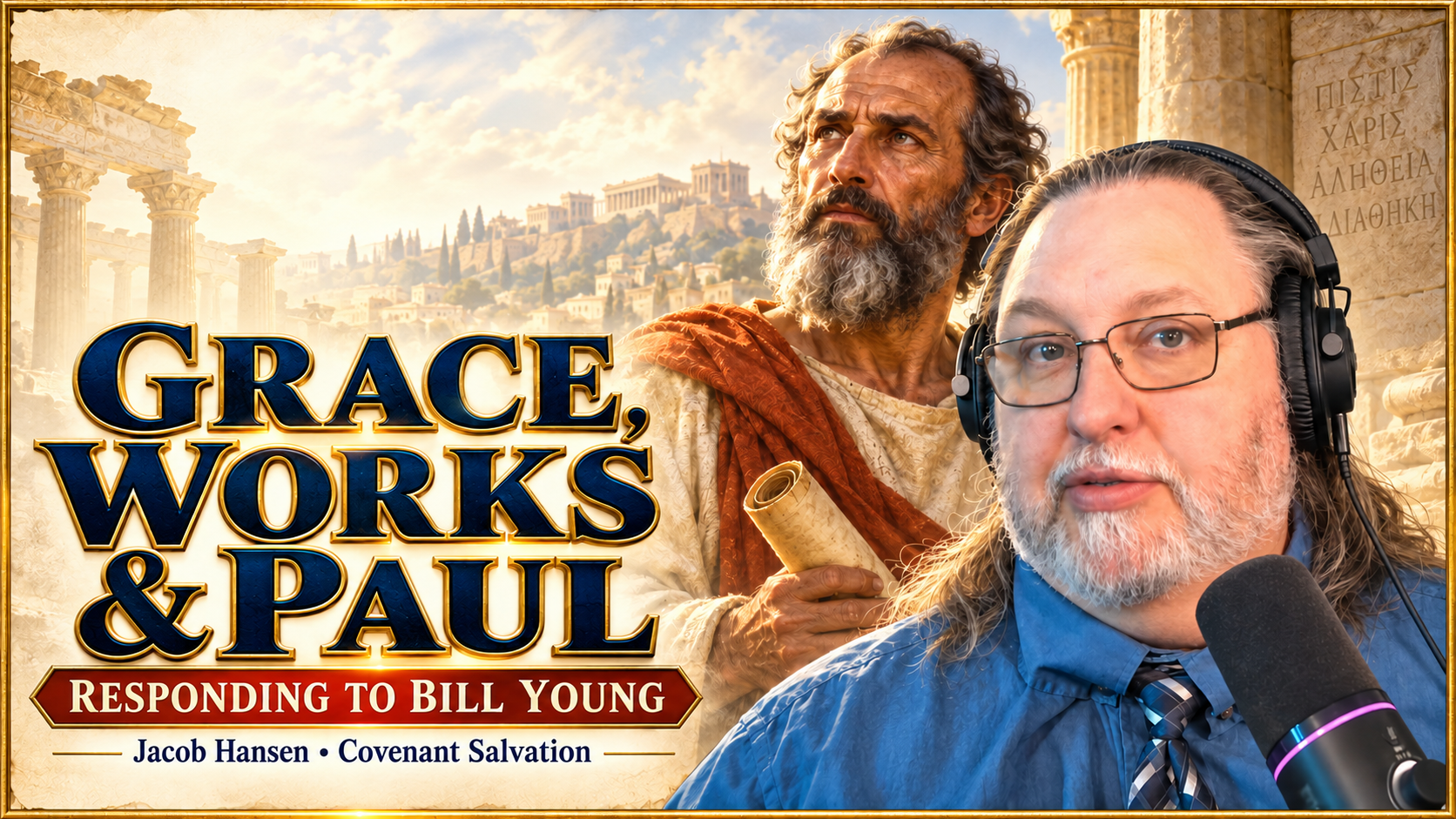
Bill Young's Response to Jacob Hansen: Does Covenant Obedience Deny Grace?

Bill Young's Response to Jacob Hansen: Does Covenant Obedience Deny Grace?

Does obedience turn the gift of salvation into a wage? That is the question beneath Bill Young’s response to Jacob Hansen—and it deserves a better answer than either “Mormonism is counterfeit” or “modern scholarship proves us right.” A Christian can affirm that Christ alone makes salvation possible while still believing that repentance, faithfulness, and a transformed life matter. The dispute begins when we ask how they matter: as payment, as conditions of receiving a gift, as evidence of living faith, or as the life that grace itself creates.

In Episode 104, Young argues that Hansen’s covenant model gives familiar LDS requirements a more attractive vocabulary without changing their function. That objection has force against any explanation that merely renames achievement as relationship. But Young’s broader conclusion—that necessary covenant obedience must therefore amount to earning salvation—requires an additional argument. Neither the presence of conditions nor the fact that human beings actually act establishes that their actions purchase God’s forgiveness.

This response approaches the debate from a Latter-day Saint perspective while taking Protestant objections seriously. It examines the supplied transcript and comment-section record alongside Pauline scholarship, Jewish historical scholarship, LDS sources, and evangelical biblical commentaries. Some of the evidence supports Young’s criticisms of oversimplified apologetics; other evidence directly challenges his portrayal of LDS grace and the scholarly alternatives he dismisses. The purpose is to identify which claims survive careful examination and to hold our treatment of other people to the Christian standard we invoke.

In this response

  • Young’s strongest objection
  • Paul, Judaism, and covenant
  • Grace, necessary works, and merit
  • “After all we can do”
  • What LDS leaders have taught
  • Comments and logical fallacies
  • The Christian standard
  • Frequently asked questions
  • Sources and further reading

What this response examines

The principal source is Young’s “Response to Jacob Hansen’s Covenant Model of Salvation”, identified as Episode 104 in the supplied materials. Quotations below follow the supplied transcript, with punctuation lightly normalized where needed; timestamps identify the relevant passages. The opening Hansen clip is presented within Young’s episode, so this article evaluates the argument as represented there rather than claiming to review every statement Hansen has made elsewhere.

Comment quotations come from the supplied document titled EP 104: Response to Jacob Hansen’s Covenantal Salvation Comment section. Usernames and document paragraph numbers identify excerpts where individual comment permalinks were not supplied. These are selected examples, not a statistical description of the entire audience. The record also contains substantive biblical arguments and objections to mockery. A commenter’s statement is attributed to that account; it is not automatically treated as Young’s own position.

Tuesday, July 21, 2026

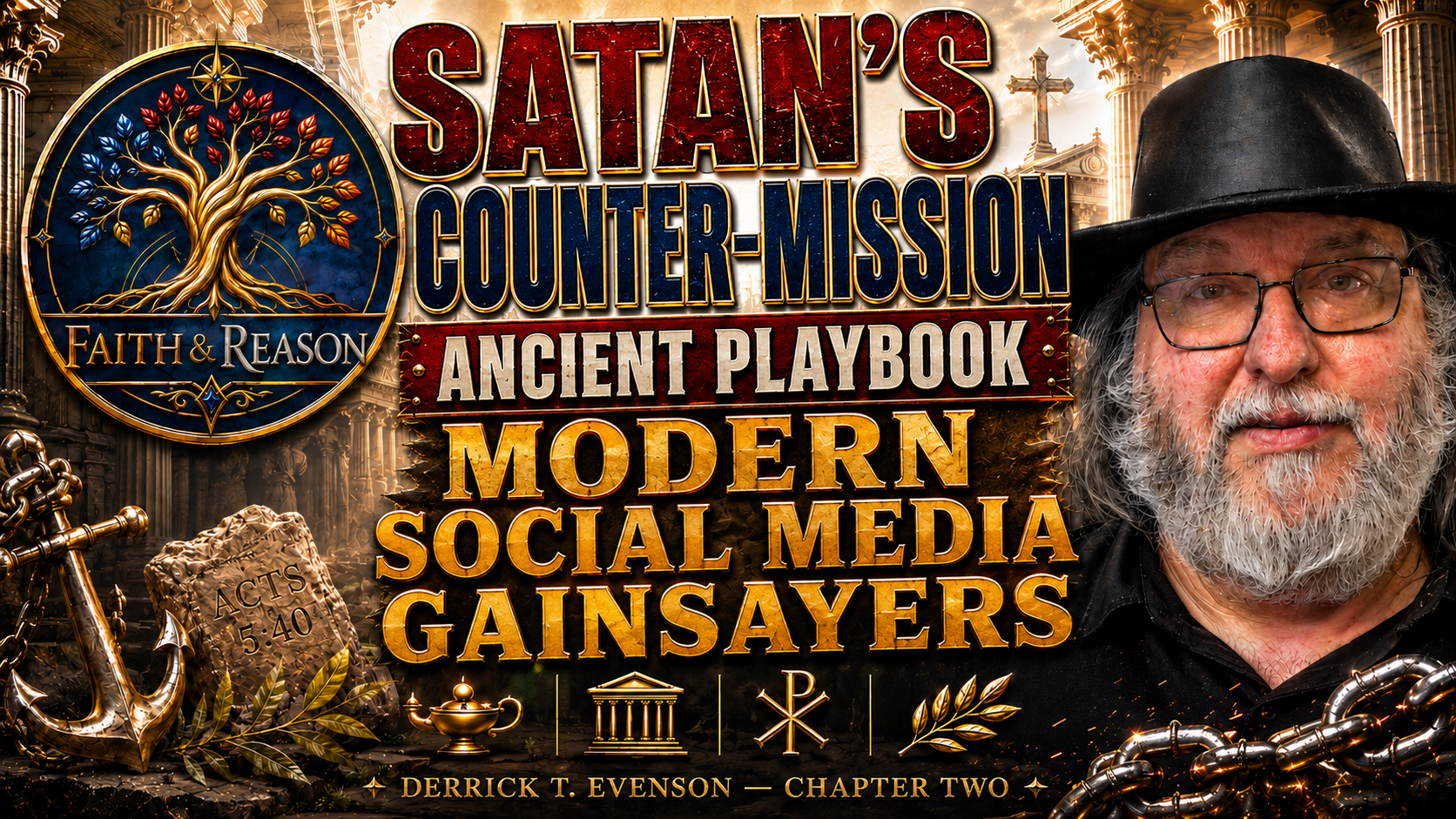
Satan's Counter-Mission: The Ancient Playbook Behind Modern Social Media Gainsayers

Satan's Counter-Mission: The Ancient Playbook Behind Modern Social Media Gainsayers

How First-Century Religious Polemics Reappear in the Digital Age

Did you know that long before YouTube exposés, TikTok reaction videos, livestream debates, and thumbnails announcing that someone's faith tradition had been "destroyed" or they "got cooked," religious opponents were already employing a variety of tactics? These tactics included not only labels and ridicule but also the strategic use of selective evidence, harsh accusations of deception, and appeals to the prevailing orthodoxy of the time.

Throughout history, individuals and groups have engaged in polemical discourse, employing familiar patterns that transcend modern technology and social media platforms. While social media may amplify these exchanges and offer new avenues for expression, the fundamental dynamics of polemics—debate and dispute—are anything but new. They are deeply rooted in the fabric of human communication and interaction.

Understanding these historical parallels can offer valuable insights. However, it is crucial to recognize that for Latter-day Saints, acknowledging these patterns should not devolve into a license to demonize every critic. Instead, it calls upon us to foster a more nuanced approach to dialogue and engagement. This means we must strive for discernment without slipping into paranoia. We can hold firm convictions without succumbing to contempt for others.

In our conversations and debates, we want to aim to express truth in a manner that reflects the charity of Jesus Christ. This challenges us to engage thoughtfully and respectfully, even when faced with opposition. We are invited to navigate the complexities of faith, belief, and skepticism with a spirit of love and understanding, creating space for constructive dialogue rather than animosity. Ultimately, our response to criticism can be a powerful testament to the principles we uphold, embodying a spirit that upholds truth while also extending grace to those with whom we may disagree.

Sunday, July 19, 2026

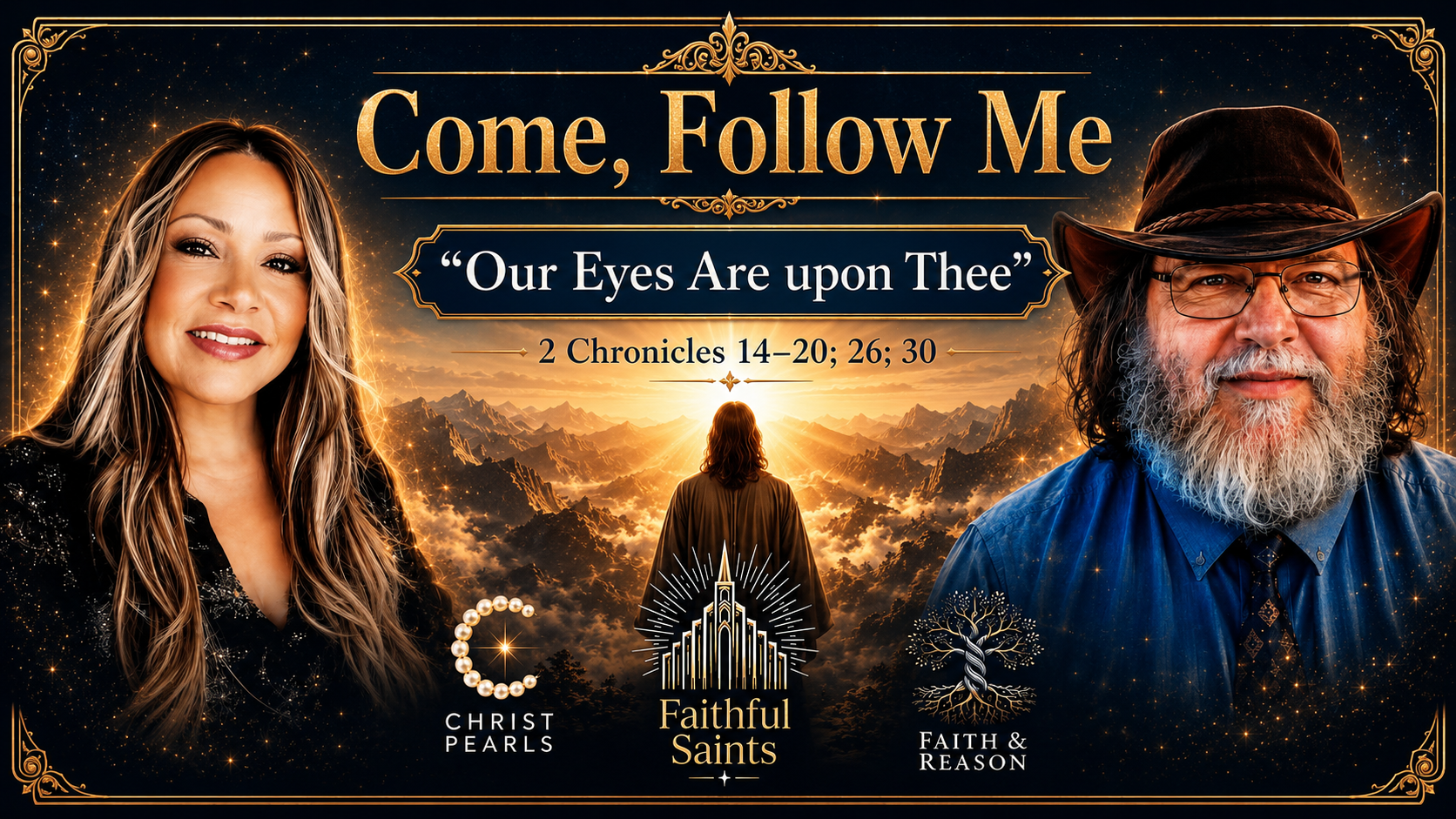
When You Don’t Know What to Do, Keep Your Eyes on God | 2 Chronicles 14–20; 26; 30

When You Don’t Know What to Do, Keep Your Eyes on God | 2 Chronicles 14–20; 26; 30

Come, Follow Me — July 20–26, 2026: “Our Eyes Are Upon Thee”

What do you do when the opposition is greater than your strength, the pressure is greater than your wisdom, and you honestly do not know what to do next?

This week’s Come, Follow Me study takes us into the lives of kings, prophets, reformers, worshippers, and ordinary families who faced that very question. Their stories reveal that peace does not come from pretending the battle is small. It comes from knowing where to turn when the battle is bigger than you.

Through the accounts of Asa, Micaiah, Jehoshaphat, Uzziah, and Hezekiah, 2 Chronicles invites us to examine where we place our trust, how we respond to correction, and whether our eyes remain fixed upon the Lord when fear, success, pride, or division threaten to pull them away. Each of these figures faced formidable challenges—be it external armies, internal strife, or the temptations of power—and their responses provide valuable lessons for our own lives.

Asa, for instance, shows how reliance on God in times of trouble can lead to unexpected victories, while Micaiah reminds us of the importance of courage in standing for truth, even in the face of overwhelming opposition. Jehoshaphat’s alliance-building and pursuit of divine guidance highlight the significance of seeking God's will in decision-making, especially when circumstances seem dire. Uzziah's rise to power illustrates the fine line between humility in success and the dangers of pride, reminding us that acknowledgment of our dependence on God is crucial. Lastly, Hezekiah's prayer in times of crisis demonstrates that sincere reliance on divine help can yield miraculous outcomes.

This week's study encourages us to reflect deeply on our own lives. When confronted with overwhelming pressure, do we allow our fears to overshadow our faith? Are we quick to seek advice from sources that may not align with our beliefs? Or do we, like these biblical figures, turn our attention steadfastly to God, trusting that He will guide us through our fiercest battles? Through these narratives, we learn that true peace comes from steadfast faith and a commitment to seek God's wisdom relentlessly, no matter how insurmountable the obstacles may appear.

Tuesday, July 14, 2026

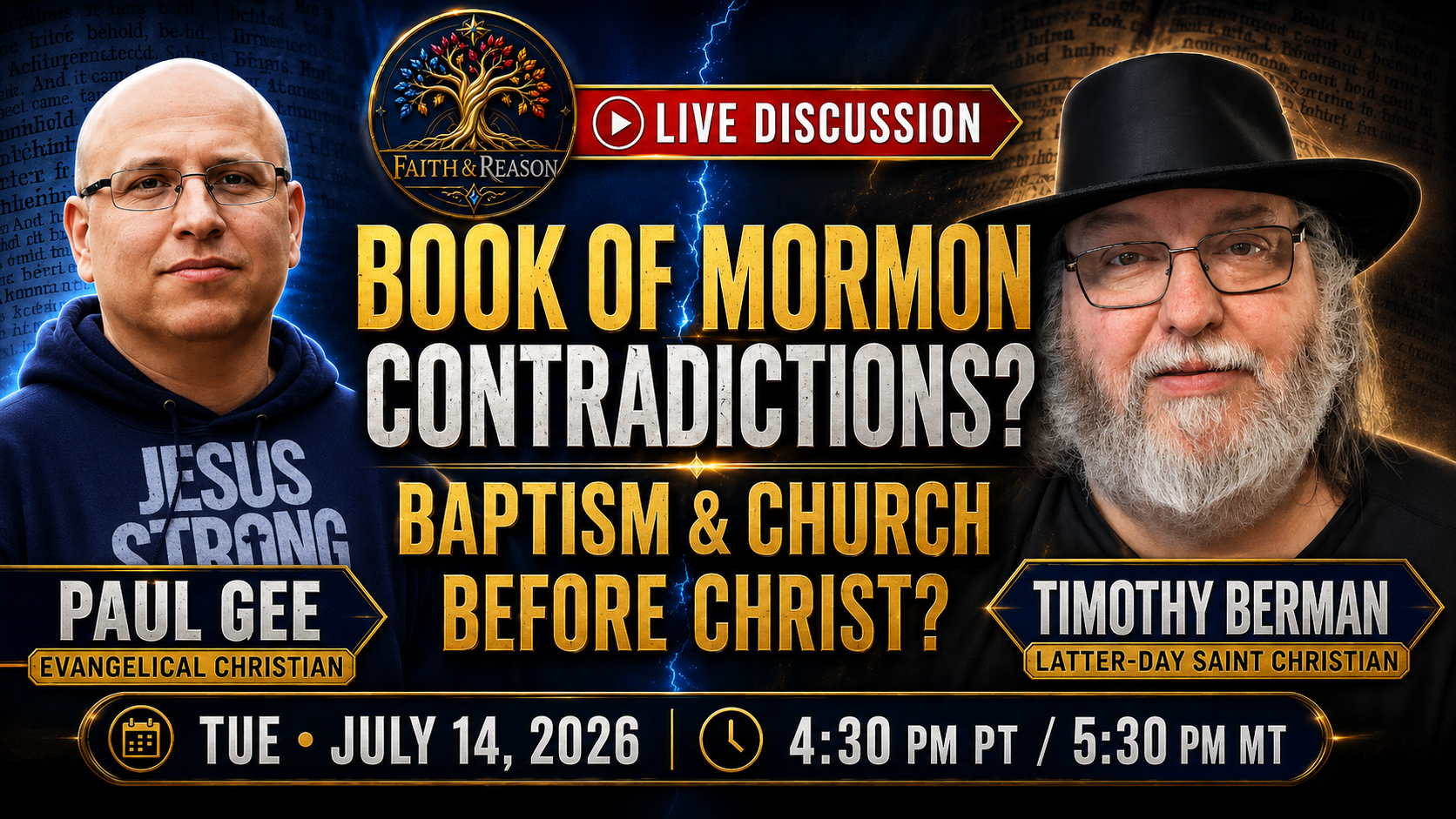
Book of Mormon Contradictions? Paul Gee and Timothy Berman Discuss Mosiah 18

Book of Mormon Contradictions? Paul Gee and Timothy Berman Discuss Mosiah 18

Tonight, Faith & Reason hosts a focused livestream discussion between Paul Gee and Timothy R. Berman examining one of the central arguments raised against the Book of Mormon: the claim that Mosiah 18 contains biblical and historical contradictions.

The discussion will stream live directly on this page.

Watch the Livestream

Date: July 14, 2026
Time: 4:30 PM Pacific / 5:30 PM Mountain
Participants: Paul Gee and Timothy R. Berman
Topic: Baptism and the Church in Mosiah 18

The livestream video is embedded below. The broadcast will begin automatically when the event goes live.

Sunday, June 21, 2026

What the Divinity of Jesus Christ Means to You

What the Divinity of Jesus Christ Means to You

Why Jesus Alone Could Accomplish the Infinite and Eternal Atonement

What manner of man commands the wind and sea—and they obey Him? He who speaks to the chaotic elements and they submit to His will, revealing His divine authority over nature itself. His voice echoes through the storm, bringing peace where there was turmoil, demonstrating an unparalleled mastery that transcends human understanding.

What manner of man possesses the power to lay down His life and take it up again? He who, with the authority inherent to His being, presents the ultimate sacrifice, fully aware of the weight of such a decision. In laying down His life, He unveils the profound mystery of love and redemption. The same strength that allows Him to give Himself away also empowers Him to conquer death, rising triumphantly to provide hope and eternal life to humanity.

What manner of man suffers more than mortal humanity can endure, yet remains until the work of redemption is complete? He bears the weight of all humanity’s sins, feeling the depths of anguish and despair, yet persevering through the agony to fulfill His purpose. His empathy is boundless, experiencing sorrow in ways that only a divine nature could comprehend. In His endurance, He illustrates the profound depth of grace, revealing that true strength is often displayed in vulnerability and unwavering commitment to a higher calling, despite the unbearable cost.

This man is a testament to the coexistence of power and humility, a divine figure whose actions reshape the narrative of humanity's relationship with the Creator. His life and legacy stand as an eternal beacon of hope, a call to embrace the extraordinary potential within each of us to rise above our circumstances and to foster love, compassion, and redemption in a world so often in need of these gifts.

These questions stand at the center of Doctrine Lesson 6, “What the Divinity of Jesus Christ Means to You,” from the 1974–75 Melchizedek Priesthood study guide When Thou Art Converted, Strengthen Thy Brethren. The lesson’s purpose was not merely to establish that Jesus was extraordinary. It invited priesthood holders to understand why Jesus Christ alone possessed power to accomplish the infinite and eternal Atonement—and why every one of us remains completely dependent upon Him.

Nearly five decades later, that central purpose remains unchanged. Some of the language used in the original lesson, however, has generated theological questions and apologetic controversy. In particular, statements by James E. Talmage and Bruce R. McConkie about Christ’s literal divine sonship have been interpreted by critics as teaching that God the Father physically descended and engaged in sexual intercourse with Mary.

A responsible modern treatment must do more than dismiss that criticism. It must distinguish among what scripture reveals, what individual Church leaders have proposed or speculated, and what the Church currently teaches as established doctrine.

It is best we do not allow controversy over the manner of Christ’s conception to distract us from the greater truth: Jesus Christ did for us what we could never do for ourselves.

Friday, June 12, 2026

Social Media Gainsayers: The Anti-Mormon Playbook Has Not Changed—Only the Platforms Have

Social Media Gainsayers: The Anti-Mormon Playbook Has Not Changed—Only the Platforms Have

How Ex-Mormon Influencers, Evangelical Critics, and Online Ministries Repackage the Same Arguments for YouTube, TikTok, Facebook, Podcasts, and Livestreams

In 1989, anti-Latter-day Saint ministries, often referred to as Counter-cult or Anti-Mormon groups, relied heavily on printed tracts, cassette tapes, books, traveling seminars, church presentations, and controversial films—most notably, The Godmakers. Pastors would announce special meetings from their pulpits, offering "classes" on how to witness to Mormons. If you strolled into any brick-and-mortar Christian bookstore, you'd find a substantial collection of books specifically discussing the Church of Jesus Christ of Latter-day Saints. Among the more notable titles were Kingdom of the Cults by the late Walter Martin, Letters to a Mormon Elder by James White of Alpha and Omega Ministries, Mormonism 101 by Bill McKeever and Eric Johnson, and Mormons Answered Verse by Verse by David A. Reed and John R. Farkas. In addition to these apologist works, you'd also discover a range of small group and individual study guides about the LDS faith.

As if that weren't enough, it wasn't uncommon for members of the faith to be invited over to a family friend's or relative's home for dinner, only to be introduced to a friendly couple. The gentleman would often start the conversation with, "I used to be a Mormon, but I’ve found Jesus." This felt like a kind of religious intervention aimed at coaxing you to leave the church. I experienced this firsthand in my early twenties when my mother-in-law invited my then-wife and me over for dinner. That evening plunged me into the world of Anti-Mormonism and apologetics. I had already purchased They Lie in Wait to Deceive by the Browns (I had all four volumes at that time), The Truth About the Godmakers by Gilbert Scharff, and The Gainsayers: A Converted Anti-Mormon Responds to the Critics of the LDS Church by Derrick T. Evenson—this last book serving as the foundation for my Social Media Gainsayers series.

This atmosphere left minimal opportunity for individuals to hear a meaningful response from Latter-day Saints. The urgency of the message was unmistakable: “They are stealing your people. They must be stopped,” as Ed Decker wrote in his letter to pastors, promoting his book and film, The Godmakers. Fast forward more than three decades, and we see that the media landscape has undergone a dramatic transformation. Pamphlets have turned into Facebook posts, and cassette tapes have been replaced by podcasts. Traveling seminars have morphed into YouTube livestreams and channels, while the controversial film The Godmakers has resurfaced on social media platforms, mainly appearing as "The Mormon Banned Cartoon." Church basement presentations have transitioned into TikTok debates and live discussions. The once-printed quotations, often stripped of context, have been condensed into fifteen-second video clips and responses. What used to be the anti-Mormon bookstore shelf has now become algorithmically generated playlists.

The technology has changed, distribution has accelerated, and the audience is now global. Yet, the underlying playbook remains startlingly familiar. Today’s social media gainsayers might identify themselves as Ex-Mormons, evangelical Christian pastors, Christian apologists, cult experts, deconstruction coaches, religious commentators, or former "insiders." Though they use differing methods, it’s crucial to note that not every critic of the Church of Jesus Christ of Latter-day Saints is manipulative, dishonest, or deceptive.

Legitimate criticisms deserve legitimate responses. Difficult historical questions should never be ignored, and former members have every right to share their personal experiences. Likewise, Christians have every right to express their disagreements with Latter-day Saint theology. The challenge arises when personal experiences are framed as universal facts, theological disagreements are marketed as scandals, and mockery and insults take the place of honest discussions. Unfortunately, algorithms often amplify the most hostile narratives.

That’s when criticism turns into gainsaying. As Latter-day Saints, we bear the responsibility to stand firm in our faith and testimony, for it is through “sound doctrine that we both exhort and convince the gainsayers” (Titus 1:9, KJV).

Saturday, May 30, 2026

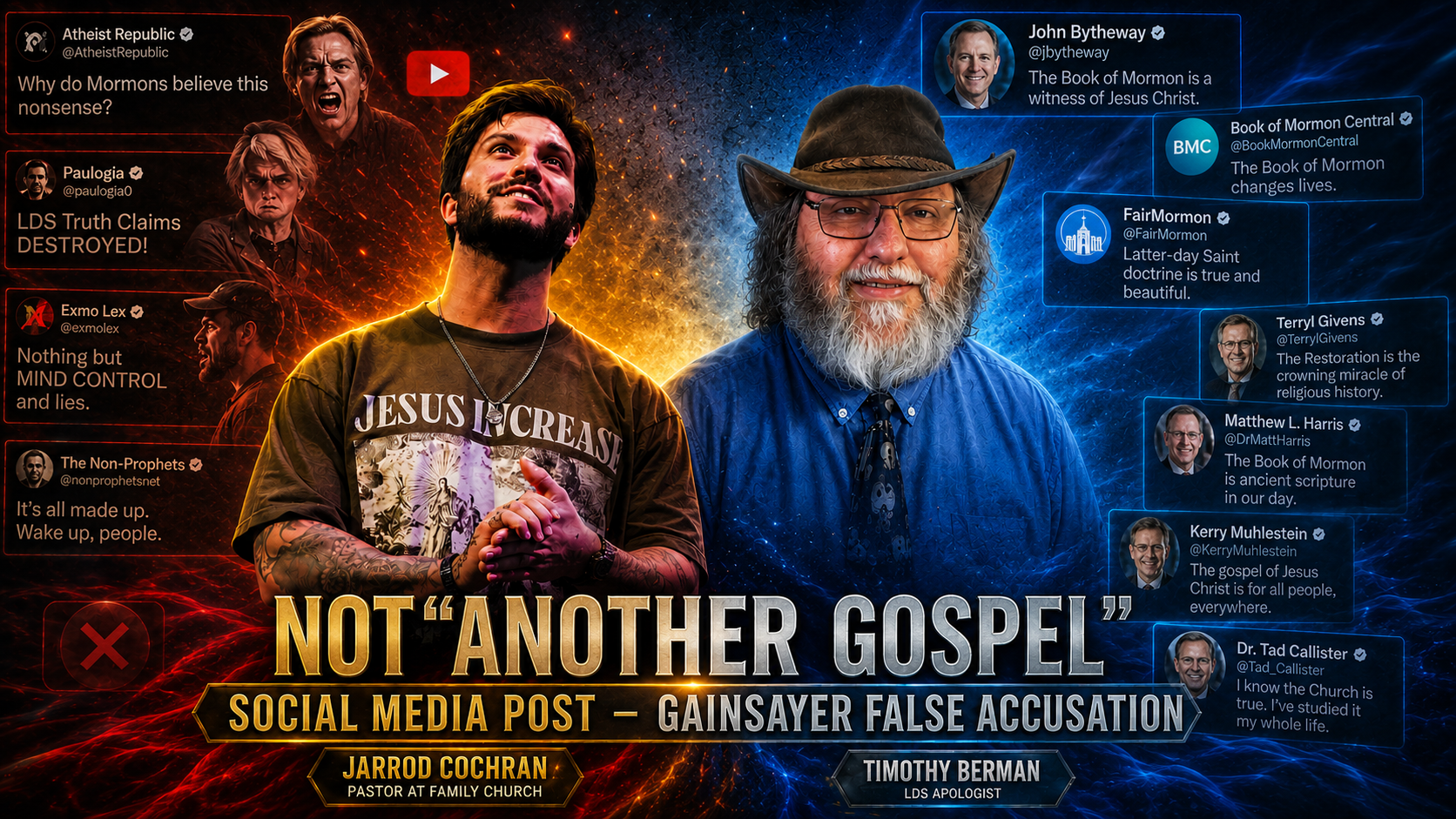
Not “Another Gospel”: A False Accusation Against Christ

Not “Another Gospel”: A False Accusation Against Christ

It really never fails that someone who has issues, without tissues, against the Church of Jesus Christ of Latter-day Saints recycle the same accusation and anti-LDS tropes. And typically, the go to Evangelical eisegesis "gotcha" verse is Galatians 1:8. A weaponized verse used to bludgeon Joseph Smith into the status of being accursed, preaching a different gospel and the case is closed. It sounds bold and confident. However, it is mere haughty arrogance posturing from a place of one being completely illiterate of properly interpreting the scriptures. Evidence of another gainsayer who is ever learning and never understanding:

You must understand this, that in the last days distressing times will come. For people will be lovers of themselves, lovers of money, boasters, arrogant, abusive, disobedient to their parents, ungrateful, unholy, unfeeling, implacable, slanderers, profligates, brutes, haters of good, treacherous, reckless, swollen with conceit, lovers of pleasure rather than lovers of God, holding to the outward form of godliness but denying its power. Avoid them! For among them are those who make their way into households and captivate immature women, overwhelmed by their sins and swayed by all kinds of desires, who are always studying yet never able to recognize truth. As Jannes and Jambres opposed Moses, so these people, of corrupt mind and counterfeit faith, also oppose the truth. But they will not make much progress because, as in the case of those two men, their folly will become plain to everyone. ... Indeed, all who want to live a godly life in Christ Jesus will be persecuted. But wicked people and impostors will go from bad to worse, deceiving others and being deceived. But as for you, continue in what you have learned and firmly believed, knowing from whom you learned it and how from childhood you have known sacred writings that are able to instruct you for salvation through faith in Christ Jesus. All scripture is inspired by God and is useful for teaching, for reproof, for correction, and for training in righteousness, so that the person of God may be proficient, equipped for every good work. (2 Timothy 3:1- 9, 12-17).

Yet, such arguments consistently collapse the moment we examine the text, the history, and the logic.

The claim is simple: Because Paul warned about another gospel and because Joseph Smith reported an angelic visitation, therefore the Restoration must be a demonic deception. An arrogant and boastful claim. One that appears to sound quite powerful - until you take the time to read Paul, understand his context, and compare it to what Latter-day Saints actually teach. Yet, these internet gainsayers are mere lazy learners who do not want to test their claims against truth. They want to sound loud and proud screaming into the Social Media landscape to deceive people. And they don't want their claims challenged.

Therefore, I am not here to dodge the passage. In fact, the only person that appears to dodge a real discussion is the gainsayer refusing to have a livestream discussion on whether or not the Book of Mormon is demonic. As such is the individual's claim. Neither am I here to soften Paul. I am here to take the claim seriously, steelman it, and then show how it fails on every textual, historical, and theological level.

Today, let's examine Jarrod Cochran's claims regarding Joseph Smith, the Book of Mormon, and an unfolding dialogue regarding whether or not this gentleman is speaking truth - or perpetuating ongoing lies and deceptions.

Friday, May 29, 2026

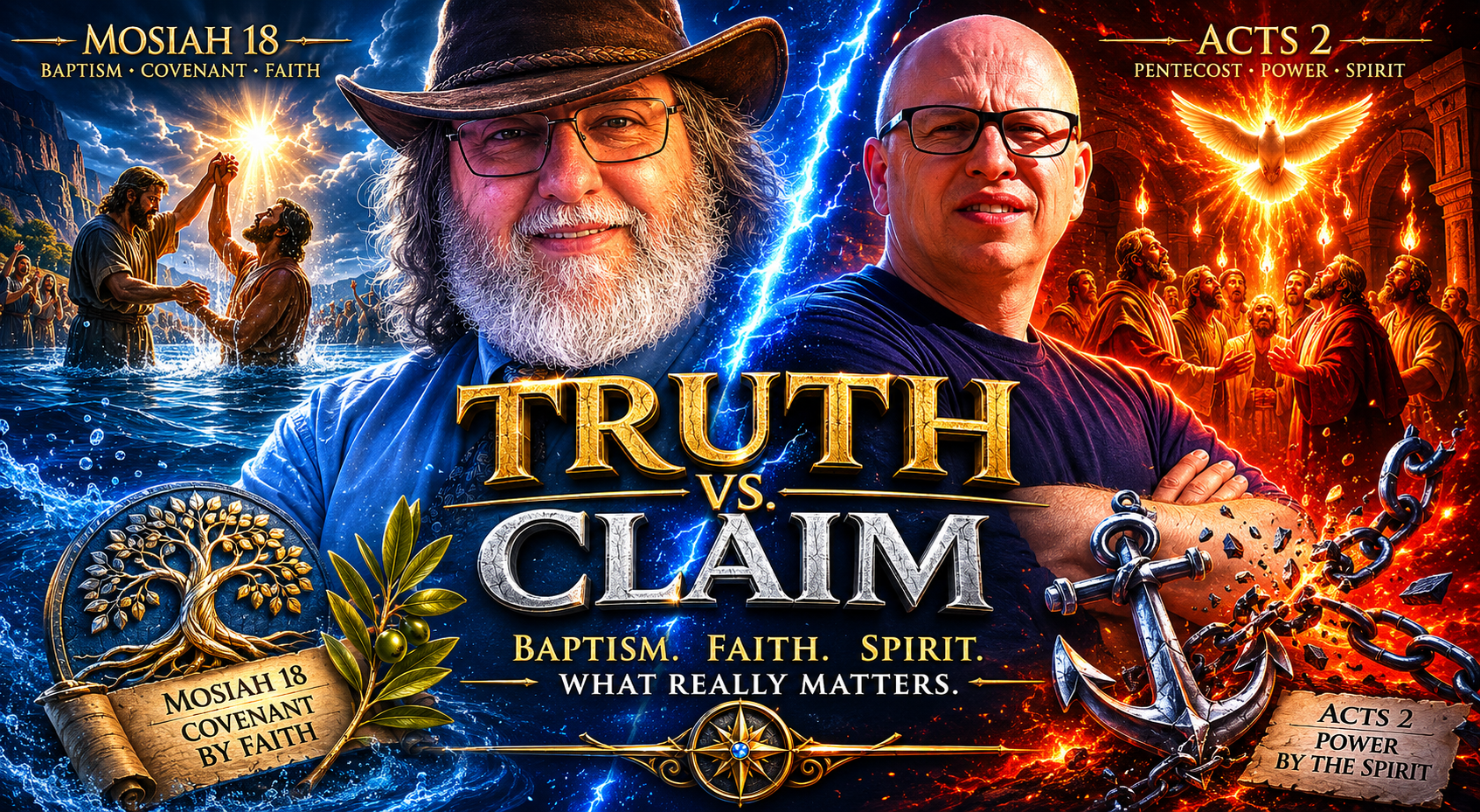
Book of Mormon Contradictions? A Latter-day Saint Responds to Paul Gee on "Baptism" and "Church" in Mosiah 18

Book of Mormon Contradictions? A Latter-day Saint Responds to Paul Gee on "Baptism" and "Church" in Mosiah 18

We are going to look at a very specific claim: that the Book of Mormon story of baptism in Mosiah is just Joseph Smith copying Acts 2 - and that baptism for the remission of sins could not have existed before Jesus Christ, therefore the Book of Mormon contradicts the Bible. If this is true, Latter-day Saint scripture definitely collapses. If it is not, then this criticism is built on a very sandy foundation. Let's actually examine to see if such a claim has any credibility and validity to truth or if it is a false claim.

Now, I am not asking you to take my own word for it. I am asking that we open up the scriptures, open up our hearts and minds because we are going to walk through Paul Gee's argument, steelman it, and then test it against scripture, history, and essential logic. By doing this, we can critically assess the merits of his claims and their implications for the understanding of both the Book of Mormon and biblical texts.

This is not an attack on Paul. In fact, he reached out and asked me to read it as it will supposedly prove that the Book of Mormon is false. And I will quote him fairly, present his argument in its strongest form, and will show how I believe it fails - scripturally, historically, and logically. By carefully dissecting the specifics of his argument, we can delve deeper into the theological and historical context of baptism and its significance within both texts.

Understanding that baptism as a practice existed in various forms before Christ and that the concept of a remission of sins is not exclusively tied to any one scripture, we must analyze whether the Old Testament precedents and the teachings of Christ later broaden our comprehension of baptism. This exploration will hopefully shed new light on claims made against the Book of Mormon, fostering a more nuanced and comprehensive understanding of the narrative within its pages.

As we navigate through this intricate discussion, I invite all readers to remain open-minded and reflect critically on the scriptures, drawing personal insights even as we engage with challenging interpretations. A sincere examination can lead us to a deeper faith and understanding of these profound spiritual texts.