Sunday, August 23, 2026

"I Will Declare What He Hath Done for My Soul" | COME FOLLOW ME - OLD TESTAMENT 2026 | Psalms 49-86

"I Will Declare What He Hath Done for My Soul" | COME FOLLOW ME - OLD TESTAMENT 2026 | Psalms 49-86

The Temple Pattern of Descent, Ascent, and Exaltation in Israel's Hymnal of Redemption

"Come and hear, all ye that fear God, and I will declare what he hath done for my soul." - Psalm 66:16 KJV


This study reads the selected Psalms 49-86 as a canonical and theological journey through mortality, sin, lament, repentance, remembrance, redemption, and public witness. These poems do not form a single authored liturgy; they cross the boundary between Books II and III of the Psalter and include wisdom instruction, penitential prayer, individual and communal lament, historical recital, royal hope, and testimony. Read together, however, they trace a temple-shaped movement from estrangement toward the presence of God. Psalm 49 exposes the inability of wealth or human power to ransom life from death; Psalm 51 turns confession into a prayer for divine re-creation; Psalms 63, 69, and 77 give faithful language to abandonment and distress; Psalms 66, 71, and 78 transform remembered deliverance into covenant testimony; and Psalms 72, 85, and 86 direct personal restoration toward righteous kingship and Zion. The Book of Mormon intensifies this pattern in Alma 36, Alma 26, Alma 34, and Alma 42, where anguish gives way to joy through Jesus Christ and redeemed experience becomes missionary proclamation. The central claim is that biblical ascent does not deny descent. The worshipper rises by bringing mortality, guilt, fear, and unanswered questions into covenant relationship with the God who alone can redeem, cleanse, heal, and receive the soul. Psalm 66:16 therefore becomes more than a memorable line: it is the vocation of a redeemed people.

Scripture and method note. Biblical quotations follow the King James Version unless otherwise noted. This article distinguishes the psalms' ancient literary setting, their Christian canonical fulfillment in Jesus Christ, and their Latter-day Saint resonance. "Exaltation" is used first for being lifted into divine presence, covenant joy, and praise; restored doctrine gives that movement its fuller horizon in eternal life with God.

The Psalms as the Soul's Ascent Back to Eden

The soul does not merely want relief from pain. At its deepest level, it longs for the presence of God - for the wholeness, communion, and holy order represented by Eden. That longing is one reason the Psalms remain indispensable. They do not speak only from the summit of faith. They also pray from the pit, the wilderness, the sickbed, the battlefield, the guilty conscience, and the long night when God seems silent. The Psalter gives covenant people permission to bring the whole truth of mortal life into worship.

Calling the Psalms Israel's "temple hymnal" captures something essential, but it also requires care. Many psalms are rooted in sanctuary worship, sacrifice, procession, royal ceremony, pilgrimage, and public praise. Others may have begun in personal or communal crisis before being gathered for liturgical use. Sigmund Mowinckel emphasized the Psalms' setting in Israel's worship, while Claus Westermann stressed the dynamic relationship between lament and praise. James Luther Mays therefore describes the Psalms as both scripture and liturgy: ancient prayers that became the prayerbook of later communities (Mowinckel; Westermann; Mays).

The temple lens becomes especially fruitful when joined to the pattern of descent, ascent, and exaltation. The biblical sanctuary represents ordered creation and the divine dwelling among humanity; temple worship moves symbolically toward holiness and presence (Levenson 275-98). In the Psalms, that movement is often existential rather than architectural. The worshipper descends into fear, sin, mortality, exile, or confusion; ascends through remembrance, repentance, sacrifice, trust, and covenant appeal; and is lifted into renewed joy, praise, divine fellowship, and testimony. Walter Brueggemann's well-known categories of orientation, disorientation, and new orientation offer a closely related account of the spiritual world of the Psalter (Brueggemann).

This pattern does not mean that every psalm begins in Eden, passes through a fixed ritual sequence, and ends in triumph. Hebrew poetry resists mechanical outlines. Its parallel lines deepen, contrast, intensify, and sometimes destabilize one another. Yet across Psalms 49-86, a recurring theological grammar becomes visible: false securities fail, the soul cries out, God's mighty acts are remembered, mercy opens a path, and the redeemed worshipper declares what God has done. The result is a spiritual autobiography of redemption, not because all the psalms were written by one person, but because generations of worshippers can find their own descent and ascent within Israel's inspired songs.

Sunday, August 16, 2026

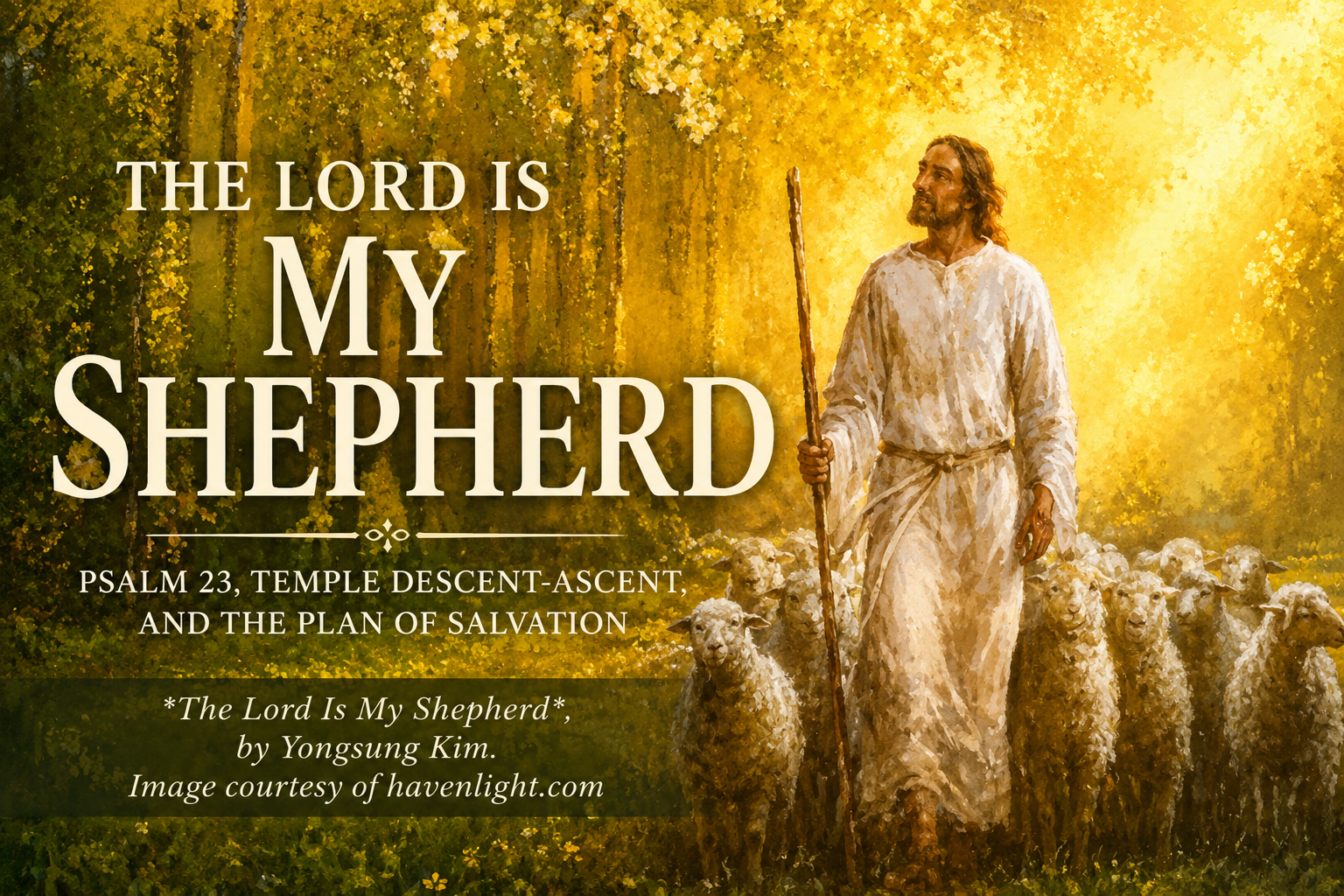
"The Lord Is My Shepherd": Psalm 23, Temple Descent-Ascent, and the Plan of Salvation

"The Lord Is My Shepherd": Psalm 23, Temple Descent-Ascent, and the Plan of Salvation

A Come, Follow Me Study for August 17-23, 2026: Psalms 1-2; 8; 19-33; 40; 46

"For thou art with me." - Psalm 23:4

Most of us first learned Psalm 23 as a psalm of comfort. We hear it at funerals, repeat it in hospital rooms, and reach for it when grief has stripped life down to its most difficult questions. That use is neither accidental nor misplaced. Yet Psalm 23 does more than assure us that God will remain near when we die. It poetically traces an entire journey: the Lord provides, restores, guides, accompanies, protects, welcomes, anoints, and finally brings the worshipper into His house.

That movement makes Psalm 23 especially meaningful for Latter-day Saints. Its imagery can be read as a temple-shaped journey from ordered life into mortal darkness and then upward into covenant fellowship and the presence of God. Read within the immediate sequence of Psalms 22-24, the pattern becomes even more striking: lament and suffering in Psalm 22, the Shepherd's presence in Psalm 23, and ascent to the holy hill with the King of glory in Psalm 24. Nancy deClaissé-Walford's intertextual study similarly argues that these three neighboring psalms form a powerful statement of trust when read together (deClaissé-Walford 139-52).

This interpretation requires one careful qualification. Psalm 23 is not demonstrably a word-for-word transcript of an ancient Israelite temple ceremony, and the full Latter-day Saint plan of salvation should not be projected backward into every Hebrew phrase as though the psalmist were writing a systematic doctrinal manual. Psalm 23 is commonly classified as a psalm of trust or confidence, while a pilgrimage setting that culminates at the temple remains a respected scholarly proposal rather than an uncontested conclusion (Smith 61-66; Tappy 255-80). The temple and plan-of-salvation reading offered here is therefore a disciplined canonical and theological synthesis: it begins with what the Hebrew poem says, follows the intertextual patterns the Psalter supplies, reads the psalm through Jesus Christ, and then asks how Restoration scripture enlarges its hope.

What Come, Follow Me Actually Assigns for August 17-23

The official 2026 reading is often abbreviated as "Psalms 1-46," but the assigned passages are selections rather than every chapter in that range: Psalms 1-2; 8; 19-33; 40; and 46. The manual invites readers to notice the Psalms' vivid images of the Savior, including the green pastures, still waters, rod, staff, and overflowing cup of Psalm 23. It then connects Psalm 24's "hill of the Lord" with the temple and with preparation to enter the presence of God (Come, Follow Me).

The broader three-week schedule is also selective. August 24-30 covers Psalms 49-51; 61-66; 69-72; 77-78; and 85-86, while August 31-September 6 covers Psalms 102-103; 110; 116-119; 127-128; 135-139; and 146-150. Keeping the actual readings clear strengthens the study because it allows Psalm 23 to function as the focal text for this week without forcing an artificial structure onto every psalm from 1 through 46.

Sunday, August 9, 2026

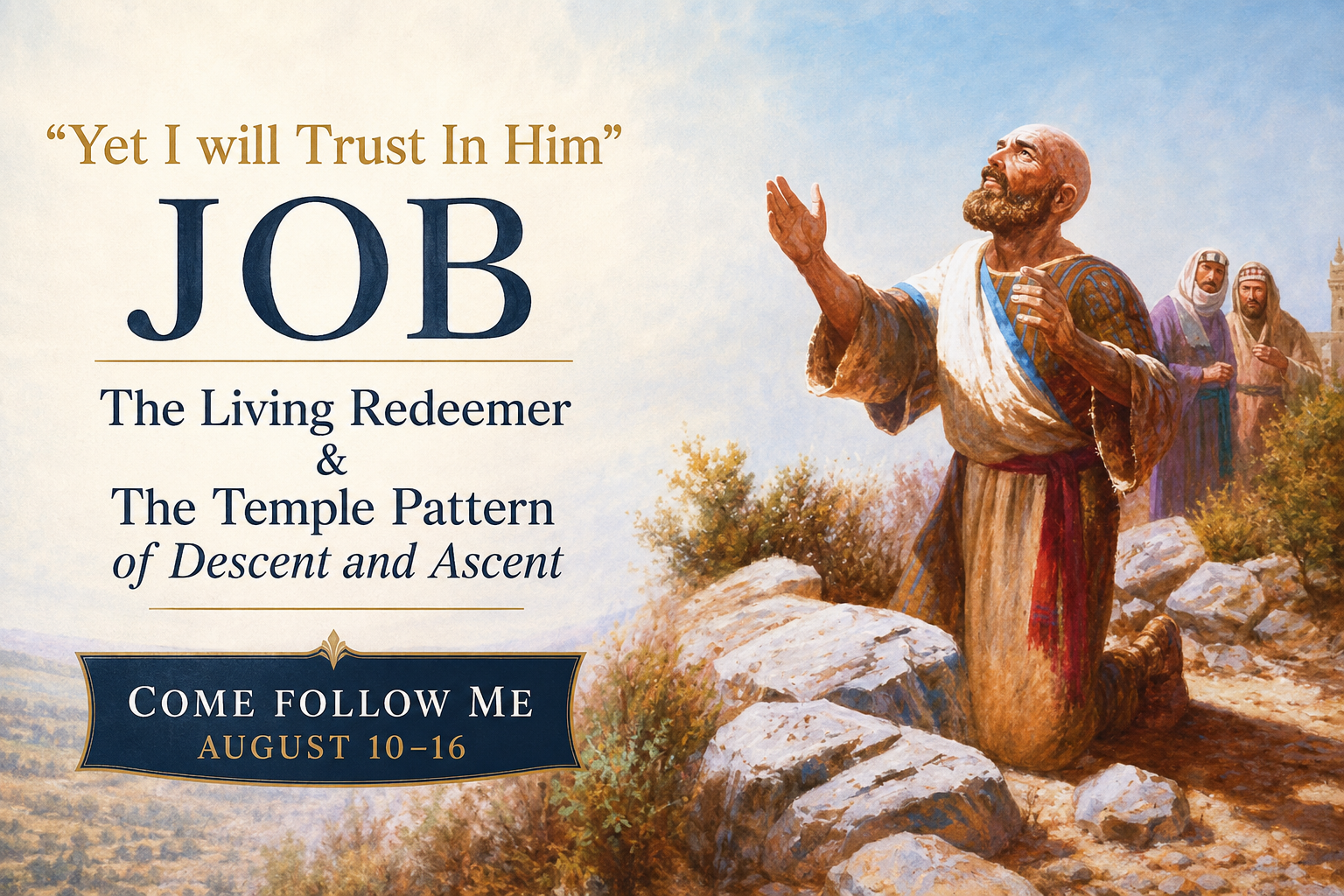
"Yet Will I Trust in Him": Job, the Redeemer, and the Temple Pattern of Descent and Ascent

"Yet Will I Trust in Him": Job, the Redeemer, and the Temple Pattern of Descent and Ascent

How suffering, covenant faithfulness, divine perspective, and restoration reveal the plan of salvation

What do we do when life falls apart—not because we have walked away from God, but while we are doing our best to remain faithful to Him? What do we say when prayer does not immediately change the diagnosis, restore the relationship, return what was lost, or explain why a righteous person has been permitted to suffer? Those questions are not signs of spiritual failure. They are among the deepest questions of mortality, and the book of Job refuses to answer them with a slogan.

Job is not a story about a man who never struggled. He grieved, protested, questioned, and pleaded for God to answer him. He described himself as stripped of glory, surrounded by darkness, abandoned by loved ones, and unable to find the God he still longed to meet. Yet his anguish never became indifference. Job kept turning toward God, even when he could not understand God. His questions and his faith occupied the same ash heap.

That is the spiritual tension at the heart of the 2026 Come, Follow Me lesson on Job. The manual emphasizes that faith in Job is questioned and tested without being completely abandoned. Not every question receives an explanation, but questions can coexist with faith. Job therefore becomes more than a case study in the problem of evil. He becomes a witness of what covenant trust looks like when familiar answers no longer seem adequate.

Read as a whole, Job is a temple-shaped wisdom drama of descent, covenant testing, divine encounter, intercession, and restoration. Its movement carries Job from abundance into ashes, from ashes into argument, from argument toward a living Redeemer, and from limited mortal understanding into the presence of God. The book does not merely ask, “Why do righteous people suffer?” It presses us toward a more searching question: How does a covenant disciple remain faithful until God reveals a larger perspective through the living Redeemer?

How Should We Read the Book of Job?

The first step in responsible expository teaching is to respect the kind of literature we are reading. Job begins with a prose prologue in chapters 1–2, moves into an extended poetic body in chapters 3–41, and returns to prose in the concluding portion of chapter 42. Within the poetic core are Job’s lament, three cycles of debate with Eliphaz, Bildad, and Zophar, Job’s extended defense, the speeches of Elihu, and the Lord’s response from the whirlwind. This carefully arranged structure is one reason Job should not be read as if it were a modern courtroom transcript.

The Religious Studies Center essay “Hast Thou Considered My Servant Job?” acknowledges both the possible historical foundation of Job and the book’s evident literary shaping. Modern scholarship commonly classifies Job as wisdom literature, but that label does not exhaust the book. Will Kynes notes that Job can also be read through the lenses of lament, drama, controversy dialogue, lawsuit, exemplary sufferer narrative, epic, prophecy, and apocalyptic literature. Carol A. Newsom describes the book as a contest of moral imaginations because Job and his interlocutors do not simply exchange information; they present competing visions of God, justice, suffering, and human righteousness.

This literary awareness also helps us understand the heavenly scene in Job 1–2. The Come, Follow Me manual explains that these chapters poetically emphasize Satan’s role as adversary or accuser and should not be treated as a literal transcript of a conversation between God and Satan. The scene reveals the theological issue driving the drama: Is Job’s devotion genuine, or is it merely the price he pays for prosperity and protection? The question is not only whether Job will survive suffering. The question is whether worship can remain worship when the expected rewards disappear.

Catherine Petrany sharpens this literary observation by attending to the Hebrew expression ha-satan, “the adversary” or “the accuser.” The definite article makes the expression function like a title rather than a personal name. Within Job’s ancient heavenly-court scene, this figure roams, investigates, and prosecutes a case; he is not yet portrayed with every feature that later Jewish and Christian texts associate with the Devil. That historical distinction explains the role this character plays in Job without requiring Latter-day Saint readers to discard restored teachings about Satan’s premortal rebellion. The disciplined approach is to let Job’s prologue define the accuser’s narrative function, then let the wider canon supply additional doctrine without forcing all later details back into two poetic chapters.

To call Job a wisdom drama, or even to recognize mythic and liturgical dimensions in it, is not to call it false. In biblical studies, mythic can describe a narrative’s use of cosmic imagery, creation symbolism, heavenly councils, chaos creatures, and archetypal conflict. Liturgical can describe patterns of mourning, petition, divine encounter, sacrifice, and restored communion. Those categories help us see how Job’s personal anguish is placed within a cosmic frame without requiring us to deny that the story may preserve the memory of a real righteous sufferer.

Saturday, August 8, 2026

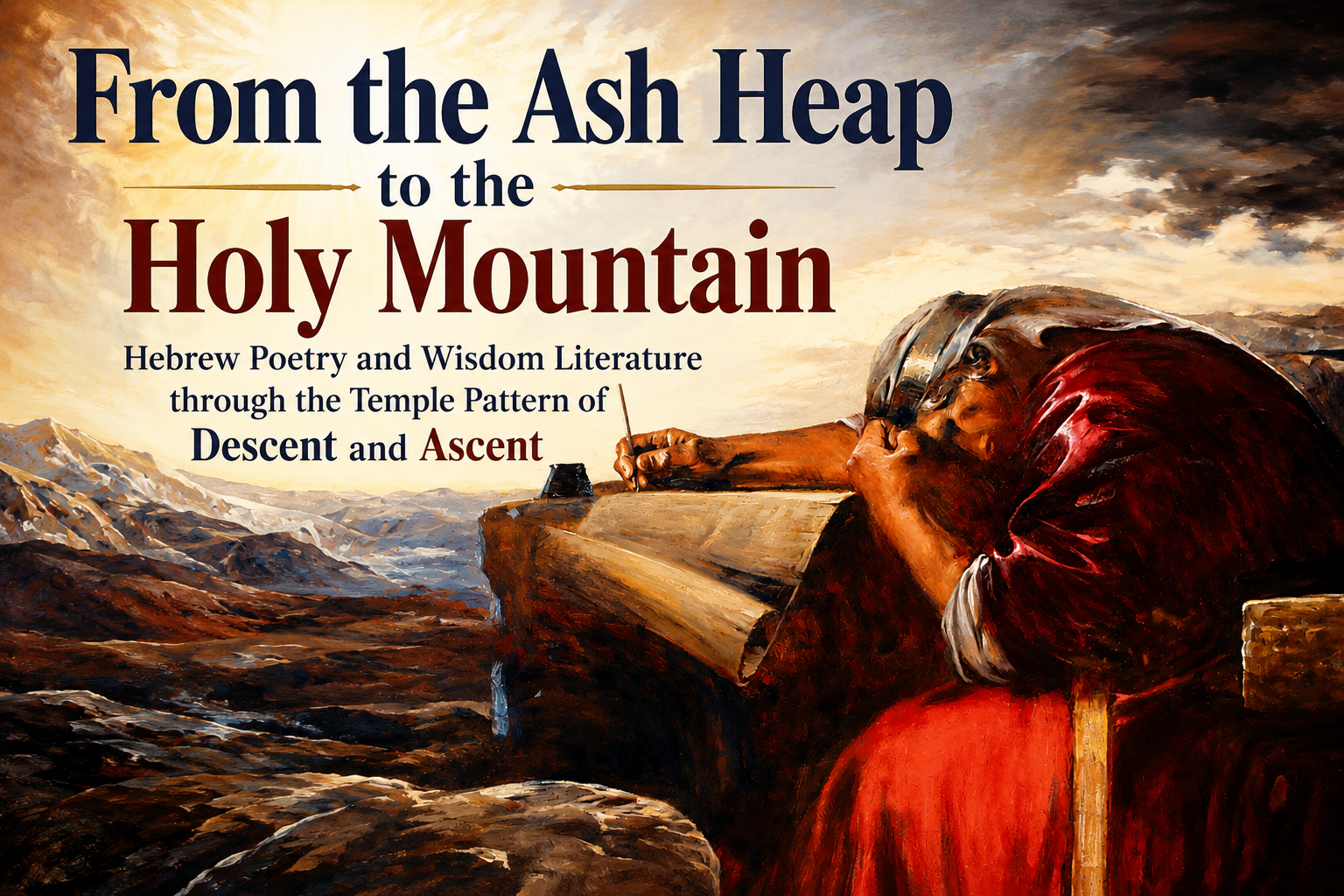
From the Ash Heap to the Holy Mountain: Hebrew Poetry and Wisdom Literature through the Temple Pattern of Descent and Ascent

From the Ash Heap to the Holy Mountain: Hebrew Poetry and Wisdom Literature through the Temple Pattern of Descent and Ascent

A Come, Follow Me introduction to Job, Psalms, Proverbs, and Ecclesiastes

Job, Psalms, Proverbs, and Ecclesiastes do not offer one flat explanation of faithful life. They give us an inspired conversation. Job protests any theology that reduces suffering to a predictable equation. The Psalms teach covenant Israel to pray through joy, guilt, abandonment, fear, gratitude, and praise. Proverbs forms moral perception by training the disciple to fear the Lord and choose wisdom over folly. Ecclesiastes exposes the vapor-like instability of mortal achievement and the limits of human control. Read together, these books move repeatedly from order into disorientation and from disorientation toward a renewed, humbler communion with God.

This study proposes the temple pattern of descent and ascent as a theological and devotional framework for that movement. Descent names mortality, estrangement, lament, disorder, and the collapse of false certainty. Ascent names purification, covenant formation, divine instruction, unveiled perspective, and renewed presence. The framework is grounded most directly in the temple setting of many Psalms—especially Psalm 24—but it should not be mistaken for a claim that Job, Proverbs, and Ecclesiastes were all composed as a single temple ritual. Instead, it is a canonical, Christ-centered reading that brings the wisdom books into conversation with Israel’s worship, the plan of salvation, and the Latter-day Saint journey back into God’s presence. The W.I.S.D.O.M. arc developed below provides the series structure: Walk, Invite, Seek, Discern, Observe, and Meet.