Showing posts with label Latter-day Saint Living. Show all posts

Sunday, September 6, 2026

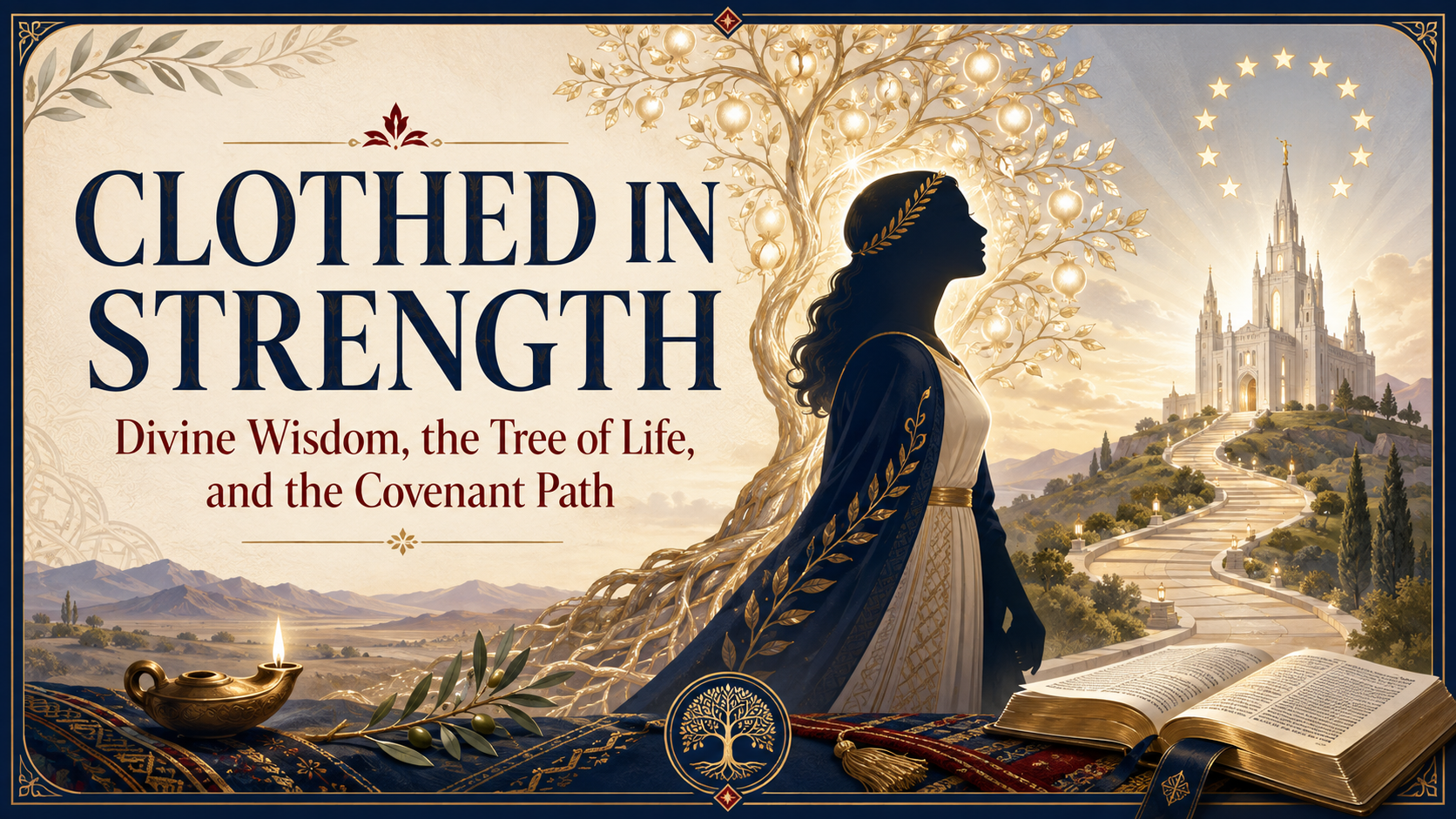
Proverbs 31, the Bride of Christ, and the Covenant Path

Proverbs 31, the Bride of Christ, and the Covenant Path

Word of Wisdom, Heavenly Parents, Temple Covenants, Theosis, and Exaltation


Proverbs 31 is often reduced to a checklist for an impossibly productive wife. Yet Proverbs 31:10–31 is first a carefully crafted Hebrew poem: an alphabetic acrostic that praises the eshet hayil, the “woman of strength,” whose fear of the Lord becomes visible in wise stewardship, economic agency, disciplined labor, faithful speech, household care, and mercy toward the poor. Read in the canonical context of Proverbs, she is not merely a passive model of private virtue. She is wisdom embodied.

This study develops a deliberately typological and temple-shaped reading of the poem. The eshet hayil becomes an icon of the Bride of Christ—the covenant community whose life is ordered by reverence, fidelity, holiness, and fruitful service. Doctrine and Covenants 89 adds an embodied discipline of appetite and spiritual receptivity; the covenants of the temple endowment give that discipleship a sacred grammar of obedience, sacrifice, the gospel of Jesus Christ, chastity, and consecration; and Revelation presents the faithful Church as a Bride made ready for the Lamb. Patristic theosis and Latter-day Saint exaltation converge in proclaiming transformation through participation in divine life, while retaining important theological distinctions. Proverbs 31 thus portrays the ordinary shape of extraordinary holiness: a people transformed by Christ until their works praise them at the gates.

A further Restoration layer emerges from the doctrine of Heavenly Parents and the feminine personification of Wisdom. Proverbs calls Wisdom a Tree of Life; 1 Nephi places a radiant tree beside the vision of a virgin mother and her divine Son; and Latter-day Saint scholars have compared these images with ancient Asherah and tree-goddess traditions. The biblical record clearly reports that Josiah removed an Asherah object from the temple, but the claim that this act erased an authentic revelation of Heavenly Mother remains a debated reconstruction. This study therefore treats the Wisdom-Tree-Mother constellation as a disciplined theological resonance, not as a substitute for revelation or proof that Lady Wisdom, Asherah, Mary, Shekhinah, and Heavenly Mother are one figure. Revelation 12 extends this pattern through a solar-clothed, star-crowned Woman who gives birth under threat from the dragon, receives divine nourishment in the wilderness, and survives as the mother of a commandment-keeping people. The Joseph Smith Translation identifies her as the Church of God and her child as the kingdom of God and Christ; the wider Israel-Zion-Mary-Bride symbolism therefore enriches divine-motherhood theology without making the Woman a direct portrait of Heavenly Mother.

How is the Lord inviting you to become a person of covenant strength? Choose one sphere—appetite, speech, money, work, fidelity, preparation, or care for the poor—and write one concrete act of consecration you will practice this week. Share the study with someone who has learned to hear Proverbs 31 as pressure rather than praise, and invite them to rediscover the woman of strength as a witness of grace-shaped wisdom.

Anchor Verse

“Favour is deceitful, and beauty is vain: but a woman that feareth the Lord, she shall be praised.” — Proverbs 31:30 (KJV)

What if Proverbs 31 is not a measuring stick but a mirror?

For generations, Proverbs 31 has been handed to women as a formidable list of domestic expectations: rise before dawn, manage a household, conduct business, produce clothing, care for the poor, speak flawlessly, and somehow never appear weary. Read that way, the poem can become less like good news and more like an inspired performance review. Women may feel judged by it, while men may assume that it addresses someone else. Both reactions miss the literary force of the text. Proverbs does not end with a spreadsheet of feminine productivity. It ends with poetry—a public song of praise celebrating what wisdom looks like when reverence for God takes flesh in the world.

The opening expression, eshet hayil, is commonly rendered “virtuous woman,” “capable wife,” “excellent wife,” or “woman of valor.” The Hebrew noun hayil carries a wide field of meaning that includes strength, capacity, wealth, competence, and valor. The woman is not praised because she is ornamental, silent, or fragile. She is strong. She evaluates a field and buys it. She plants a vineyard, trades profitably, supervises a complex household economy, speaks wisdom, prepares for adversity, and opens her hands to the poor. Her strength is neither self-display nor domination. It is power disciplined by covenant loyalty.

The poem gathers wisdom into a living covenant portrait

Proverbs begins by personifying Wisdom as a woman who calls in public places, invites the simple to learn, offers life, and warns against paths that end in death (Prov. 1:20–33; 8:1–36; 9:1–6). The book then concludes with a flesh-and-blood portrait of a woman whose decisions make wisdom visible. The literary movement is striking: Wisdom’s voice in Proverbs 1–9 becomes wisdom’s work in Proverbs 31. The fear of the Lord announced as the beginning of knowledge in Proverbs 1:7 reappears near the conclusion in Proverbs 31:30. What begins as instruction becomes character; what begins as a path becomes a practiced life.

That canonical pattern creates a responsible bridge to the New Testament’s image of the Church as the Bride of Christ. The historical woman praised in Proverbs 31 should not be erased, nor should every feature be converted into a hidden allegory. Yet Christian typology recognizes recurring covenant patterns that reach fulfillment in Jesus Christ and His people. The faithful, fruitful, mercy-giving, wisely ordered woman can therefore become an icon of the ecclesial Bride—a community that trusts her covenant Lord, clothes herself in righteous deeds, cares for the vulnerable, and prepares for the marriage supper of the Lamb (Eph. 5:25–27; Rev. 19:7–9).

For Latter-day Saints, Proverbs' feminine Wisdom also opens a question that much of Christian theology leaves underdeveloped: if exaltation means becoming like our Heavenly Parents, how might the Bible's feminine images of life, wisdom, birth, nurture, glory, and covenant presence witness to divine motherhood? That question is legitimate, but it requires disciplined distinctions. Grammatical femininity is not automatically a divine woman, a sacred tree is not automatically Heavenly Mother, and the recovery of an ancient goddess cult would not by itself establish revealed truth.

From admired virtue to temple-shaped discipleship

The central question is therefore not, “How can one woman accomplish everything in this poem?” The deeper question is, “How does the covenant people become the kind of Bride whose whole life praises the Lord?” A Restoration reading brings the Word of Wisdom and temple covenants into this conversation. Doctrine and Covenants 89 orders embodied appetite toward wisdom and revelation. The temple endowment calls disciples to obedience, sacrifice, the gospel of Jesus Christ, chastity, and consecration. Proverbs 31 shows those commitments becoming ordinary practice—in work, speech, sexuality, economics, mercy, preparation, and worship.

The added layer follows four levels of evidence. Official Restoration teaching establishes Heavenly Parents. The biblical text establishes Lady Wisdom, the Tree of Life, and Josiah's removal of the Asherah. Archaeology and comparative religion illuminate ancient tree and mother symbolism. Finally, Latter-day Saint temple theology asks what these patterns may mean. Keeping those levels distinct allows faith to become deeper without asking historical evidence to carry more than it can bear. Revelation 12 supplies an especially important control because the Joseph Smith Translation explicitly identifies the Woman with the Church and the child with God's kingdom. Any Heavenly Mother resonance must therefore remain analogical and theological rather than replace that revealed ecclesial meaning.

This reading must be stated carefully. Proverbs 31:10–31 is not known to have served as a prescribed ceremony in Solomon’s temple, and Doctrine and Covenants 89 is not the secret historical key to the poem. The phrase “temple-liturgical” in this study names a canonical and theological reading, not an unsupported claim about ancient ritual origins. The poem is temple-shaped because it portrays an ordered covenant life moving from reverence to holiness, from stewardship to consecration, and from faithful labor to praise at the gates. It is liturgical because it is a song of praise that forms the worshipping community’s imagination—and because it is still sung in many Jewish homes at the beginning of Shabbat, a custom commonly traced to early modern Jewish mysticism rather than the biblical temple period.

Sunday, August 30, 2026

Let Everything That Hath Breath Praise the Lord: When Lament Becomes Hallelujah

Let Everything That Hath Breath Praise the Lord: When Lament Becomes Hallelujah

Psalms 87–150 and the Covenant Ascent into Praise, Presence, Mercy, and Divine Faithfulness


The closing movement of the Psalms rises like a liturgical crescendo, but it does not reach hallelujah by pretending that suffering never happened. It carries affliction, exile, mortality, repentance, unanswered questions, and covenant longing into the presence of God. There, pain is neither minimized nor given the final word. Psalms 87–150 teach that biblical praise is more than religious enthusiasm. Praise is covenant memory: the deliberate act of remembering who God is, what He has done, and why His faithfulness remains trustworthy when life feels unsteady.

This Christ-centered Come, Follow Me study focuses on the 2026 reading assignment—Psalms 102–103; 110; 116–119; 127–128; 135–139; and 146–150—while placing those texts within the wider closing movement beginning with Zion in Psalm 87. Together, these psalms reveal the Lord as Creator, covenant Keeper, healer, righteous King, and refuge of the afflicted. They point Christian readers toward Jesus Christ as the enthroned Lord, eternal High Priest, rejected Cornerstone, and compassionate Savior. The Psalter finally summons every instrument, every nation, and “every thing that hath breath” to praise the Lord—not because mortality is painless, but because mercy endures, God reigns, and the road home remains open.

Reading the Closing Psalms as a Covenant Journey

The traditional Jewish name for the Psalter is Tehillim, “Praises.” That title may initially seem surprising because the book contains grief, protest, confession, fear, anger, royal celebration, wisdom instruction, and even prayers that make modern readers uncomfortable. Yet the name tells us where the whole collection is headed. The Psalms do not say that every moment feels praiseworthy. They teach the covenant people how to bring every moment—including the most painful one—before the God who is worthy of praise. The 2026 Come, Follow Me lesson similarly emphasizes that praise can take the form of singing, praying, bearing testimony, and deepening our commitment to follow the Lord.

Biblical scholar Walter Brueggemann famously describes a recurring movement in the Psalms from orientation, through disorientation, into a new orientation. That pattern is not a mechanical formula, and not every psalm moves through all three stages. It is nevertheless a helpful pastoral lens. Faith begins with received assurances about God and the world; suffering then destabilizes what once seemed secure; grace finally creates a renewed confession that has passed through pain rather than bypassed it. The resulting praise is deeper because it is no longer naïve. It has learned that lament can be faithful speech and that worship can survive the night.

The final two books of the Psalter, Psalms 90–106 and 107–150, also answer the crisis left by the apparent collapse of Davidic kingship in Psalm 89. Human thrones fail, generations pass, and Israel experiences exile, but the Lord remains King. Torah still gives light. Zion still represents divine presence and covenant hope. The final five psalms then gather the entire creation into praise. Canonical scholars such as Gerald H. Wilson and the authors of The Book of Psalms have therefore encouraged readers to attend not only to each psalm individually but also to the theological meaning created by the Psalter’s final arrangement. The destination of this prayer book matters: after every lament has been heard, the last canonical word is hallelujah.

A Note on the Reading Range

The official August 31–September 6, 2026, Come, Follow Me assignment includes Psalms 102–103; 110; 116–119; 127–128; 135–139; and 146–150. This study briefly uses Psalms 87–93 as a bridge from Zion to divine kingship and then concentrates on the assigned passages. That wider frame preserves the larger canonical ascent without confusing the supplemental material with the official reading list.

Sunday, August 23, 2026

"I Will Declare What He Hath Done for My Soul" | COME FOLLOW ME - OLD TESTAMENT 2026 | Psalms 49-86

"I Will Declare What He Hath Done for My Soul" | COME FOLLOW ME - OLD TESTAMENT 2026 | Psalms 49-86

The Temple Pattern of Descent, Ascent, and Exaltation in Israel's Hymnal of Redemption

"Come and hear, all ye that fear God, and I will declare what he hath done for my soul." - Psalm 66:16 KJV


This study reads the selected Psalms 49-86 as a canonical and theological journey through mortality, sin, lament, repentance, remembrance, redemption, and public witness. These poems do not form a single authored liturgy; they cross the boundary between Books II and III of the Psalter and include wisdom instruction, penitential prayer, individual and communal lament, historical recital, royal hope, and testimony. Read together, however, they trace a temple-shaped movement from estrangement toward the presence of God. Psalm 49 exposes the inability of wealth or human power to ransom life from death; Psalm 51 turns confession into a prayer for divine re-creation; Psalms 63, 69, and 77 give faithful language to abandonment and distress; Psalms 66, 71, and 78 transform remembered deliverance into covenant testimony; and Psalms 72, 85, and 86 direct personal restoration toward righteous kingship and Zion. The Book of Mormon intensifies this pattern in Alma 36, Alma 26, Alma 34, and Alma 42, where anguish gives way to joy through Jesus Christ and redeemed experience becomes missionary proclamation. The central claim is that biblical ascent does not deny descent. The worshipper rises by bringing mortality, guilt, fear, and unanswered questions into covenant relationship with the God who alone can redeem, cleanse, heal, and receive the soul. Psalm 66:16 therefore becomes more than a memorable line: it is the vocation of a redeemed people.

Scripture and method note. Biblical quotations follow the King James Version unless otherwise noted. This article distinguishes the psalms' ancient literary setting, their Christian canonical fulfillment in Jesus Christ, and their Latter-day Saint resonance. "Exaltation" is used first for being lifted into divine presence, covenant joy, and praise; restored doctrine gives that movement its fuller horizon in eternal life with God.

The Psalms as the Soul's Ascent Back to Eden

The soul does not merely want relief from pain. At its deepest level, it longs for the presence of God - for the wholeness, communion, and holy order represented by Eden. That longing is one reason the Psalms remain indispensable. They do not speak only from the summit of faith. They also pray from the pit, the wilderness, the sickbed, the battlefield, the guilty conscience, and the long night when God seems silent. The Psalter gives covenant people permission to bring the whole truth of mortal life into worship.

Calling the Psalms Israel's "temple hymnal" captures something essential, but it also requires care. Many psalms are rooted in sanctuary worship, sacrifice, procession, royal ceremony, pilgrimage, and public praise. Others may have begun in personal or communal crisis before being gathered for liturgical use. Sigmund Mowinckel emphasized the Psalms' setting in Israel's worship, while Claus Westermann stressed the dynamic relationship between lament and praise. James Luther Mays therefore describes the Psalms as both scripture and liturgy: ancient prayers that became the prayerbook of later communities (Mowinckel; Westermann; Mays).

The temple lens becomes especially fruitful when joined to the pattern of descent, ascent, and exaltation. The biblical sanctuary represents ordered creation and the divine dwelling among humanity; temple worship moves symbolically toward holiness and presence (Levenson 275-98). In the Psalms, that movement is often existential rather than architectural. The worshipper descends into fear, sin, mortality, exile, or confusion; ascends through remembrance, repentance, sacrifice, trust, and covenant appeal; and is lifted into renewed joy, praise, divine fellowship, and testimony. Walter Brueggemann's well-known categories of orientation, disorientation, and new orientation offer a closely related account of the spiritual world of the Psalter (Brueggemann).

This pattern does not mean that every psalm begins in Eden, passes through a fixed ritual sequence, and ends in triumph. Hebrew poetry resists mechanical outlines. Its parallel lines deepen, contrast, intensify, and sometimes destabilize one another. Yet across Psalms 49-86, a recurring theological grammar becomes visible: false securities fail, the soul cries out, God's mighty acts are remembered, mercy opens a path, and the redeemed worshipper declares what God has done. The result is a spiritual autobiography of redemption, not because all the psalms were written by one person, but because generations of worshippers can find their own descent and ascent within Israel's inspired songs.

Sunday, August 16, 2026

"The Lord Is My Shepherd": Psalm 23, Temple Descent-Ascent, and the Plan of Salvation

"The Lord Is My Shepherd": Psalm 23, Temple Descent-Ascent, and the Plan of Salvation

A Come, Follow Me Study for August 17-23, 2026: Psalms 1-2; 8; 19-33; 40; 46

"For thou art with me." - Psalm 23:4

Most of us first learned Psalm 23 as a psalm of comfort. We hear it at funerals, repeat it in hospital rooms, and reach for it when grief has stripped life down to its most difficult questions. That use is neither accidental nor misplaced. Yet Psalm 23 does more than assure us that God will remain near when we die. It poetically traces an entire journey: the Lord provides, restores, guides, accompanies, protects, welcomes, anoints, and finally brings the worshipper into His house.

That movement makes Psalm 23 especially meaningful for Latter-day Saints. Its imagery can be read as a temple-shaped journey from ordered life into mortal darkness and then upward into covenant fellowship and the presence of God. Read within the immediate sequence of Psalms 22-24, the pattern becomes even more striking: lament and suffering in Psalm 22, the Shepherd's presence in Psalm 23, and ascent to the holy hill with the King of glory in Psalm 24. Nancy deClaissé-Walford's intertextual study similarly argues that these three neighboring psalms form a powerful statement of trust when read together (deClaissé-Walford 139-52).

This interpretation requires one careful qualification. Psalm 23 is not demonstrably a word-for-word transcript of an ancient Israelite temple ceremony, and the full Latter-day Saint plan of salvation should not be projected backward into every Hebrew phrase as though the psalmist were writing a systematic doctrinal manual. Psalm 23 is commonly classified as a psalm of trust or confidence, while a pilgrimage setting that culminates at the temple remains a respected scholarly proposal rather than an uncontested conclusion (Smith 61-66; Tappy 255-80). The temple and plan-of-salvation reading offered here is therefore a disciplined canonical and theological synthesis: it begins with what the Hebrew poem says, follows the intertextual patterns the Psalter supplies, reads the psalm through Jesus Christ, and then asks how Restoration scripture enlarges its hope.

What Come, Follow Me Actually Assigns for August 17-23

The official 2026 reading is often abbreviated as "Psalms 1-46," but the assigned passages are selections rather than every chapter in that range: Psalms 1-2; 8; 19-33; 40; and 46. The manual invites readers to notice the Psalms' vivid images of the Savior, including the green pastures, still waters, rod, staff, and overflowing cup of Psalm 23. It then connects Psalm 24's "hill of the Lord" with the temple and with preparation to enter the presence of God (Come, Follow Me).

The broader three-week schedule is also selective. August 24-30 covers Psalms 49-51; 61-66; 69-72; 77-78; and 85-86, while August 31-September 6 covers Psalms 102-103; 110; 116-119; 127-128; 135-139; and 146-150. Keeping the actual readings clear strengthens the study because it allows Psalm 23 to function as the focal text for this week without forcing an artificial structure onto every psalm from 1 through 46.

Saturday, August 8, 2026

From the Ash Heap to the Holy Mountain: Hebrew Poetry and Wisdom Literature through the Temple Pattern of Descent and Ascent

From the Ash Heap to the Holy Mountain: Hebrew Poetry and Wisdom Literature through the Temple Pattern of Descent and Ascent

A Come, Follow Me introduction to Job, Psalms, Proverbs, and Ecclesiastes

Job, Psalms, Proverbs, and Ecclesiastes do not offer one flat explanation of faithful life. They give us an inspired conversation. Job protests any theology that reduces suffering to a predictable equation. The Psalms teach covenant Israel to pray through joy, guilt, abandonment, fear, gratitude, and praise. Proverbs forms moral perception by training the disciple to fear the Lord and choose wisdom over folly. Ecclesiastes exposes the vapor-like instability of mortal achievement and the limits of human control. Read together, these books move repeatedly from order into disorientation and from disorientation toward a renewed, humbler communion with God.

This study proposes the temple pattern of descent and ascent as a theological and devotional framework for that movement. Descent names mortality, estrangement, lament, disorder, and the collapse of false certainty. Ascent names purification, covenant formation, divine instruction, unveiled perspective, and renewed presence. The framework is grounded most directly in the temple setting of many Psalms—especially Psalm 24—but it should not be mistaken for a claim that Job, Proverbs, and Ecclesiastes were all composed as a single temple ritual. Instead, it is a canonical, Christ-centered reading that brings the wisdom books into conversation with Israel’s worship, the plan of salvation, and the Latter-day Saint journey back into God’s presence. The W.I.S.D.O.M. arc developed below provides the series structure: Walk, Invite, Seek, Discern, Observe, and Meet.

Sunday, August 2, 2026

Esther and the Pattern of Covenant Deliverance

Esther and the Pattern of Covenant Deliverance

Preserving God’s Covenant People Through Hidden Providence

By Jessica Shipp (@ChristPearls), with companion devotional and editorial contributions by Timothy R. Berman

Editor's Note: Jessica Shipp contributed the primary article, biblical character study, and chapter-by-chapter summary. Timothy R. Berman contributed the E.S.T.H.E.R. acrostic, devotional applications, additional reflections, and editorial presentation for Faith & Reason.

The Book of Esther occupies a unique place in Scripture. Unlike every other biblical book, God’s name never appears explicitly in its pages. Yet His presence is everywhere. Rather than revealing Himself through miracles or prophetic declarations, the Lord works quietly through ordinary people, ordinary decisions, and seemingly ordinary events. The story invites us to look beyond coincidence and recognize the unseen hand of providence guiding history according to His covenant purposes.

The historical setting is equally significant. More than a century after the Babylonian exile, many Jews had returned to Jerusalem under Zerubbabel, Ezra, and Nehemiah, but countless others remained scattered throughout the Persian Empire. Living among the nations, they preserved their covenant identity while existing within a foreign culture. At precisely this moment, Haman obtains a royal decree ordering the destruction of every Jew in the empire:

“To destroy, to kill, and to cause to perish, all Jews, both young and old, little children and women, in one day…” (Esther 3:13)

This is far more than a political crisis. The covenant people themselves stand under a sentence of death. Once again, God’s promises appear to hang by a thread. Yet this pattern is familiar throughout Scripture. Pharaoh sought to destroy Israel’s sons. Athaliah attempted to eradicate the royal seed of David. Herod sought the life of the infant Messiah. Time and again, when God’s covenant purposes seem threatened, He raises faithful men and women whose courage preserves His people until His greater purposes unfold. Esther belongs to that pattern.

Sunday, July 26, 2026

“I Am Doing a Great Work”: Stay on the Wall and Finish What God Called You to Do

“I Am Doing a Great Work”: Stay on the Wall and Finish What God Called You to Do

“I Am Doing a Great Work”

Stay on the Wall and Finish What God Called You to Do
Come, Follow Me—July 27–August 2 | Ezra 1; 3–7; Nehemiah 2; 4–6; 8


There are some distractions that do not look dangerous because they look quite reasonable. 

They arrive as invitations, conversations, controversies, urgent notifications, unexpected opportunities, and demands for our immediate attention. They ask us to take a moment and step away from what God may have placed before us - not necessarily forever, just long enough for us to lose our concentration and focus. 

This was the very strategy used against Nehemiah. 

Nehemiah’s enemies did not begin by openly commanding him to abandon the rebuilding of Jerusalem. Instead, they repeatedly invited him to leave the work and meet them in the plain of Ono. Such a proposal sounded quite diplomatic; however, Nehemiah recognized the deception beneath. He was able to discern and understood that not every invitation deserved an answer. Nor every controversy deserved his attention and presence. 

His response has become one of the most significant and clearest declarations of spiritual focus in scripture: “I am doing a great work, so that I cannot come down” (Nehemiah 6:3). Nehemiah was not boasting about his personal importance. What he did is declare the significance of the assignment - or calling - God had entrusted to him. More to the point, Nehemiah took seriously the stewardship of what God called him to accomplish. 

The wall was more than stone and timber. Jerusalem’s restoration represented covenant renewal, spiritual protection, communal identity, temple worship, and the fulfillment of God’s promises. 

This week’s Come Follow Me Study for the Old Testament is about more than rebuilding a temple or repairing a city wall. It is regarding how we are open and willing to recognize the work God has placed before each of us, resisting whatever pulls us away from it, and trusting that the Lord will strengthen our hands as we remain faithful and obedient to His will, purpose, and plans. 

Tuesday, July 21, 2026

Satan's Counter-Mission: The Ancient Playbook Behind Modern Social Media Gainsayers

Satan's Counter-Mission: The Ancient Playbook Behind Modern Social Media Gainsayers

How First-Century Religious Polemics Reappear in the Digital Age

Did you know that long before YouTube exposés, TikTok reaction videos, livestream debates, and thumbnails announcing that someone's faith tradition had been "destroyed" or they "got cooked," religious opponents were already employing a variety of tactics? These tactics included not only labels and ridicule but also the strategic use of selective evidence, harsh accusations of deception, and appeals to the prevailing orthodoxy of the time.

Throughout history, individuals and groups have engaged in polemical discourse, employing familiar patterns that transcend modern technology and social media platforms. While social media may amplify these exchanges and offer new avenues for expression, the fundamental dynamics of polemics—debate and dispute—are anything but new. They are deeply rooted in the fabric of human communication and interaction.

Understanding these historical parallels can offer valuable insights. However, it is crucial to recognize that for Latter-day Saints, acknowledging these patterns should not devolve into a license to demonize every critic. Instead, it calls upon us to foster a more nuanced approach to dialogue and engagement. This means we must strive for discernment without slipping into paranoia. We can hold firm convictions without succumbing to contempt for others.

In our conversations and debates, we want to aim to express truth in a manner that reflects the charity of Jesus Christ. This challenges us to engage thoughtfully and respectfully, even when faced with opposition. We are invited to navigate the complexities of faith, belief, and skepticism with a spirit of love and understanding, creating space for constructive dialogue rather than animosity. Ultimately, our response to criticism can be a powerful testament to the principles we uphold, embodying a spirit that upholds truth while also extending grace to those with whom we may disagree.

Sunday, July 19, 2026

When You Don’t Know What to Do, Keep Your Eyes on God | 2 Chronicles 14–20; 26; 30

When You Don’t Know What to Do, Keep Your Eyes on God | 2 Chronicles 14–20; 26; 30

Come, Follow Me — July 20–26, 2026: “Our Eyes Are Upon Thee”

What do you do when the opposition is greater than your strength, the pressure is greater than your wisdom, and you honestly do not know what to do next?

This week’s Come, Follow Me study takes us into the lives of kings, prophets, reformers, worshippers, and ordinary families who faced that very question. Their stories reveal that peace does not come from pretending the battle is small. It comes from knowing where to turn when the battle is bigger than you.

Through the accounts of Asa, Micaiah, Jehoshaphat, Uzziah, and Hezekiah, 2 Chronicles invites us to examine where we place our trust, how we respond to correction, and whether our eyes remain fixed upon the Lord when fear, success, pride, or division threaten to pull them away. Each of these figures faced formidable challenges—be it external armies, internal strife, or the temptations of power—and their responses provide valuable lessons for our own lives.

Asa, for instance, shows how reliance on God in times of trouble can lead to unexpected victories, while Micaiah reminds us of the importance of courage in standing for truth, even in the face of overwhelming opposition. Jehoshaphat’s alliance-building and pursuit of divine guidance highlight the significance of seeking God's will in decision-making, especially when circumstances seem dire. Uzziah's rise to power illustrates the fine line between humility in success and the dangers of pride, reminding us that acknowledgment of our dependence on God is crucial. Lastly, Hezekiah's prayer in times of crisis demonstrates that sincere reliance on divine help can yield miraculous outcomes.

This week's study encourages us to reflect deeply on our own lives. When confronted with overwhelming pressure, do we allow our fears to overshadow our faith? Are we quick to seek advice from sources that may not align with our beliefs? Or do we, like these biblical figures, turn our attention steadfastly to God, trusting that He will guide us through our fiercest battles? Through these narratives, we learn that true peace comes from steadfast faith and a commitment to seek God's wisdom relentlessly, no matter how insurmountable the obstacles may appear.

Tuesday, July 14, 2026

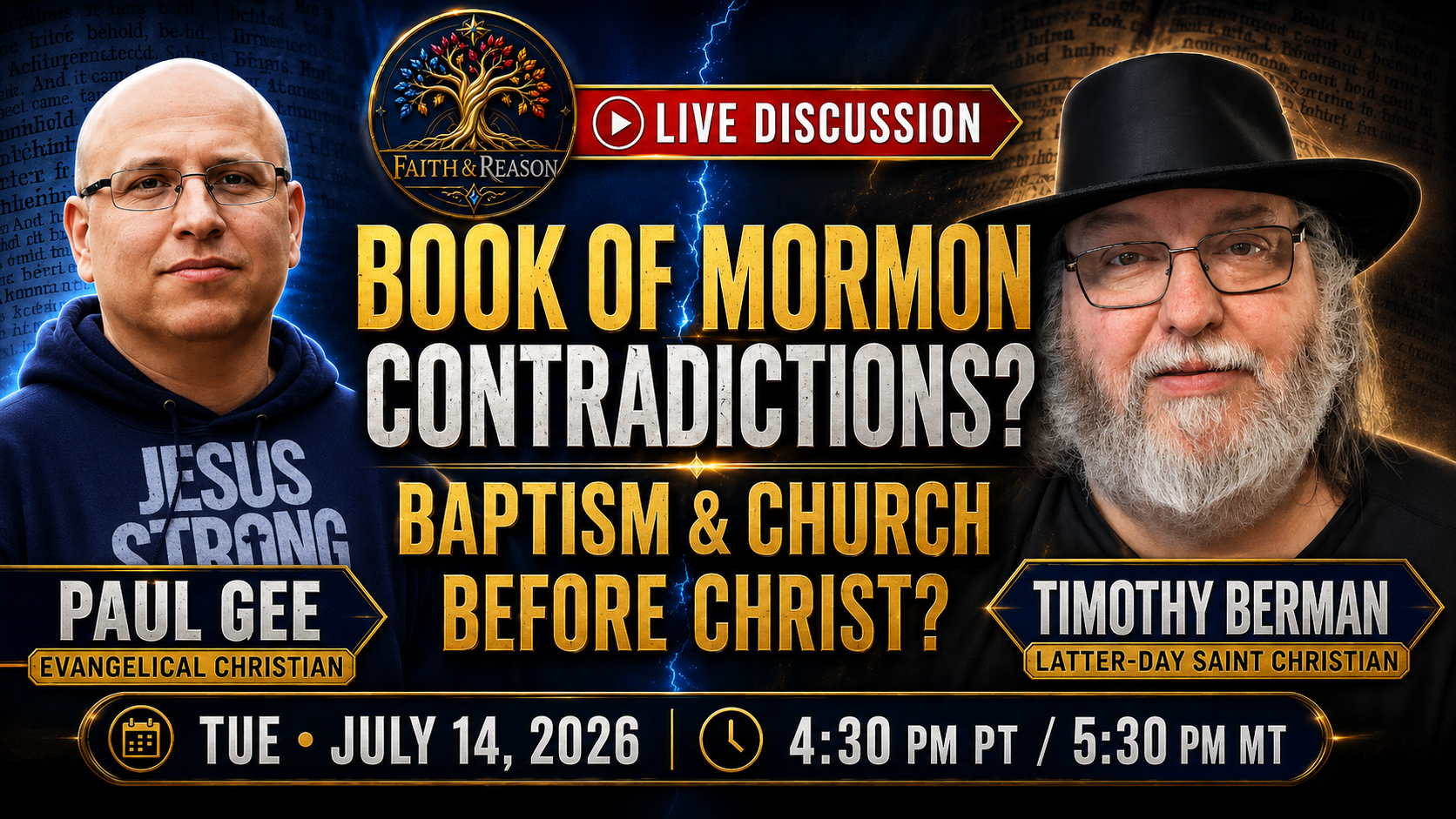
Book of Mormon Contradictions? Paul Gee and Timothy Berman Discuss Mosiah 18

Book of Mormon Contradictions? Paul Gee and Timothy Berman Discuss Mosiah 18

Tonight, Faith & Reason hosts a focused livestream discussion between Paul Gee and Timothy R. Berman examining one of the central arguments raised against the Book of Mormon: the claim that Mosiah 18 contains biblical and historical contradictions.

The discussion will stream live directly on this page.

Watch the Livestream

Date: July 14, 2026
Time: 4:30 PM Pacific / 5:30 PM Mountain
Participants: Paul Gee and Timothy R. Berman
Topic: Baptism and the Church in Mosiah 18

The livestream video is embedded below. The broadcast will begin automatically when the event goes live.

Sunday, July 12, 2026

He Trusted in the Lord: When Faith Is Challenged and Reform Becomes Necessary | Come Follow Me 2 Kings 16–25

He Trusted in the Lord: When Faith Is Challenged and Reform Becomes Necessary | Come Follow Me 2 Kings 16–25

Let's face the reality and truth: Our faith is going to be tested time and time again. Much of the time, there are going to be those seasons where our faith is not tested through seasons of silence. Instead, they are going to be tested through seasons where there are clamor and noise.

The Assyrian voice outside the wall is quite loud. The threat is very public. The accusation is calculated. And the enemy does not merely attack Jerusalem's defenses; the enemy attacks Jerusalem's confidence in God. I want to say this again: The enemy does not merely attack Jerusalem's defenses because the enemy attacks Jerusalem's confidence in God. This becomes a powerful tension in 2 Kings 16-25. For good reason, because the issue is not only whether Judah is capable of surviving Assyria or Babylon. The deeper question is whether God's people will trust the Lord when worldly power looks more practical than covenant faithfulness.

This week's Come Follow Me lesson, "He Trusted in the Lord God of Israel," places us in some of the darkest years of Israel and Judah's history. The Northern Kingdom is conquered and scattered by Assyria. Whereas the Southern Kingdom struggles with idolatry, compromise, fear, reform, and eventual destruction. Yet in the middle of spiritual rebellion and decline, two kings stand out: Kink Hezekiah, who trusted the Lord when Jerusalem was threatened, and King Josiah who seemed to turn to scripture and renew covenants when the Book of the Law was rediscovered. The latter resulting in what scholars refer to as the Deuteronomist Reform or the Josiah Reformation. Bridging first temple Judaism with the movement toward what will become the Second Temple era of Jewish history.

The contrast here is quite sobering as Ahaz looked to Assyria for security and compromised the First Temple - or Solomon's Temple. While Hezekiah seemed to turn to look unto the Lord and went to the temple in prayer. Josiah heard the scriptures, humbled himself, and led a reform that reshaped Jewish history and religious worship. Zedekiah rebelled and Babylon rose up - bringing destruction upon Jerusalem. It's destruction of the city and temple a fulfillment of prophecy the Jew's of First Temple Jerusalem refused to accept.

These chapters teach that trust is not something built upon sentimental optimism. Trust is built on covenantal loyalty while under pressure and enduring the refiner's fire.

Tuesday, July 7, 2026

Afflicted, Yet Highly Favored | Finding God’s Goodness in a Broken World — 1 Nephi 1

Afflicted, Yet Highly Favored | Finding God’s Goodness in a Broken World — 1 Nephi 1

What does it truly mean to be highly favored of God?

Many of us carry an underlying assumption that if we are faithful, life should become easier. We expect obedience to produce comfort, clarity, answered prayers, and protection from suffering. Yet Jesus never promised a life without hardship. He said, “In the world ye shall have tribulation,” but then added, “be of good cheer; I have overcome the world” (John 16:33). Nephi begins his record with this same tension. He had “seen many afflictions,” and yet he described himself as “highly favored of the Lord” (1 Nephi 1:1).

How can both be true?

Perhaps God’s favor is not proven by the hardships He prevents, but by His presence within the hardships we endure. Joseph was falsely accused and imprisoned, yet even there “the Lord was with Joseph, and shewed him mercy” (Genesis 39:20–21). Divine favor does not always mean receiving the life we hoped to have. Sometimes it means discovering the life God is forming within us through His goodness, grace, and sustaining presence.

Nephi does not deny or minimize his afflictions. Instead, he interprets them through his “great knowledge of the goodness and the mysteries of God” (1 Nephi 1:1).

That distinction matters.

Affliction was part of Nephi’s story, but it was not the final meaning of his story. As Paul later taught, tribulation can produce patience, experience, and hope because the love of God is poured into our hearts through the Holy Ghost (Romans 5:3–5).

First Nephi chapter 1 begins with affliction and divine favor, but it ends with faith and divine deliverance. Between those two declarations, Jerusalem receives a prophetic warning (1 Nephi 1:4). Lehi prays “with all his heart” on behalf of his people (1 Nephi 1:5). Heaven opens, revelation comes, and Lehi is called to testify of the Messiah and “the redemption of the world” (1 Nephi 1:19).

The people reject his message, mock him, and seek his life. Yet rejection does not have the final word. Nephi concludes by declaring that “the tender mercies of the Lord” are over those who exercise faith, making them mighty “unto the power of deliverance” (1 Nephi 1:20). Even God’s warnings reveal His mercy. The Lord declares that He takes no pleasure in destruction but desires that the wicked turn from their ways and live (Ezekiel 33:11). God warns because He loves. He confronts because He desires repentance, healing, and restoration.

God’s warnings are expressions of His mercy, and those who respond in faith will discover His power to deliver.

Today, we will walk through 1 Nephi chapter 1 and examine how Nephi interpreted his afflictions through God’s goodness and tender mercies.

We will see Lehi respond to a broken world with intercessory prayer rather than condemnation. We will examine how revelation led him to proclaim Jesus Christ and redemption. And we will discover why the rejection of God’s message could not overcome His power to preserve and deliver the faithful.

As we study, we must also ask ourselves: How are we interpreting our own afflictions? Are we measuring God’s goodness only by the circumstances we want Him to change? Could the correction or warning we are resisting actually be an expression of His mercy? Scripture does not promise that the righteous will avoid affliction. It declares, “Many are the afflictions of the righteous: but the Lord delivereth him out of them all” (Psalm 34:19).

God’s favor is not measured by the absence of hardship. It is revealed through His faithful presence, His goodness made known, and His sustaining mercy through every affliction. We may experience many afflictions and still be highly favored of the Lord. The hardship is real—but so are His tender mercies. And because His mercy is real, affliction does not have the final word.

Sunday, July 5, 2026

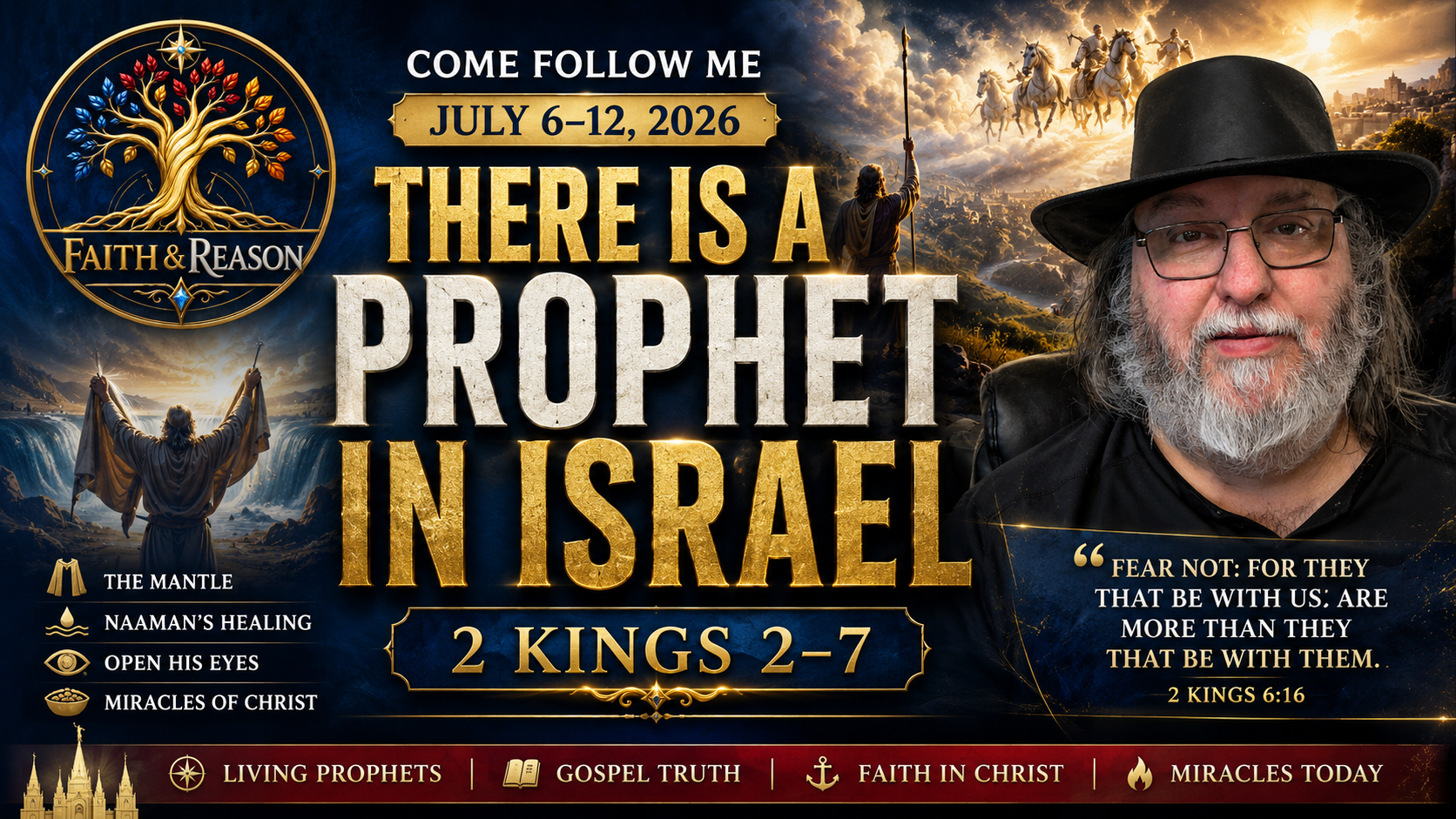
There Is a Prophet in Israel: When You Feel Surrounded, God Is Still Working | Come Follow Me 2 Kings 2–7

There Is a Prophet in Israel: When You Feel Surrounded, God Is Still Working | Come Follow Me 2 Kings 2–7

There were moments in my own life when the challenges seemed larger than the promise. The overall pressure felt immediate. Fear seemed quite rational. The surrounding issues seemed visible, measurable, and impossible to ignore. This is where Elisha's servant saw when he woke and found the city surrounded by horses and chariots. The servant's question was not dramatic, it is quite human: "Alas, my master! How shall we do?"

Elisha did not deny the reality of the danger. He did not pretend the army was not there. He simply saw more than the servant saw. His answer is one of the great faith-building declarations of scripture: "Fear not: for they that be with us are more than they that be with them." Elisha, then, prayed that the Lord will open the young man's eyes, and suddenly the mountain was filled with heavenly help. The issue had not changed, the servant's vision had.

This is the very heart of this week's Come Follow Me lesson in 2 Kings 2-7. The title of the lesson is, "There is a Prophet in Israel," and it walks us through the ministry of Elisha, the successor of Elijah. These chapters are filled with miracles: water healed, oil multiplied, a child raised, poisoned food purified, bread multiplied, Naaman cleansed, an ax head recovered, armies restrained, and prophetic words fulfilled. Yet the deeper message is not merely how miracles happened, nor how long ago they happened, because the deeper message is that the Lord still works through covenant faith, prophetic authority, humble obedience, and spiritual eyes that learn to see beyond fear and doubt.

The official Come Follow Me material notes that although Elisha's record does not preserve much of his direct teaching, his miracles testify of Christ's life-giving, nourishing, and healing power. These miracles point us to the Savior who raises, feeds, cleanses, restores, and opens up eyes. They invite us to ask the same prayer Elisha offered: Lord, open our eyes, that we may see.

Sunday, June 28, 2026

Rehoboam's Pride, Elijah's Fire & the Voice You're Missing | 1 Kings 12-13; 17–22 CFM

Rehoboam's Pride, Elijah's Fire & the Voice You're Missing | 1 Kings 12-13; 17–22 CFM

Choose This Day: Finding Christ in the Divided Kingdoms of Our Lives

Quite frankly, I am grateful for the many people who have come into my life and spoken to me directly, compassionately, and with genuine understanding. They showed patience and grace without sitting in judgment over me. They met me in difficult and messy moments, listened to what I was carrying, and helped me confront unhealthy attitudes and behaviors without condemning me.

Yet, if I am completely honest, I have also carried resentment, bitterness, self-hatred, and anger toward people whom I believed had betrayed, ignored, or abandoned me.

Every one of us is shaped—lifted, wounded, strengthened, or misled—by the voices we choose to follow.

Families may rise or fall because of those voices. Communities may flourish or fracture because of them. Our faith may deepen or drift depending on whose counsel we trust and whose influence we permit to guide our decisions.

Much of the pain we carry may be traced to someone who used influence selfishly—or to someone who possessed the ability to help but refused to use it.

The opposite is also true.

Some of the deepest healing we experience comes through Christlike leaders, mentors, friends, and disciples who choose to show up, serve, and sacrifice. They meet us in places where others might pass by. They take time to understand, comfort, encourage, and help us move forward without excusing destructive behavior or enabling us to remain stuck.

That tension between selfish influence and Christlike service stands at the heart of this week’s Come, Follow Me study for June 29–July 5: “If the Lord Be God, Follow Him,” covering 1 Kings 12–13 and 17–22.

Sunday, June 21, 2026

What the Divinity of Jesus Christ Means to You

What the Divinity of Jesus Christ Means to You

Why Jesus Alone Could Accomplish the Infinite and Eternal Atonement

What manner of man commands the wind and sea—and they obey Him? He who speaks to the chaotic elements and they submit to His will, revealing His divine authority over nature itself. His voice echoes through the storm, bringing peace where there was turmoil, demonstrating an unparalleled mastery that transcends human understanding.

What manner of man possesses the power to lay down His life and take it up again? He who, with the authority inherent to His being, presents the ultimate sacrifice, fully aware of the weight of such a decision. In laying down His life, He unveils the profound mystery of love and redemption. The same strength that allows Him to give Himself away also empowers Him to conquer death, rising triumphantly to provide hope and eternal life to humanity.

What manner of man suffers more than mortal humanity can endure, yet remains until the work of redemption is complete? He bears the weight of all humanity’s sins, feeling the depths of anguish and despair, yet persevering through the agony to fulfill His purpose. His empathy is boundless, experiencing sorrow in ways that only a divine nature could comprehend. In His endurance, He illustrates the profound depth of grace, revealing that true strength is often displayed in vulnerability and unwavering commitment to a higher calling, despite the unbearable cost.

This man is a testament to the coexistence of power and humility, a divine figure whose actions reshape the narrative of humanity's relationship with the Creator. His life and legacy stand as an eternal beacon of hope, a call to embrace the extraordinary potential within each of us to rise above our circumstances and to foster love, compassion, and redemption in a world so often in need of these gifts.

These questions stand at the center of Doctrine Lesson 6, “What the Divinity of Jesus Christ Means to You,” from the 1974–75 Melchizedek Priesthood study guide When Thou Art Converted, Strengthen Thy Brethren. The lesson’s purpose was not merely to establish that Jesus was extraordinary. It invited priesthood holders to understand why Jesus Christ alone possessed power to accomplish the infinite and eternal Atonement—and why every one of us remains completely dependent upon Him.

Nearly five decades later, that central purpose remains unchanged. Some of the language used in the original lesson, however, has generated theological questions and apologetic controversy. In particular, statements by James E. Talmage and Bruce R. McConkie about Christ’s literal divine sonship have been interpreted by critics as teaching that God the Father physically descended and engaged in sexual intercourse with Mary.

A responsible modern treatment must do more than dismiss that criticism. It must distinguish among what scripture reveals, what individual Church leaders have proposed or speculated, and what the Church currently teaches as established doctrine.

It is best we do not allow controversy over the manner of Christ’s conception to distract us from the greater truth: Jesus Christ did for us what we could never do for ourselves.

Hear Thou in Heaven Their Prayer: Returning to God with All Your Heart

Hear Thou in Heaven Their Prayer: Returning to God with All Your Heart

There are moments when the distance between faithfulness and failure feels almost impossibly small.

A glance lingers. A private desire is entertained. A warning is dismissed. One compromise makes the next compromise easier, and before long, a person who once walked closely with God finds himself standing in the wreckage of choices he never imagined he would make.

That is part of the tragedy of David’s story.

Yet this week’s Come Follow Me 2026 Old Testament study does not leave us standing on the rooftop with David, trapped in the moment when temptation first entered his heart. It carries us into Nathan’s courageous confrontation, through David’s anguish and the painful consequences of sin, and onward into Solomon’s prayer for wisdom and his dedication of the house of the Lord.

At the center of these chapters is a plea filled with covenant hope:

“If they shall bethink themselves in the land whither they were carried captives, and repent, and make supplication unto thee … saying, We have sinned, and have done perversely, we have committed wickedness; And so return unto thee with all their heart, and with all their soul … then hear thou their prayer and their supplication in heaven thy dwelling place, and maintain their cause.” —1 Kings 8:47–49, KJV

This is not a lesson about flawless kings or effortless discipleship. David fell. Solomon began with wisdom and ended with a divided heart. Both stories warn us that yesterday’s spiritual strength cannot substitute for today’s surrender.

But these chapters also testify that God has provided a covenant path of return. He hears the prayer of the humble. He grants wisdom to those who sincerely seek it. He establishes His name in His holy house. Through Jesus Christ, He invites wounded, wandering, and repentant people to come home.

The question is not merely whether David or Solomon remained faithful. The question is whether our hearts are fully turned toward the Lord today.

Friday, June 12, 2026

Social Media Gainsayers: The Anti-Mormon Playbook Has Not Changed—Only the Platforms Have

Social Media Gainsayers: The Anti-Mormon Playbook Has Not Changed—Only the Platforms Have

How Ex-Mormon Influencers, Evangelical Critics, and Online Ministries Repackage the Same Arguments for YouTube, TikTok, Facebook, Podcasts, and Livestreams

In 1989, anti-Latter-day Saint ministries, often referred to as Counter-cult or Anti-Mormon groups, relied heavily on printed tracts, cassette tapes, books, traveling seminars, church presentations, and controversial films—most notably, The Godmakers. Pastors would announce special meetings from their pulpits, offering "classes" on how to witness to Mormons. If you strolled into any brick-and-mortar Christian bookstore, you'd find a substantial collection of books specifically discussing the Church of Jesus Christ of Latter-day Saints. Among the more notable titles were Kingdom of the Cults by the late Walter Martin, Letters to a Mormon Elder by James White of Alpha and Omega Ministries, Mormonism 101 by Bill McKeever and Eric Johnson, and Mormons Answered Verse by Verse by David A. Reed and John R. Farkas. In addition to these apologist works, you'd also discover a range of small group and individual study guides about the LDS faith.

As if that weren't enough, it wasn't uncommon for members of the faith to be invited over to a family friend's or relative's home for dinner, only to be introduced to a friendly couple. The gentleman would often start the conversation with, "I used to be a Mormon, but I’ve found Jesus." This felt like a kind of religious intervention aimed at coaxing you to leave the church. I experienced this firsthand in my early twenties when my mother-in-law invited my then-wife and me over for dinner. That evening plunged me into the world of Anti-Mormonism and apologetics. I had already purchased They Lie in Wait to Deceive by the Browns (I had all four volumes at that time), The Truth About the Godmakers by Gilbert Scharff, and The Gainsayers: A Converted Anti-Mormon Responds to the Critics of the LDS Church by Derrick T. Evenson—this last book serving as the foundation for my Social Media Gainsayers series.

This atmosphere left minimal opportunity for individuals to hear a meaningful response from Latter-day Saints. The urgency of the message was unmistakable: “They are stealing your people. They must be stopped,” as Ed Decker wrote in his letter to pastors, promoting his book and film, The Godmakers. Fast forward more than three decades, and we see that the media landscape has undergone a dramatic transformation. Pamphlets have turned into Facebook posts, and cassette tapes have been replaced by podcasts. Traveling seminars have morphed into YouTube livestreams and channels, while the controversial film The Godmakers has resurfaced on social media platforms, mainly appearing as "The Mormon Banned Cartoon." Church basement presentations have transitioned into TikTok debates and live discussions. The once-printed quotations, often stripped of context, have been condensed into fifteen-second video clips and responses. What used to be the anti-Mormon bookstore shelf has now become algorithmically generated playlists.

The technology has changed, distribution has accelerated, and the audience is now global. Yet, the underlying playbook remains startlingly familiar. Today’s social media gainsayers might identify themselves as Ex-Mormons, evangelical Christian pastors, Christian apologists, cult experts, deconstruction coaches, religious commentators, or former "insiders." Though they use differing methods, it’s crucial to note that not every critic of the Church of Jesus Christ of Latter-day Saints is manipulative, dishonest, or deceptive.

Legitimate criticisms deserve legitimate responses. Difficult historical questions should never be ignored, and former members have every right to share their personal experiences. Likewise, Christians have every right to express their disagreements with Latter-day Saint theology. The challenge arises when personal experiences are framed as universal facts, theological disagreements are marketed as scandals, and mockery and insults take the place of honest discussions. Unfortunately, algorithms often amplify the most hostile narratives.

That’s when criticism turns into gainsaying. As Latter-day Saints, we bear the responsibility to stand firm in our faith and testimony, for it is through “sound doctrine that we both exhort and convince the gainsayers” (Titus 1:9, KJV).

Wednesday, April 29, 2026

Melchizedek Priesthood Study Manual - 1974/75 | Doctrine Lesson 5: In Whom Do You Have Faith

Melchizedek Priesthood Study Manual - 1974/75 | Doctrine Lesson 5: In Whom Do You Have Faith

Is Jesus Christ Jehovah? That question sits at the center of Latter‑day Saint belief and shapes how scripture, worship, and devotion fit together.

Many Latter‑day Saints answer this simply: yes. The claim that Jesus Christ is Jehovah—the God of the Old Testament—threads through the Bible, the Book of Mormon, and modern LDS scripture. When you read those texts together, a single, continuous picture of the Savior emerges: the same divine Being who made covenants with Israel is the One who came to earth, taught, and atoned for us.

Scriptural Evidence That Connects the Names

The Old Testament presents Jehovah as Israel’s covenant‑making, creative, and redeeming God. The New Testament introduces Jesus as the divine Word who was with God in the beginning and through whom all things were made. The Book of Mormon and Doctrine and Covenants pick up that same thread and make the connection explicit. For example, when the resurrected Savior declares, “Behold, I am Jesus Christ” (3 Nephi 11:10–11), it reads as a direct fulfillment of the prophetic voice that spoke for God in earlier scripture.

Prophecies such as Isaiah 9:6 calling the coming child “Mighty God,” and John 1:1–3 identifying the Word as God, point to one eternal actor in salvation history. Passages like Colossians 1:16, which speak of Christ’s role in creation, reinforce the idea that the One who created and guided Israel is the same One who walked the earth as Jesus.

LDS Doctrinal Context

Latter‑day Saint teaching emphasizes that Jehovah is Jesus Christ. Modern prophets and revelations encourage members to read the Old and New Testaments together with latter‑day scripture, seeing continuity rather than contradiction. The doctrine of premortality—where Jesus is chosen as Savior before the world’s foundation (see Abraham 3:27)—underscores that His divine role predates His mortal life. Doctrine and Covenants passages that affirm the Lord’s universal lordship further shape this understanding.

Why This Matters for Faith and Practice

Seeing Jesus as Jehovah changes how scripture is read and how worship is lived. It ties the covenants and promises of Israel to the life, Atonement, and Resurrection of Christ. That continuity makes the Savior’s teachings feel less like a new chapter and more like the central thread of a single, unfolding story. For believers, it deepens trust in His unchanging nature and invites a more personal relationship with the God who has always been involved in human history.

Curious how Latter‑day Saints answer the question, “Is Jesus Christ Jehovah?” — and why it matters? Read more to see a clear, scripture‑rooted explanation that’s both simple and soul‑stirring.

Tuesday, April 28, 2026

General Conference Reflection: Come Home - The Savior's Call to the Weary

General Conference Reflection: Come Home - The Savior's Call to the Weary

There have been those moments in my own life when silence felt louder than any noise - when distance from God doesn't come through rebellion, it comes through weariness, disappointments, or quiet drifting. In those moments - I never thought of them as sacred hidden places. However, Elder Clark G. Gilbert's message, Come Home, reminded me of how Christ rescued me. Elder Gilbert's testimony is both disarming and deeply personal: Jesus Christ is not waiting to condemn you - He is actively calling you back. This is not an invitation for us to return to any religious belief - it is a return to a covenantal relationship where Christ desires to bring us face-to-face with our Heavenly Father. Through this process, we find healing, restoration, peace, and the joy that surpasses all understanding. It is an invitation for those wandering and lost today.

And here is the profound truth Elder Gilbert centers his message: Christ is not only our Redeemer - but He is also our Repairer. This distinction is of immense importance. Many of us hold to the idea that Jesus forgives us - however, how many of us truly believe and experience the reality of His power to restore us? Through personal stories, doctrinal clarity, and prophetic and apostolic witness, this message unfolds the spiritual reality and truth - no fracture; spiritual, emotional, or relational, is beyond the Savior's power to amend through the gift and tender mercies of the infinite atonement.

Elder Gilbert's message acknowledges the real barriers that prevent people from returning. It is these barriers I have found myself referring back to regarding my own devotional teachings and messages. The very same barriers I’ve struggled with over the years in returning back to the faith of the Restored Gospel. Feelings of not belonging, feelings of inadequacy, doubt, or even feeling trapped within cultural or religious expectations often obscure an intimate relationship with Jesus Christ. Elder Gilbert does not dismiss these struggles; instead, he speaks directly into them with compassion and clarity. His approach is refreshing as it resonates with the hearts of many who grapple with these complex emotions.

For me, the ultimate truth of this message is not about people leaving the faith - it is about the reason they are able to return. And for me, the Gospel of Jesus Christ is not a place for perfect people - it is a home for those returning. This home isn’t just a metaphorical return; it’s a genuine invitation to embrace love, understanding, and acceptance in the arms of a Savior who knows our struggles intimately.

Consider what the Savior taught regarding this profound and yet simplistic principle and truth:

"As Jesus was walking along, he saw a man called Matthew sitting at the tax-collection station, and he said to him, "Follow me." And he got up and followed him. And as he sat at dinner in the house, many tax collectors and sinners came and were sitting with Jesus and his disciples. When the Pharisees saw this, they said to his disciples, "Why does your teacher eat with tax collectors and sinners?" But when he heard this, he said, "Those who are well have no need of a physician, but those who are sick. Go and learn what this means, I desire mercy, not sacrifice. For I have not come to call the righteous but sinners." (Matthew 9:10-13, NRSVUE).

In this scene, Jesus is having a meal with Matthew, a former tax collector, and a mixed crowd of people whom the religious leaders dubbed as tax collectors and sinners. When the Pharisees, the self-appointed guardians of what’s pure and pious, ask why he would spend time with such unclean folks, Jesus turns the whole conversation on its head. He doesn’t see himself as a judge but as a healer. He highlights that his mission isn’t about reaffirming those who think they’re just fine—essentially the self-righteous—but about reaching out to those who are honest enough to see their own brokenness. By quoting the prophet Hosea—“I desire mercy, not sacrifice”—he underscores that compassion trumps strict religious rules or pushing people away.

In addition to this powerful depiction, it's crucial to reflect on the implications of this teaching in our daily lives. The moments we find ourselves in judgment rather than in service can detract from our mission as followers of Christ. When we look at the world with eyes that see brokenness, we are called to serve rather than criticize. Our posture should always be one of humility, recognizing our own need for mercy.

For me, Christ is not waiting to condemn; even the Apostle Paul writes: "Therefore there is now no condemnation for those who are in Christ Jesus" (Romans 8:1, NRSVUE). In my own life, those I have ministered to and sat in counsel with over the years have experienced this invitation to come back to Him. And the sad reality is: how often do we stand in the shoes of the Pharisees? How often are we prone to judge and criticize those who have left the LDS Faith, or even those who have left the Christian faith in general? While the Pharisees saw the dinner table as a place of judgment and an opportunity to avoid those who are deemed unworthy - sinners - Christ saw it as a place of ministry, healing, and deep connection.

One of the oft-repeated excuses that frustrates me is this: The Gospel is Perfect; the Church is True - the people are not. This bumper sticker cliché seems to slap a band-aid on people who have truly been disappointed, hurt, or pushed to the side as if they don't matter or belong. This perspective can inadvertently perpetuate a culture of exclusion rather than inclusion, failing to recognize that the essence of the Gospel is about love and reconciliation.

In reality, Jesus' message invites every individual, regardless of their past or present struggles, to experience the fullness of His grace and mercy—a message that should resonate deeply within the walls of every church and community devoted to His service.

Our Heavenly Family: What the Gospel Teaches About Premortal Life and the Plan of Progression

Our Heavenly Family: What the Gospel Teaches About Premortal Life and the Plan of Progression

What if your identity didn’t start at birth—but before time as you know it?

Culture and society constantly attempt to define you by your past, your struggles, or your achievements, the restored gospel of Jesus Christ offers a radically different foundation: you are not an accident—you are a child of God.

This truth sits at the very heart of Latter-day Saint belief and shapes everything from purpose to destiny. If you’ve ever wondered, Who am I? Why am I here? Where am I going? —this doctrine answers all three with clarity, hope, and eternal perspective. Understanding this inherent identity offers comfort amidst life's challenges and reassures you that your existence is meaningful and intentional.

The idea that your identity predates your mortal experience invites a profound reflection on the nature of your soul. It posits that you were known to God before the foundation of the world, reinforcing a sense of belonging that transcends earthly definitions. This foundational belief encourages individuals to look beyond transient labels and societal expectations, fostering a deeper connection with the divine.

In this post, we’ll walk through the doctrine of our Heavenly Family as taught in Chapter 2 of the Gospel Principles manual—unpacking it through scripture, thoughtful explanation, and real-life application. We will explore how viewing yourself as a beloved child of Heavenly Parents impacts your day-to-day life, the decisions you make, and the way you interact with others. By examining scripture, we’ll delve into key passages that illuminate your divine lineage and help you internalize the powerful message that you are part of a larger, eternal family.

Join us as we navigate these teachings together, uncovering the significance of your eternal identity and how it serves as a guiding light through trials and triumphs alike. Through this exploration, may you gain a renewed perspective on your divine worth and a deeper understanding of your eternal purpose.