Showing posts with label Come Follow Me Old Testament. Show all posts

Sunday, July 26, 2026

“I Am Doing a Great Work”: Stay on the Wall and Finish What God Called You to Do

“I Am Doing a Great Work”: Stay on the Wall and Finish What God Called You to Do

“I Am Doing a Great Work”

Stay on the Wall and Finish What God Called You to Do
Come, Follow Me—July 27–August 2 | Ezra 1; 3–7; Nehemiah 2; 4–6; 8


There are some distractions that do not look dangerous because they look quite reasonable. 

They arrive as invitations, conversations, controversies, urgent notifications, unexpected opportunities, and demands for our immediate attention. They ask us to take a moment and step away from what God may have placed before us - not necessarily forever, just long enough for us to lose our concentration and focus. 

This was the very strategy used against Nehemiah. 

Nehemiah’s enemies did not begin by openly commanding him to abandon the rebuilding of Jerusalem. Instead, they repeatedly invited him to leave the work and meet them in the plain of Ono. Such a proposal sounded quite diplomatic; however, Nehemiah recognized the deception beneath. He was able to discern and understood that not every invitation deserved an answer. Nor every controversy deserved his attention and presence. 

His response has become one of the most significant and clearest declarations of spiritual focus in scripture: “I am doing a great work, so that I cannot come down” (Nehemiah 6:3). Nehemiah was not boasting about his personal importance. What he did is declare the significance of the assignment - or calling - God had entrusted to him. More to the point, Nehemiah took seriously the stewardship of what God called him to accomplish. 

The wall was more than stone and timber. Jerusalem’s restoration represented covenant renewal, spiritual protection, communal identity, temple worship, and the fulfillment of God’s promises. 

This week’s Come Follow Me Study for the Old Testament is about more than rebuilding a temple or repairing a city wall. It is regarding how we are open and willing to recognize the work God has placed before each of us, resisting whatever pulls us away from it, and trusting that the Lord will strengthen our hands as we remain faithful and obedient to His will, purpose, and plans. 

Sunday, January 25, 2026

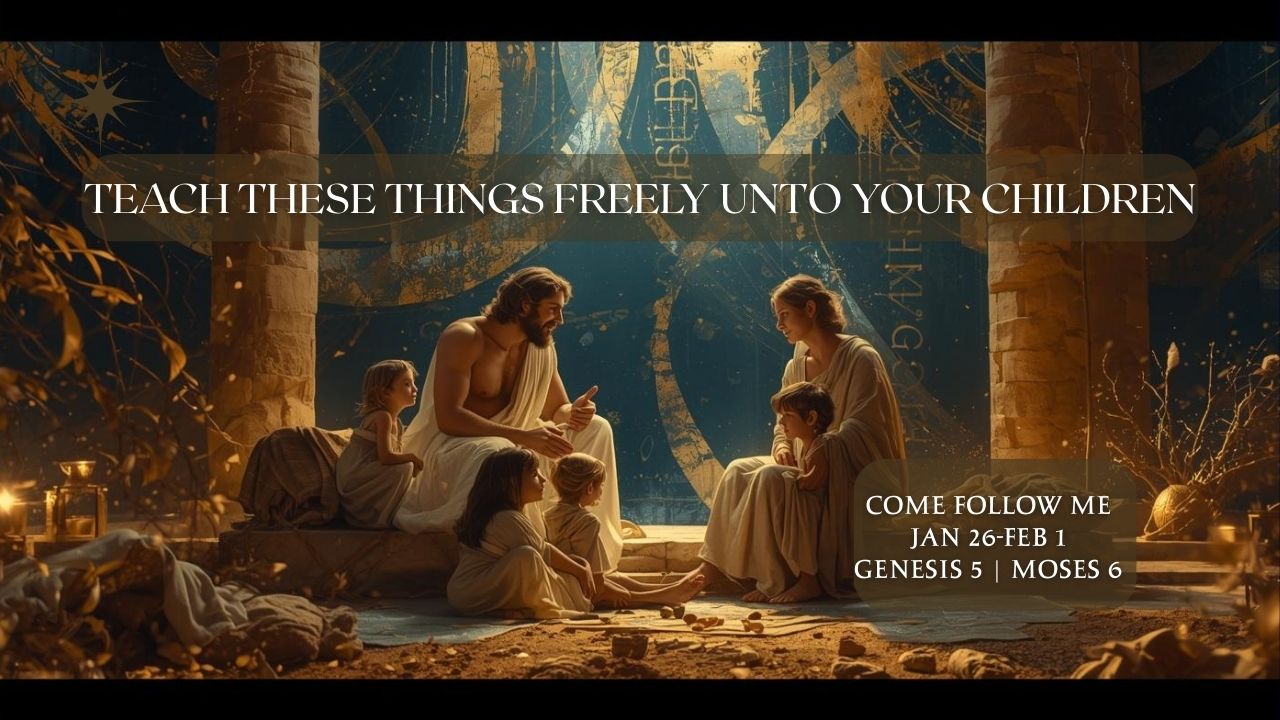
CFM - Jan 26 - Feb 1 | Genesis 5; Moses 6: "Teach These Things Freely unto Your Children"

CFM - Jan 26 - Feb 1 | Genesis 5; Moses 6: "Teach These Things Freely unto Your Children"

Many of us most likely assume the gospel began in the New Testament. Yet Genesis 5 and Moses 6 reveal something astonishing: the fullness of the gospel—faith in Christ, repentance, baptism, the Holy Ghost, priesthood, and covenant discipleship—was taught from the very beginning. These chapters unveil a sweeping narrative of divine instruction, generational faithfulness, and the sacred responsibility to teach truth to rising generations.

For many of us, navigating a morally chaotic world can be incredibly challenging. In these turbulent times, these chapters offer a profound blueprint for spiritual resilience. The teachings found within Genesis and Moses not only provide guidance but also serve as a reminder that the principles of the gospel are timeless. They anchor us in our faith and help us to cultivate a sense of moral clarity amid confusion and chaos. For those in recovery, these scriptures reveal the ancient pattern of redemption, rebirth, and transformation through Christ, showcasing how individuals have consistently turned to God for restoration and new beginnings.

This study for the Come Follow Me - Old Testament invites us to delve deeply into the genealogies, doctrines, and prophetic ministries of pivotal figures like Adam, Seth, and Enoch, along with their descendants. It illuminates the remarkable legacy of faith that was passed down through generations. The narratives of these early prophets illustrate how their teachings and life experiences reflect Christ’s redemptive work. They emphasize the importance of our covenantal responsibility to “teach these things freely unto your children” (Moses 6:58), urging us to carry forward the torch of faith and truth to future generations.

As we engage with these ancient texts, we not only gain insights into the foundations of our beliefs but also discover the imperative to be proactive stewards of spiritual knowledge. In doing so, we can empower those around us to withstand the pressures of the world, fostering a community that thrives on the principles of the gospel. By sharing the stories and teachings of our ancestors, we reaffirm the enduring relevance of their faith and the everlasting hope that can be found in Christ.