There is an endless stream of criticism against the beliefs, traditions, and views of the Latter-day Saint Christian Faith. These criticisms consistently surface and always lack a fair or informed understanding of what the Restored Gospel actually teaches. Glenn E. Chatfield's recent post, titled "God Had a Father God?" is one such example. And it is not the first time this topic has been brought to my attention - I've already addressed a similar criticism presented by Life After Ministry - where there is a clear misconception. Chatfield merely offered his thoughts and linked to Life After Ministry blog post. Chatfield also claims that he refutes the LDS on his blog using nothing more than LDS teachings and scriptures. This is not what is in dispute. What is questionable is how he is using LDS Teachings and Scriptures in a way that presents the teachings and doctrines of the Latter-day Saint faith in a false manner. This is accomplished by cherry-picking quotes and scriptures, building strawman arguments, deflection, and even engaging in ad hominem against past and present leaders. Not only that, but critics also tend to project and insult any who may be a Latter-day Saint and attempt to engage in discussion with them. Take for example Chatfield's recent comment to an anonymous commentator:
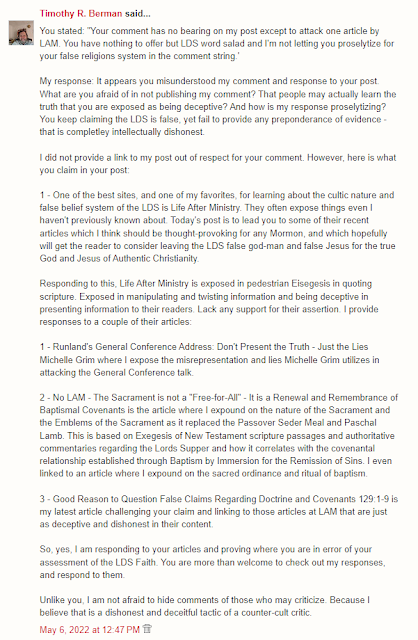
One of Chatfield's posts, dated May 5, 2022, titled Good Stuff to Peruse, I engaged in a discussion with him regarding this issue. Here is his response:
What was he responding too? Here is my comment. The point of this is that the individual guilty of any ad hominem is Glen E. Chatfield. Here are some of the personal insults he has used to attack anyone willing to step up to correct any misinformation and refute any erroneous information that is deceptive and manipulative. - He is a cult member defending false teachings: It is inflammatory and outright slanderous
- LDS is a demonic and false system: Arbitrarily dismissing any Latter-day Saint and calling them demonic and false.
- LDS Apologists merely cause confusion: Again, further dismissal of any rational discussion.
- Joseph Smith a lying and false Prophet: insulting and attacking Joseph Smith without evidence and rational thought.
The observable attitude and behavior of critics like Chatfield also show that they are entrenched in such toxic apologetics where they do not hold themselves to the same expected standards of respect that is imposed on others. Meaning, they flippantly call people out for perceived personal insults when they are themselves the one doing the insulting and personal attacks. This is called projection. Critics attempt to push their own insecure and inadequacies upon others and then blame them for the exact behavior they are observed in doing.
The particular criticism that centers around the Latter-day Saint belief of God's nature and the idea God may have had a Father is misconstrued. First, it is oversimplified and framed in a way that does sound quite absurd. On this point - Chatfield is correct. Only correct in the sense that he is manipulating and regurgitating previous information in a way that does sound absurd. Second, it speaks to the nature of how critics, and those who are apostates, are merely lazy learners because often times they do not put forth any effort, energy, and time to honestly engage with the theological nuances of the LDS Faith. Critics often have a rally cry of superiority. "I was a member, I know what I am talking about" or a list of callings and positions of some low hanging fruit of authority. It does not amount to a hill of beans - what matters is whether they are willing to consider the possibility that they may very well be wrong. Sadly, Chatfield, like most critics in my experience of various discussions over the decades of apologetics, is staunch in that they are 100% Correct and use LDS Teachings and scriptures to prove how wrong the LDS Faith is. It is strutting around like a peacock and pontificating intelligence when in reality they are peddling wares of lies and deceptions. Causing confusion and faith crisis and essentially lying in wait to deceive (Ephesians 4:14-15).
Therefore, my aim is to respond to Glenn E. Chatfield (as I know he won't allow me to publish a comment on his post because has articulated how he does not want his audience to be "confused" or "deceived"). It also will shed light on what has already been established addressed regarding the claim is deemed quite absurd.
Rebuttal to Glenn E. Chatfield's Post: God Had a Father God?"
Chatfield's post, that is under scrutiny and examination here, reflects several common misconceptions about LDS teaching, doctrine, and faith. Granted, it is important to take the time to have a cohesive and rational discussion where there are theological differences. However, it is Chatfield's observable attitude and behavior regarding the tone, arguments, and presentation that call into question his credibility and undermine his assertions. He relies heavily on logical fallacies (as well as Life After Ministries). And when he engages in any discussion, it is observed to come from a condescending attitude that lacks empathy, compassion, and genuine engagement. Quite uninviting. He does little to foster any meaningful conversation. Nor does he accurate represent what Latter-day Saints actually believe in - no matter how often he may claim that he is merely quoting LDS teaching, leaders, and scriptures.
Chatfield's presenting argument relies on the following fallacies:
1. Straw Man Fallacy: By grossly misrepresenting LDS teaching and beliefs about God's nature, through oversimplification and caricaturing the LDS beliefs, Chatfield reduces the idea of God having a Father to a mere crude notion of an endless chain of God's (infinite regression idea and teaching interpreted by numerous counter-cult ministries and apostates over the years).
2. False Equivalence: Chatfield claims that the LDS God is "nothing like the God of the Bible". By this reasoning, he is implying that because our understanding differs from creedal Christian belief - it is deemed unbiblical and indefensible. This argument fails in acknowledging how LDS theology is deeply rooted in scripture. This includes teachings about divine parentage (e.g., Hebrews 12:9, which refers to God as the Fathers of spirits). Furthermore, Latter-day saints affirm the divine and omnipotent and eternal nature of God. Aligning closely to the Biblical foundation - even if additional revealed truths expand upon these ideas.
3. Appeal to Ridicule: Employing trigger phrases, like "this is one of those absurd doctrines" are not theological or rational arguments. They are rhetorical mechanisms designed to arbitrarily dismiss LDS beliefs outright. Such hostile and passive aggressive language comes across as arrogant, condescending, and prideful. As such, it discourages any productive and rational discussions. It also reveals a lack of respect for differing perspectives.
4. Circular Reasoning: Chatfield, assuming that the creedal Christian perspective and worldview of God is the only valid interpretation, uses it as the standard by which LDS doctrine and teaching is measured. Doing so, he disregards the plausibility that LDS Teachings offer greater insights due to restored truths that were once lost or obscured.
Addressing the Tone of Condescension and Arrogance
Chatfield’s tone is unnecessarily condescending, as evidenced by statements like “And LDS claims they are Christian?!?!” Such rhetorical flourishes reveal an underlying assumption that his interpretation of Christianity is definitive, leaving no room for differing perspectives. This attitude not only alienates Latter-day Saints but also undermines his credibility as someone seeking genuine theological engagement.
Respectful dialogue should aim to understand the beliefs of others rather than mock them. Latter-day Saints unequivocally affirm Jesus Christ as the Son of God, the Savior of the world, and the central figure in God’s eternal plan. Questioning our Christian identity without careful consideration of our faith’s Christ-centered foundation comes across as dismissive rather than constructive.
The LDS Perspective on the Godhead: Monarchial Monotheism
When properly examined, Latter-day Saint theology reflects a monarchial monotheistic view of the Godhead, distinct yet compatible with biblical principles. This perspective acknowledges one God—God the Father—who reigns supreme, with His Son, Jesus Christ, and the Holy Ghost united in purpose and divinity.
The doctrine of divine parentage and eternal progression, as cited by Orson Pratt in The Seer (p. 132), does not detract from the supremacy of God the Father but rather emphasizes His role as the ultimate source of life and creation. The idea that we are “begotten by our Father in Heaven” and that He, in turn, was begotten by a Father aligns with the biblical notion of God as the “Father of spirits” (Hebrews 12:9) and the principle that “as man is, God once was; as God is, man may become” (Lorenzo Snow). This understanding highlights the eternal nature of God’s work and glory: to bring to pass the immortality and eternal life of His children (Moses 1:39).
Far from being a “chain of gods” that diminishes God’s majesty, this doctrine expands our understanding of His eternal nature and His love for us as His children. It underscores the biblical truth that we are created in His image (Genesis 1:27) and invites us to strive for spiritual growth and eventual exaltation through the grace of Jesus Christ.
Conclusion
Glenn E. Chatfield’s critique reflects a misunderstanding of Latter-day Saint theology and relies on logical fallacies, misrepresentation, and dismissive rhetoric. In contrast, LDS doctrine offers a profound and biblically grounded understanding of God’s nature, the Godhead, and our divine potential as His children.
Rather than dismissing LDS beliefs as “absurd,” I invite critics like Chatfield to engage in sincere study and dialogue. By doing so, we can move beyond condescension and ridicule and work toward mutual understanding, even in the face of theological differences.