
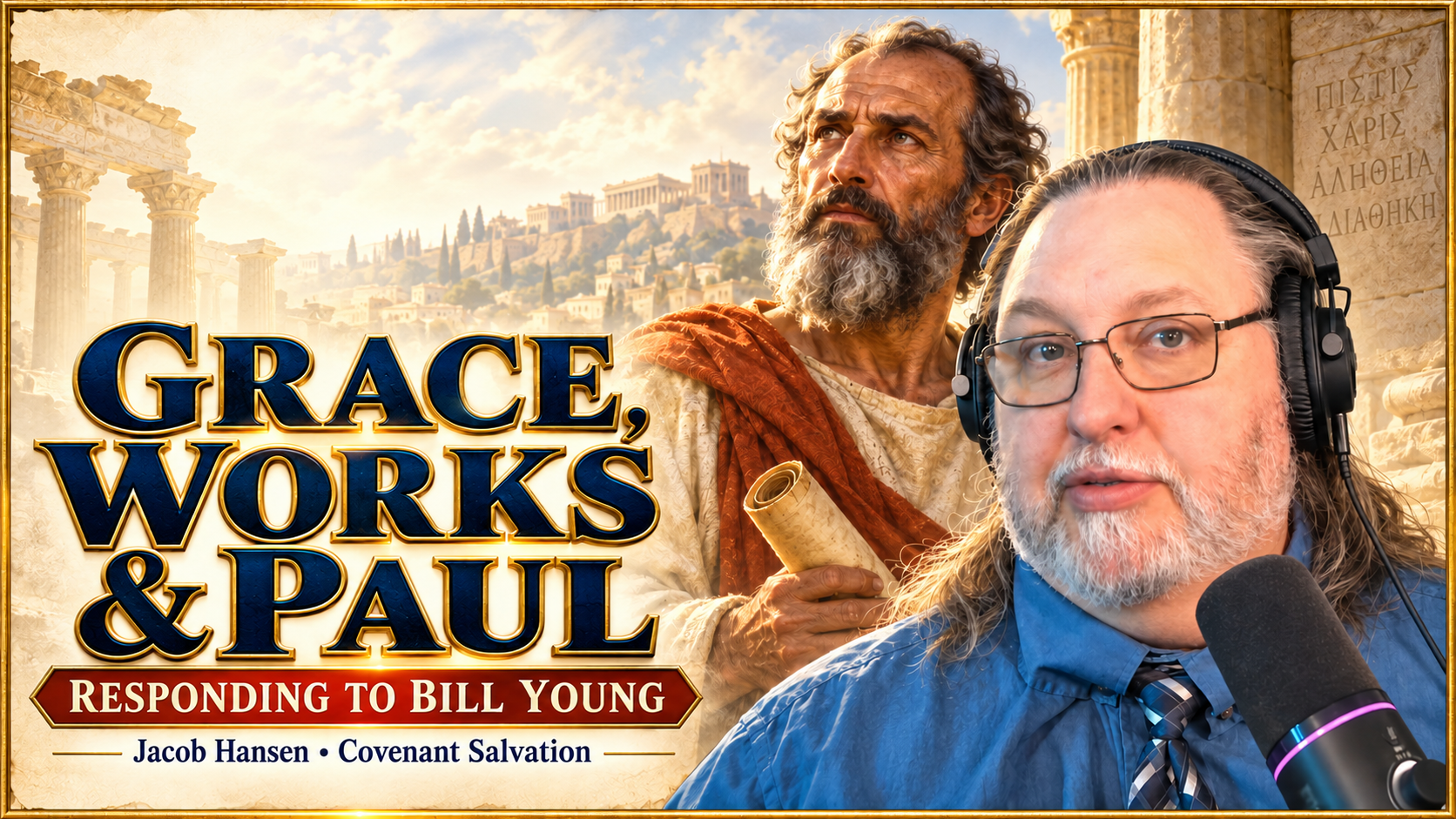
Does obedience turn the gift of salvation into a wage? That is the question beneath Bill Young’s response to Jacob Hansen—and it deserves a better answer than either “Mormonism is counterfeit” or “modern scholarship proves us right.” A Christian can affirm that Christ alone makes salvation possible while still believing that repentance, faithfulness, and a transformed life matter. The dispute begins when we ask how they matter: as payment, as conditions of receiving a gift, as evidence of living faith, or as the life that grace itself creates.
In Episode 104, Young argues that Hansen’s covenant model gives familiar LDS requirements a more attractive vocabulary without changing their function. That objection has force against any explanation that merely renames achievement as relationship. But Young’s broader conclusion—that necessary covenant obedience must therefore amount to earning salvation—requires an additional argument. Neither the presence of conditions nor the fact that human beings actually act establishes that their actions purchase God’s forgiveness.
This response approaches the debate from a Latter-day Saint perspective while taking Protestant objections seriously. It examines the supplied transcript and comment-section record alongside Pauline scholarship, Jewish historical scholarship, LDS sources, and evangelical biblical commentaries. Some of the evidence supports Young’s criticisms of oversimplified apologetics; other evidence directly challenges his portrayal of LDS grace and the scholarly alternatives he dismisses. The purpose is to identify which claims survive careful examination and to hold our treatment of other people to the Christian standard we invoke.
In this response
- Young’s strongest objection
- Paul, Judaism, and covenant
- Grace, necessary works, and merit
- “After all we can do”
- What LDS leaders have taught
- Comments and logical fallacies
- The Christian standard
- Frequently asked questions
- Sources and further reading
What this response examines
The principal source is Young’s “Response to Jacob Hansen’s Covenant Model of Salvation”, identified as Episode 104 in the supplied materials. Quotations below follow the supplied transcript, with punctuation lightly normalized where needed; timestamps identify the relevant passages. The opening Hansen clip is presented within Young’s episode, so this article evaluates the argument as represented there rather than claiming to review every statement Hansen has made elsewhere.
Comment quotations come from the supplied document titled EP 104: Response to Jacob Hansen’s Covenantal Salvation Comment section. Usernames and document paragraph numbers identify excerpts where individual comment permalinks were not supplied. These are selected examples, not a statistical description of the entire audience. The record also contains substantive biblical arguments and objections to mockery. A commenter’s statement is attributed to that account; it is not automatically treated as Young’s own position.
1. Steelmanning Bill Young: the strongest objection deserves an answer
Young’s central objection appears most clearly at approximately 38:25–39:47. He argues that if obedience and ordinances remain necessary for a final saving verdict, introducing covenant language has not removed works from the system. His conclusion is that “calling this staying in the covenant thing instead of earning salvation does not eliminate the theological problem of working for your salvation.” That is a serious challenge to explain the actual relationship between grace and obedience, rather than assuming that the word covenant settles it. Transcript, 38:25–39:47.
The strongest Protestant version of this objection distinguishes the ground of justification from the fruit of regeneration. On that account, Christ’s saving work alone grounds the verdict, faith receives Christ, and good works follow as the evidence of genuine faith. If an LDS explanation makes a person’s moral performance an additional basis of acceptance before God, the Protestant critic has identified a substantive disagreement. An adequate response must explain why required obedience does not become an independent contribution that completes an otherwise insufficient atonement.
Young also raises legitimate questions about history and institutional authority. A recent explanation by a persuasive LDS creator does not erase earlier teaching, and an individual scholar’s interpretation does not automatically become the Church’s official position. Similarly, discovering that Paul addresses Jewish and Gentile relations does not make his teaching about sin, judgment, forgiveness, and righteousness disappear. These are fair constraints on LDS apologetics, and the response below accepts them.
What does not follow is that every conditional account of salvation is an account of earned salvation, that covenant membership and forgiveness are mutually exclusive, or that reinterpretation necessarily proves deception. Those are separate propositions. They must be established from the relevant texts and arguments rather than smuggled into a definition of works salvation that already excludes the position being examined.
2. Covenantal nomism and the New Perspective on Paul are not interchangeable
Three questions frequently get collapsed in this debate: What patterns characterized ancient Jewish religion? What was Paul arguing against? And how should Christians describe salvation today? E. P. Sanders’s category of covenantal nomism addresses the first question: broadly, divine election establishes the covenant relationship, while obedience, repentance, and atonement belong within that relationship. The New Perspective on Paul concerns a family of reassessments of Paul that drew partly on that historical revision. It is not simply another name for Sanders’s description of Judaism.
James D. G. Dunn’s foundational essay illustrates the distinction. Dunn welcomes Sanders’s challenge to the portrayal of Judaism as a religion of self-earned salvation yet criticizes aspects of Sanders’s account of Paul. Dunn then places the confrontation in Galatians within the dispute over Jewish and Gentile table fellowship and the social function of law observance. The scholars were engaged in an argument with one another, not announcing a single finished theory. Dunn, “The New Perspective on Paul,” §§I–II.
This matters in both directions. Young cannot refute every covenant reading merely by showing that one formulation of Sanders or Dunn is inadequate. Latter-day Saints cannot claim that invoking Sanders, Dunn, or N. T. Wright establishes the entire LDS account of ordinances, priesthood, exaltation, or continuing revelation. Historical scholarship can challenge a premise in an argument against LDS theology without independently proving LDS theology. That narrower claim is both more modest and more defensible.
Nor is an LDS interest in grace and covenant a sudden invention of Hansen’s generation. Blake T. Ostler discussed Paul, grace, covenant relationship, and continuing fidelity in a 1990 Dialogue article. His treatment also criticized reductive LDS portrayals of traditional Christian grace. One need not accept every historical judgment in that essay to recognize an established LDS conversation rather than a newly coordinated vocabulary campaign. Ostler, “The Concept of Grace in Christian Thought,” pp. 13–17.
3. Jewish scholarship challenges a caricature without eliminating diversity
Young is right to resist the claim that every ancient Jewish source fits one harmonious pattern. The corresponding LDS mistake would be to turn “Judaism was not simply legalistic” into “no Jewish text ever connected obedience with final judgment.” Those statements are very different. Grace, election, repentance, judgment, and obedience can coexist within a religious tradition, and their relationship can vary across authors, communities, and periods.
Jewish scholar Adele Reinhartz explains the significance of Sanders’s intervention in its twentieth-century setting: it challenged the use of Judaism as Christianity’s negative foil and recovered the importance of covenant, repentance, atonement, and forgiveness in Jewish religious life. That historical correction matters even where later scholars revise Sanders. It makes a sweeping opposition between gracious Christianity and graceless Judaism an inadequate starting point. Reinhartz, “Paul and Palestinian Judaism in 20th Century Context”.
A critic of the New Perspective can accept that correction while pressing harder on judgment. Simon Gathercole’s Where Is Boasting? argues for the importance of obedience in early Jewish expectations of final vindication and relates that issue to Paul’s challenge to human confidence. The publisher’s synopsis explicitly distinguishes this from simply reviving a crude legalistic stereotype. His work therefore strengthens Young’s objection to an overly tidy historical model without establishing that any role for obedience necessarily excludes grace. Gathercole, Where Is Boasting?, publisher’s description.
Jewish approaches to Paul also extend beyond the older New Perspective debate. Mark D. Nanos’s “Paul within Judaism” research emphasizes Paul’s Jewish identity and the particular situation of his non-Jewish addressees; it should be recognized as a contested scholarly approach, not presented as unanimous agreement. Paula Fredriksen likewise situates Paul’s mission within a Jewish, apocalyptic expectation of God’s action among the nations. These perspectives remind Christian interpreters to investigate Paul’s historical world before treating him as a direct participant in much later denominational disputes. Nanos, research interview; Fredriksen, Paul: The Pagans’ Apostle, publisher’s description.
The defensible conclusion is therefore specific: ancient Judaism cannot responsibly be reduced to people trying to buy heaven through flawless rule keeping, and covenant language does not automatically settle Paul’s theology. Both cautions are necessary. Neither gives Christians permission to use Judaism as a rhetorical prop in an argument about which modern denomination has understood grace.
4. Paul’s justification language can be judicial and covenantal
One recurring problem in the episode is the pressure to choose between an individual’s right standing before God and membership in God’s covenant people. Young correctly insists that justification concerns guilt and divine judgment. But showing that justification has a judicial dimension does not demonstrate that its covenantal dimension is irrelevant. A verdict can concern both a person’s standing and that person’s inclusion among the people whom God vindicates.
Wright explicitly combines the two. In “The Shape of Justification,” he treats justification as God’s judicial declaration and connects that declaration with the family promised to Abraham. He also distinguishes justification from the transformation of a person’s character. His account does not replace forgiveness with mere group identification: he writes, “Membership in this family cannot be played off against forgiveness of sins. The two belong together.” Whether one agrees with Wright’s full interpretation or not, it is inaccurate to refute him as though he simply discarded the courtroom. Wright, §§2 and 4.
Paul’s argument itself supplies a reason to keep these concerns together. Romans 3 moves from universal sin and justification to the question of whether God is God of Jews only or also of Gentiles. Romans 4 then develops Abraham’s fatherhood in relation to faith, circumcision, and the promise. The social and covenantal questions are embedded in the discussion of righteousness; they are not an unrelated topic imposed on it. Conversely, the presence of Abraham and Gentile inclusion does not make the reality of sin disappear.
The evangelical commentator G. Walter Hansen—not Jacob Hansen—similarly treats identification as Abraham’s children as a central concern in Galatians 3:7. His exposition connects that identity with faith in Christ rather than ethnic qualification. This is useful evidence that attention to covenant family is not a peculiarly LDS strategy. It is also not evidence that this commentator accepts LDS theology. G. Walter Hansen, Galatians, “Identified as Children of Abraham”.
The logical error to avoid is a false dilemma: either justification is judicial or it concerns covenant belonging. The real exegetical debate asks how those dimensions relate, which texts establish that relationship, and what conclusions follow. LDS defenders should be equally careful not to turn “covenantal” into a universal lexical definition that overrides the context of every occurrence of righteousness language.
5. Necessary obedience does not automatically mean meritorious payment
Young’s strongest argument becomes weaker, when necessary, condition silently changes into earning. The terms answer different questions. A condition specifies something required in a relationship or process. Merit concerns a claim to reward on the basis of worth or achievement. Evidence indicates that something is present. A means describes how something is received or accomplished. Calling all four “works” does not establish that they function identically in a doctrine of salvation.
A simple analogy clarifies the logical distinction without proving a theology. Accepting a freely offered reconciliation may be necessary to participate in the restored relationship, but acceptance does not purchase the other person’s forgiveness. Whether repentance, baptism, or perseverance functions comparably in Christian salvation must be argued from scripture. The analogy establishes only that conditionality and payment are not equivalent by definition. Young still needs the premise that the particular LDS condition functions as merit or as an unacceptable basis of the verdict.
John M. G. Barclay’s research on grace is relevant because it examines the assumptions people bring to the language of gifts. The publisher’s account of Paul and the Power of Grace emphasizes that Paul’s grace is given without regard to recipients’ prior worthwhile still creating consequential obligations and transformed relationships. An unearned gift need not be a gift that leaves the recipient’s life unchanged. This distinction illuminates the debate; it does not establish the legitimacy of every LDS requirement. Barclay, Paul and the Power of Grace, publisher’s introduction.
Ephesians 2:8–10 likewise refuses to separate the gift of salvation from its intended result. Salvation is by grace through faith, not a basis for boasting, and believers are created in Christ for good works. A Latter-day Saint should not use verse 10 to cancel verses 8–9. A Protestant should not use verses 8–9 to make verse 10 incidental. The text distinguishes works as a basis for boasting from the good works associated with new creation; the interpretive task is to preserve that distinction.
Young makes another fair observation when he notes that the money used for tithing comes from a member’s bank account, not from Jesus’s bank account. It is imprecise to say that a believer’s actions cease to be the believer’s actions simply because Christ commands them. But that correction does not prove that divine enabling and human action are mutually exclusive. Philippians 2:12–13 places human responsibility alongside God’s work in the person’s willing and doing. Grace-enabled agency remains real agency; identifying the human actor does not identify the ultimate source of saving power. Transcript, 38:57–39:30.
6. A scholar Young cites complicates his absolute language about works
At approximately 15:25–15:40, Young describes salvation as “by grace through faith and without any works,” adding, “Not to be saved and not to stay saved and not to show your loyalty or allegiance of fidelity to your salvation.” Read in its strongest charitable sense, this may be an emphatic rejection of works as the ground of salvation. Taken at its full verbal breadth, however, it also excludes a necessary evidential or persevering role for works. That broader claim is disputed within Protestant theology itself. Transcript, 15:25–15:40.
Thomas R. Schreiner, one of the scholars Young invokes later in the episode, opens his essay “Justification by Works and Sola Fide” by affirming that “works are necessary for justification and salvation.” He then carefully argues that works do not constitute the basis of salvation: Christ’s atoning work does. Good works arise through the Spirit and evidence genuine faith. His account therefore preserves justification by faith alone while assigning works a necessary role. The distinction is central to the essay, especially its discussion on pages 52–55. Schreiner, Southern Baptist Journal of Theology 19.4 (2015), pp. 39–58.
This is not an attempt to recruit Schreiner as an LDS apologist. His explanation differs materially from LDS accounts, and his defense of sola fide should not be concealed. The point is logical: a Protestant scholar can affirm a necessary relationship between works and salvation while denying that works earn salvation. Consequently, Young cannot establish the LDS position’s error merely by identifying the word necessary. He must explain why the LDS relationship between obedience and salvation differs in the relevant respect from the relationship his own cited Protestant scholarship permits.
That is where a fruitful debate belongs. Are LDS ordinances understood as divinely appointed reception of grace, as an additional ground of justification, or differently in different sources? Does perseverance describe living faith, a condition of continuing relationship, or meritorious achievement? Which of these differences is actually condemned by the Pauline text under discussion? Those questions expose the disagreement more accurately than treating every account of obedience as the same theological system.
7. Paul’s warnings and James’s argument still require interpretation
The biblical difficulty is not resolved by quoting Ephesians 2:8–9 and ending the discussion. Romans 2:6–13 describes judgment according to deeds; Romans 8:13 connects life with putting sinful practices to death through the Spirit; Galatians 6:7–9 connects sowing to the Spirit, eternal life, and not giving up. Second Corinthians 5:10 also places human conduct within the horizon of judgment. These passages must be interpreted alongside Paul’s emphatic rejection of boasting and self-established righteousness.
Christians disagree about how the passages fit together. Some accounts emphasize the evidential character of works, others the conditional character of perseverance, and others distinctions among judgment, reward, justification, and final salvation. A list of warning passages does not, by itself, prove the entire LDS model. It does show why an unqualified claim that conduct has no necessary relationship to final salvation is not simply the uncontested reading of Paul. The distinction between the ground of salvation and the life of the saved remains indispensable.
James 2 supplies a related challenge, but it should not become an isolated counter-slogan. LDS scholar Mark D. Ellison examines how Paul and James address different argumentative situations even when they employ overlapping language about Abraham, faith, and works. George M. Stulac’s evangelical commentary likewise reads Abraham’s action in James 2 in relation to the working and maturation of his faith, rather than assuming Abraham first became accepted by God only when he offered Isaac. Both treatments require attention to Genesis 15 and Genesis 22 and to the respective authors’ purposes. Ellison, “Paul and James on Faith and Works”; Stulac, James, “Abraham”.
A responsible LDS response therefore affirms that dead faith is not the goal of the gospel while refusing to caricature Protestant faith alone as permission to sin. A responsible Protestant response explains how living faith, obedience, and judgment relate without presuming that every LDS use of those terms expresses an attempt to pay for redemption. The disagreement is substantial enough to deserve precision from both sides.
8. Covenant cannot be dismissed by counting one word
Young observes that Paul refers to covenant only eight times that he can find in his letters. Even if one accepts a particular count, a word-frequency observation cannot settle the importance of a concept. Theological themes can operate through related language, narrative, quotation, and allusion. Abraham, promise, inheritance, adoption, and the olive-tree discussion in Romans 11 all require interpretation whether or not the noun covenant appears in every passage. Transcript, approximately 17:25.
This does not license an interpreter to insert a covenant scheme into every verse. The correction is methodological: demonstrate the theme through the argument of a passage, rather than either assuming it or dismissing it by a count. In Romans 4 and Galatians 3, the promise to Abraham is explicit. That is a stronger starting point than an assertion that Paul either uses a later technical phrase or cannot have had a corresponding concern.
The discussion of baptism needs the same care. Young says circumcision and baptism are not biblical cognates at approximately 11:13–11:20. If he means that they are not identical institutions with identical functions, that is reasonable. If he means there is no significant biblical relationship to discuss, Colossians 2:11–13 is an obvious obstacle: circumcision imagery, burial with Christ in baptism, faith, and divine action appear together. Romans 6 and Galatians 3:26–29 also connect baptism with participation in Christ. These texts warrant an argument about the relationship; they do not independently validate every later LDS ordinance. Transcript, 11:13–11:20.
9. What does “after all we can do” mean in 2 Nephi 25:23?
Young says that historical Mormonism has “always understood” 2 Nephi 25:23 to mean that people first do everything they can and then Jesus fills the remaining gap. That describes an interpretation many people recognize, but the word always makes a much larger historical claim. Before resolving that claim, the textual issue deserves attention: the phrase occurs within Nephi’s effort to persuade his audience to believe in Christ and be reconciled to God. Transcript, 42:36–43:23.
The immediately following verses complicate a simple sequence of independent human achievement followed by divine assistance. Nephi’s people continue observing the law of Moses because it is commanded, yet he distinguishes that observance from being made alive in Christ through faith. He directs their children to Christ for remission of sins and explains the law’s limited role. A reading of verse 23 must account for those affirmations rather than extracting its final phrase as a complete theology of grace. 2 Nephi 25:23–27.
Jared W. Ludlow offers a detailed literary argument that the first-person plural and the surrounding discussion locate the passage within Nephi’s people’s situation before Christ’s fulfillment of the law of Moses. On that reading, the temporal issue concerns the history of salvation, rather than a universal requirement that individuals exhaust every possible good deed before grace becomes active. This is an argued interpretation, not a settled dictionary rule that after always means despite. Ludlow, “‘After All We Can Do’ (2 Nephi 25:23),” especially the discussion of verses 23–27 and the summary.
Young is entitled to reject that reading, but rejecting it requires engaging the grammar, audience, and surrounding argument. Calling a contextual interpretation “repackaging” identifies a suspicion about its origin; it does not answer its evidence. Conversely, LDS defenders should acknowledge that a persuasive reading of Nephi does not erase later interpretations that shaped actual members’ experiences. Textual meaning and reception history are related questions, but they are not the same question.
10. Have LDS leaders taught that salvation cannot be earned?
In the supplied comment record, @TruthToMormons asks an interlocutor to “please provide even one LDS general authority that has laid out the case you just made.” That request can be legitimate. If someone claims to describe official Church teaching, institutional sources matter. But it is necessary to specify what is being requested: a General Authority’s endorsement of a particular Pauline theory, or a General Authority’s rejection of earned salvation? The latter is directly documented. [Comment record, ¶306.]
In October 1988, Dallin H. Oaks acknowledged that members’ emphasis on commandments could create a misleading impression about how salvation is obtained. He stated, “Man cannot earn his own salvation,” while maintaining the importance of obedience and Christ’s atonement. That combination is important: the talk cannot honestly be reduced either to earned salvation or to a denial that commandments matter. It also predates the current YouTube debate by decades. Oaks, “What Think Ye of Christ?”.
In April 2015, Dieter F. Uchtdorf, then a counselor in the First Presidency, stated: “Salvation cannot be bought with the currency of obedience; it is purchased by the blood of the Son of God.” He also rejected an interpretation in which grace waits until human effort has been exhausted. This directly challenges the claim that grace-first LDS explanations lack support in senior Church teaching. It does not amount to an endorsement of every exegetical detail in Hansen’s presentation. Uchtdorf, “The Gift of Grace”.
An honest account must also acknowledge the harder formulations. The 2018 Book of Mormon Student Manual reproduces language from the Bible Dictionary that “grace cannot suffice without total effort on the part of the recipient.” That language helps explain why some members experienced grace as contingent on an exhausting standard of performance. The same discussion also describes grace as enabling power. It deserves contextual analysis, not denial that the demanding wording exists. Book of Mormon Student Manual, chapter 12, discussion of 2 Nephi 25:23.
The defensible historical conclusion is that LDS teaching contains both strong demands for obedience and explicit denials that salvation can be earned. A fuller reception history would investigate how those emphases have interacted across time and settings. Young’s experience can be genuine without exhausting that history, and a contemporary Latter-day Saint’s understanding can be sincere without representing every earlier presentation. Neither person’s memory is a substitute for examining the sources.
11. Moroni 10 and Doctrine and Covenants 82 need their full context
Young appeals to the requirement to deny ungodliness in Moroni 10:32 as an impossible preliminary hurdle. Yet the passage also places perfection in Christ and attributes it to grace, while the following verse describes sanctification through Christ’s blood. The text does not portray the Savior merely congratulating people who independently became perfect before approaching him. It summons a real turning to Christ and makes his power essential to the result. Moroni 10:32–33.
There remains a legitimate disagreement about the conditional form of the passage. A critic can ask whether this account of response coheres with a particular Protestant account of justification. But the requirement to turn away from ungodliness is not identical to the claim that a person independently achieves perfection before receiving grace. Conflating those claims creates the very problem that the passage’s reference to divine power addresses.
Doctrine and Covenants 82:7 is a more difficult text and should not be softened into a harmless slogan. It warns that former sins return when a person sins again. Young then draws the further conclusion that repeated sin means the person never really repented and that the LDS Jesus never truly forgives. The warning itself does not explicitly state that every prior repentance was fraudulent or that forgiveness never occurred. Doctrine and Covenants 82:7; transcript, 43:41–44:03.
Any LDS account must interpret that warning alongside Doctrine and Covenants 58:42–43, which affirms forgiveness and describes confession and forsaking, and Mosiah 26:30, which directs repeated forgiveness when people repent sincerely. Those passages prevent a responsible summary from becoming “Christ never forgives anyone who later sins.” They do not eliminate the seriousness of repentance or settle every question about falling away. They establish that the canon contains a real promise of forgiveness as well as real warnings. Doctrine and Covenants 58:42–43; Mosiah 26:30.
12. “Teddy bear Jesus” does not refute LDS teaching about judgment
At approximately 13:20–13:28, Young uses the phrase “their teddy bear Jesus.” Later he says that in Mormonism “you never hear the bad news.” Those are sweeping descriptions, not careful distinctions among LDS and Protestant accounts of judgment, hell, resurrection, and final destiny. They make the LDS position easier to dismiss by presenting its Savior as indulgent and its gospel as lacking a serious diagnosis of sin. Transcript, 13:20–13:28; 42:08–42:22.
The Book of Mormon supplies direct counterexamples to the generalization. Second Nephi 9 discusses death, hell, judgment, and deliverance through the Holy One of Israel. Mosiah 3 presents dependence on Christ’s atonement and the need for transformation. Alma 42 wrestles with justice, mercy, repentance, and accountability. One can reject the authority of these texts or dispute their theology; one cannot accurately summarize their message as an absence of bad news about humanity’s condition.
That correction does not erase major differences concerning the Godhead, the scope of salvation, or exaltation. A serious Protestant critique can state those differences explicitly and argue from scripture. Likewise, an LDS response should not assume that using the name Jesus resolves every disagreement about his identity. The narrower refutation is sufficient here: a mocking description of an allegedly consequence-free Savior does not accurately represent a tradition whose scripture repeatedly teaches judgment and the necessity of redemption.
13. When rhetoric replaces argument: what the comment section shows
The episode’s opening frame matters. Young tells viewers that this is an idea they “had better understand” and warns about being “bamboozled by articulate LDS.” A warning about misleading arguments can be warranted, but the audience still needs an independently testable demonstration of what is false. When a speaker’s fluency itself becomes a reason to distrust that speaker, the warning can pre-empt consideration of the evidence. That is the risk of poisoning the well: discrediting a source in advance rather than answering the source’s case. Transcript, 2:44–3:12.
The supplied comment record contains a blunt example. @brenden.whitney asks, “does Jacob ever not spew complete BS” (¶21). As a stand-alone response, this is abuse rather than a rebuttal: it identifies neither a false premise nor an invalid inference. It becomes an ad hominem substitute when the audience is invited to reject Hansen’s argument because of the contempt directed at Hansen. If a substantive argument appears elsewhere, that argument must still be assessed on its own merits; the insult neither establishes nor disproves it.
Another commenter, @jamesgore3846, writes, “He is deceived by this so-called new take on Paul. It is as phony as Mormonism” (¶3). The surrounding comment also invokes Ephesians 2 and Isaiah 43, which are genuine texts worth discussing. Yet calling the interpretation phony by association with a religion already deemed phony supplies no independent reason to reject it. The task remains to show where the interpretation fails, rather than asking the reader to transfer a prior negative judgment to a new argument.
@Motorman72 writes, “Your counterfeit religion and Godhead isn’t YHWH God Most High of the Bible and thus can be mocked” (¶318; excerpt). Here the problem is an additional moral inference: even if the theological criticism were established, permission to mock does not follow automatically. One needs a separate account of why that conduct is justified, particularly when Christian speech is the stated standard. Disagreement with a doctrine and contempt for those associated with it are not interchangeable conclusions.
The record also illustrates inconsistency in applying that standard. After criticizing bullying and vitriol, @karenl7791 writes, “I would rather be known as a ‘creedal Christian’ than a Mesmerized Mormon” (¶¶612–613; quotation marks normalized). That comparison undercuts the appeal for respectful argument. Fairness requires noting that an earlier comment from the same account expressly distinguished LDS members from apologetic tactics (¶9). The criticism here concerns the specific mocking phrase, not a claim that every statement by that commenter targets all Latter-day Saints.
The thread includes substantive exchanges over biblical monotheism and other passages, including contributions from @BundokCowboy, as well as LDS replies challenging Young’s reading. Those contributions matter. Selected insulting comments cannot prove that an entire audience is incapable of reasoning, and no critic should be held responsible for every unaffiliated commenter. The examples establish particular failures of argument and consistency within the record, not a comprehensive diagnosis of everyone involved.
14. Tu quoque, appeals to experience, and an interpretation that cannot lose
When challenged about mockery, @TruthToMormons responds by asking why the interlocutor has not called out named LDS creators and channels for similar conduct (¶306). If the point is that a Christian standard must apply equally to LDS creators, it is sound. If it is offered as a reason why the original mockery needs no answer, it is tu quoque: the alleged misconduct of another party does not resolve the charge being considered. The correct response is to evaluate both cases under the same standard.
The same comment states, “I know what 2 Nephi 25:23 has always meant in Mormonism.” Former membership and decades of experience are relevant evidence about what someone encountered. They do not confer exhaustive knowledge of every LDS source or settle what Nephi’s passage means in context. The mistake is not listening to a former member; the mistake is promoting personal experience into an authority that cannot be corrected by contrary documentation. Current members should be equally restrained about treating their own experience as universal.
The request for a General Authority also needs careful handling. It is an appropriate evidentiary request when a claim concerns official teaching. It becomes a diversion when the immediate question is whether a textual argument is sound and the request substitutes for engaging that argument. A scholar can offer a valid reading without holding ecclesiastical office, just as holding ecclesiastical office does not automatically resolve a historical or grammatical question. Institutional standing and interpretive validity require related but distinct kinds of evidence.
The episode’s language about “repackaging” creates another risk. If an LDS person agrees with the critic’s description, the agreement counts as confirmation; if the person gives a different explanation, that difference is treated as evidence of concealment. Under that rule, no sincere counterexample can be admitted. This is an illustration of how a criticism can become self-sealing, not a claim that Young explicitly states every branch of that rule. His actual engagement with opposing scholars prevents the simplistic allegation that he rejects scholarship altogether.
A useful test is to ask what evidence would change the conclusion. Would an earlier General Conference address rejecting earned salvation count? Would a careful reading of the surrounding verses count? Would an evangelical scholar distinguishing necessary works from meritorious works count? If the answer is no in every case, the critic needs to explain why those sources are irrelevant. If some could count, the conversation has a workable standard of correction.
Young also objects to an “exact word” demand in the discussion of scholarly terminology. A modern technical expression need not appear verbatim in an ancient text for its underlying concept to be present. But requesting historical evidence for the concept is legitimate. Neither side should confuse the unreasonable demand for identical vocabulary with the reasonable demand for textual support. Finally, identifying a fallacy does not prove an opponent’s doctrine false: a weak argument can be offered for a true conclusion, which must still be evaluated independently. Transcript, approximately 24:58–27:19.
15. The Christian standard applies to the defender as well as the critic
The New Testament’s instructions about speech are not suspended during apologetics. Ephesians 4:29 directs speech toward edification; 1 Peter 3:15 requires a defense marked by meekness and reverence; 2 Timothy 2:24–25 joins teaching and correction with gentleness. These passages do not forbid vigorous disagreement. They require us to ask what our words are doing to the person and the audience while we pursue that disagreement.
James 3 is particularly relevant because it addresses teachers and the inconsistency of blessing God while cursing people made in God’s likeness. Its account of wisdom emphasizes peace, gentleness, mercy, and good fruit. The standard exposes LDS mockery of Protestants just as surely as Protestant mockery of Latter-day Saints. An audience’s approval cannot turn a verbal humiliation into an act of discernment.
Other warnings must also be used in context. Second Timothy 3:7 is part of a specific portrayal of deception and learning that fails to arrive at truth; it should not become an automatic label for any scholar or preacher who disagrees with us. Second Peter 2 includes accusations of exploitation that this comment record does not establish against Young. Invoking that chapter as proof that he is personally a profiteering false teacher would outrun the evidence and repeat the very failure of representation being criticized.
First John connects walking in the light with truthful confession and love, and John 13:35 identifies love among disciples as a mark of discipleship. These texts invite examination of our conduct rather than speculation about an opponent’s hidden spiritual state. A person may believe an LDS doctrine is false and still represent it accurately. A Latter-day Saint may believe a critic has seriously misread scripture and still answer without reducing that critic to a caricature.
What the argument establishes—and what remains disputed
Young’s strongest objection succeeds against a merely verbal defense of covenant obedience. If a system treats human achievement as payment that supplies what Christ failed to provide, renaming that achievement does not solve the problem. LDS defenders should explain the source, function, and limits of obedience clearly, acknowledge demanding formulations in their tradition, and avoid claiming that Pauline scholarship has settled every Restoration truth claim.
His broader argument does not establish that all necessary obedience is earned salvation, that judicial justification excludes covenant membership, or that LDS leaders have never clearly rejected earning salvation. Nor does the textual evidence sustain an account in which the Book of Mormon lacks serious teaching about sin and judgment or Christ never genuinely forgives. These conclusions require distinctions and counterevidence that the episode’s more sweeping rhetoric obscures.
The most productive next discussion would identify the precise point of disagreement: the ground of justification, the reception of grace, the role of ordinances, the meaning of perseverance, or the relationship between salvation and exaltation. Each deserves its own argument. Agreement that Christ saves does not dissolve those differences, but neither should those differences be exaggerated through claims the sources will not bear.
A Christian defense of truth must be willing to correct both an opponent’s error and its own overstatement. That obligation gives this debate its final test: Does the way we speak about Latter-day Saints look anything like Jesus Christ? The question also belongs to Latter-day Saints speaking about Protestants. Readers who wish to challenge this response are invited to identify a specific claim, provide the relevant source in context, and explain the inference they believe should change.
Frequently asked questions
Do Latter-day Saints believe salvation can be earned?
LDS sources teach that Christ is indispensable and include explicit denials that salvation can be earned, while also requiring faith, repentance, ordinances, and continued discipleship. The disagreement with many Protestants concerns how those requirements relate to grace, justification, and exaltation. An accurate answer must acknowledge both the rejection of earned salvation and the meaningful role assigned to obedience; half by itself gives an incomplete picture.
Does the New Perspective on Paul prove LDS theology?
No. It names a range of scholarly reassessments, not a demonstration of Restoration claims. It can challenge assumptions about Judaism, works of the law, and the relationship between justification and covenant belonging. Establishing an LDS doctrine still requires an argument for that doctrine. Scholars who help expose an oversimplified criticism may disagree strongly with LDS theology elsewhere.
Is it a contradiction to say that grace is free but faithfulness matters?
Not automatically. The key question is whether faithfulness functions as payment, a condition, evidence, or the effect of divine transformation. Those categories can overlap in particular theological systems, but they are not identical. The article’s comparison with Protestant scholarship illustrates why identifying a necessary role for works does not, without further argument, establish meritorious salvation.
Does criticizing mockery avoid the theological debate?
It would if criticism of tone replaced an answer to the argument. Here the theological claims are examined first, including their strongest forms, and the rhetoric is considered as an additional issue. A person can be wrong about doctrine and right to object to an insult, or right about doctrine and wrong to use one. Christian accountability requires evaluating both the argument and the conduct.
Sources and further reading
Primary debate record. Bill Young, “Response to Jacob Hansen’s Covenant Model of Salvation,” Episode 104. Direct quotations were checked against the supplied transcript, not a new audio transcription. Comment citations refer to the supplied comment-section DOCX and its paragraph numbering; relative age labels in that export are not treated as publication dates. The supplied Response to Bill Young document informed the requested perspective but is not used as independent evidence for historical or scholarly claims.
Pauline scholarship. James D. G. Dunn, “The New Perspective on Paul”, Bulletin of the John Rylands Library 65 (1983): 95–122, author-permitted online reproduction. N. T. Wright, “The Shape of Justification”, Bible Review, April 2001, reproduced on the author’s website. Thomas R. Schreiner, “Justification by Works and Sola Fide”, Southern Baptist Journal of Theology 19.4 (2015): 39–58.
Books used through bounded publisher descriptions. Simon J. Gathercole, Where Is Boasting? Early Jewish Soteriology and Paul’s Response in Romans 1–5 (Eerdmans, 2002). John M. G. Barclay, Paul and the Power of Grace (Eerdmans, 2020). Paula Fredriksen, Paul: The Pagans’ Apostle (Yale University Press, 2017; linked paperback edition, 2018). Their publisher summaries support only the limited descriptions given above; no unverified quotations or page-specific claims from the full books are presented.
Jewish historical perspectives. Adele Reinhartz, “Paul and Palestinian Judaism in 20th Century Context”, Journal of the Jesus Movement in Its Jewish Setting 5 (2018). Mark D. Nanos, interview on Paul within Judaism and contemporary implications, author’s website. These contributions are not presented as a single Jewish consensus.
LDS scholarly studies. Blake T. Ostler, “The Concept of Grace in Christian Thought”, Dialogue 23.4 (1990): 13–42. Jared W. Ludlow, “‘After All We Can Do’ (2 Nephi 25:23)”, originally Religious Educator 18.1 (2017): 32–47; linked reprint. Mark D. Ellison, “Paul and James on Faith and Works”, Religious Educator 13.3 (2012): 147–171. These are scholarly interpretations, not substitutes for official institutional statements.
Biblical commentaries. G. Walter Hansen, Galatians, IVP New Testament Commentary, “Identified as Children of Abraham”, on Galatians 3:7. George M. Stulac, James, IVP New Testament Commentary, “Abraham”, on James 2:20–24. Online sections, rather than unverified print page numbers, are cited.
Church teaching and scripture. Dallin H. Oaks, “What Think Ye of Christ?”, October 1988. Dieter F. Uchtdorf, “The Gift of Grace”, April 2015. Book of Mormon Student Manual, chapter 12, 2018 edition. Biblical references use standard chapter-and-verse numbering; Book of Mormon and Doctrine and Covenants passages are linked at the points of analysis.


Thank you for another True Grace/Holy Ghost Spirit Empowered Answer, Critique, Refutation, Repel, Response to Bill Young. Do a google search for - New Testament Client/Patron Salvation in The New Testament.
ReplyDelete