Showing posts with label Bill Young. Show all posts

Wednesday, November 18, 2026

Does Hebrews End Prophecy? A Scholarly Response to Bill Young on Hebrews and Continuing Revelation

YOUTUBE PREMIERE • 3:30 PM PST • LIVE CHAT

DOES HEBREWS
END PROPHECY?

68 MINUTES  •  103 PAGES  •  30 QUESTIONS

A historical, Greek-exegetical, and theological response to Bill Young's Thoughts on Hebrews and Mormonism—and an invitation to investigate Scripture for yourself.

▶ WATCH THE PREMIERE + JOIN THE CHAT ⬇ DOWNLOAD THE FREE 103-PAGE PDF

FAITH & REASON | LDS COVENANTAL APOLOGETICS
Scripture | Restoration | Covenantal Discipleship

Does Hebrews Prove There Can Be No More Prophets or Apostles?

Does the Epistle to the Hebrews establish that the Latter-day Saint faith is false? Does Jesus Christ’s supremacy mean that he can never again commission apostles or prophets, or that additional divine revelation is impossible? And should the warnings against hardened hearts in Hebrews 3–4 be applied specifically to Latter-day Saints who disagree with a particular Protestant interpretation? These are the claims at the center of my video response to Bill Young of Truth to Mormons.

My purpose is not to diminish the unique authority of Jesus Christ. Hebrews declares him the supreme revelation of God, the eternal High Priest, and the mediator of a better covenant. His once-for-all sacrifice cannot be repeated or replaced. The question is whether these truths also establish a permanent prohibition against all subordinate prophetic and apostolic ministry—a distinct conclusion that must be demonstrated rather than assumed.

To explore that question, I examine the original setting of Hebrews; its Greek language and high Christology; the priesthood and Abrahamic covenant; the testimony of John, Acts, Colossians, and Ephesians; first-century eschatology; and the arguments of J. Stuart Russell and R. C. Sproul about Jerusalem’s destruction in AD 70. I also ask what Latter-day Saint scripture actually says about the law of Moses, Christ’s completed sacrifice, and the gathering of Israel.

This post includes the full presentation transcript, chapter-linked video, and an embedded preview of the expanded 103-page study. The paper includes thirty substantive questions for Bill Young and an annotated Chicago-style bibliography. I welcome careful examination by Latter-day Saints, Protestants, Catholics, Orthodox Christians, and all serious students of Scripture.

Saturday, September 26, 2026

Cross-Examining The "New Mormonism" Thesis: Episode 1, Part One - Steelmanning the Prosecution's Case


What if the strongest evidence for a Latter-day Saint “Great Apostasy” is not that Christianity disappeared—but that Christianity survived while covenantal authority, ordinances, doctrine, and ecclesiastical unity fractured?

That distinction matters.

Bill Young’s case against what he calls “New Mormonism” depends heavily upon collapsing several very different propositions into one. He moves repeatedly from “Latter-day Saint leaders historically spoke harshly about apostate Christianity” to “therefore modern Latter-day Saints who acknowledge truth, goodness, and authentic Christian discipleship outside the restored Church are rewriting Mormonism.”

But those propositions are not equivalent.

Historic Latter-day Saint restorationism has never required the belief that every Christian between the apostolic age and Joseph Smith was wicked, spiritually dead, devoid of truth, incapable of knowing Christ, or rejected by God. What Restoration theology actually requires is something more specific: that the covenantal fullness Christ entrusted to His apostolic Church—including divine commission, priesthood authority, authoritative ordinances, revelatory governance, and certain doctrines—was no longer present in its original fullness and therefore required restoration rather than mere reform.

That is an entirely different claim.

And once that distinction is placed on the witness stand, much of the prosecution’s case begins to look less decisive than advertised.

Monday, September 14, 2026

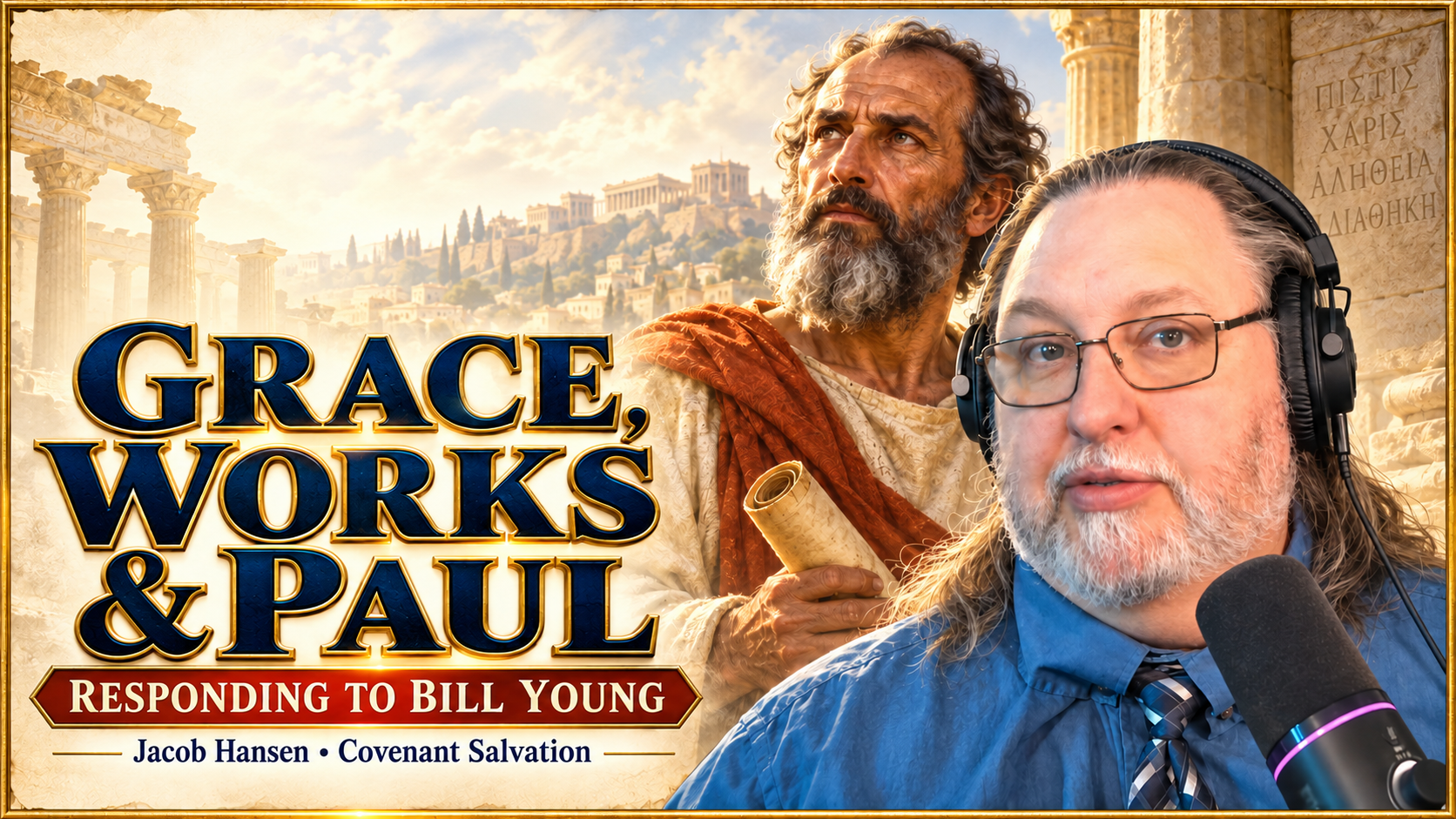
Bill Young's Response to Jacob Hansen: Does Covenant Obedience Deny Grace?

Bill Young's Response to Jacob Hansen: Does Covenant Obedience Deny Grace?

Does obedience turn the gift of salvation into a wage? That is the question beneath Bill Young’s response to Jacob Hansen—and it deserves a better answer than either “Mormonism is counterfeit” or “modern scholarship proves us right.” A Christian can affirm that Christ alone makes salvation possible while still believing that repentance, faithfulness, and a transformed life matter. The dispute begins when we ask how they matter: as payment, as conditions of receiving a gift, as evidence of living faith, or as the life that grace itself creates.

In Episode 104, Young argues that Hansen’s covenant model gives familiar LDS requirements a more attractive vocabulary without changing their function. That objection has force against any explanation that merely renames achievement as relationship. But Young’s broader conclusion—that necessary covenant obedience must therefore amount to earning salvation—requires an additional argument. Neither the presence of conditions nor the fact that human beings actually act establishes that their actions purchase God’s forgiveness.

This response approaches the debate from a Latter-day Saint perspective while taking Protestant objections seriously. It examines the supplied transcript and comment-section record alongside Pauline scholarship, Jewish historical scholarship, LDS sources, and evangelical biblical commentaries. Some of the evidence supports Young’s criticisms of oversimplified apologetics; other evidence directly challenges his portrayal of LDS grace and the scholarly alternatives he dismisses. The purpose is to identify which claims survive careful examination and to hold our treatment of other people to the Christian standard we invoke.

In this response

  • Young’s strongest objection
  • Paul, Judaism, and covenant
  • Grace, necessary works, and merit
  • “After all we can do”
  • What LDS leaders have taught
  • Comments and logical fallacies
  • The Christian standard
  • Frequently asked questions
  • Sources and further reading

What this response examines

The principal source is Young’s “Response to Jacob Hansen’s Covenant Model of Salvation”, identified as Episode 104 in the supplied materials. Quotations below follow the supplied transcript, with punctuation lightly normalized where needed; timestamps identify the relevant passages. The opening Hansen clip is presented within Young’s episode, so this article evaluates the argument as represented there rather than claiming to review every statement Hansen has made elsewhere.

Comment quotations come from the supplied document titled EP 104: Response to Jacob Hansen’s Covenantal Salvation Comment section. Usernames and document paragraph numbers identify excerpts where individual comment permalinks were not supplied. These are selected examples, not a statistical description of the entire audience. The record also contains substantive biblical arguments and objections to mockery. A commenter’s statement is attributed to that account; it is not automatically treated as Young’s own position.

Friday, January 16, 2026

Truth to Mormons Exposed: Deconstructing Bill Young’s "Idol" Claim

Truth to Mormons Exposed: Deconstructing Bill Young’s "Idol" Claim

Latter-day Saints are often exposed to someone who attempts to tell them who their God really is. Not by seeking understanding, but by speaking over them—loudly, confidently, and often inaccurately. When that happens, the question isn’t just, “How do I respond?” It’s, “How do I stay grounded in truth without losing my peace?”

Bill Young’s recent Truth to Mormons episode, “Watch Mormon God Idol Worship,” is the latest in a long line of videos that claim to “expose” Latter-day Saint belief. But beneath the sensational title lies something deeper: a pattern of misrepresentation that doesn’t just distort doctrine—it wounds real people. Many who watch these videos aren’t looking for a fight; they’re looking for clarity, stability, and a faith that can withstand scrutiny without collapsing into fear.

And the sad reality: Like most critics - Bill Young holds himself above any form of teaching, correction, rebuke, or refutation (2 Timothy 3:16).

This article steps into that space—not to trade blows, but to offer light. I am not here to defend God as if He were fragile. I am here to defend the conversation—to show that faith can be examined without being caricatured, and that discipleship grows stronger when we refuse to let someone else narrate our beliefs for us.

I write this as someone who has spent years in recovery, scripture study, apologetics, and theological study—someone who understands how spiritual distortion can harm the soul just as deeply as addiction harms the body. My goal isn’t to “win” against Bill Young or anyone else. My goal is to create a safe, honest, intellectually rigorous space where readers can breathe again, reclaim their spiritual footing, and see their faith through the lens of scripture, history, and lived discipleship—not through the lens of someone else’s outrage.

If you’ve ever felt shaken by videos like this, or if you’re simply seeking clarity in a noisy world, you’re in the right place. Let’s walk through this together with calm minds, open scriptures, and a commitment to truth that doesn’t need to shout to be strong.