Showing posts with label Grace and Sobriety. Show all posts

Thursday, May 28, 2026

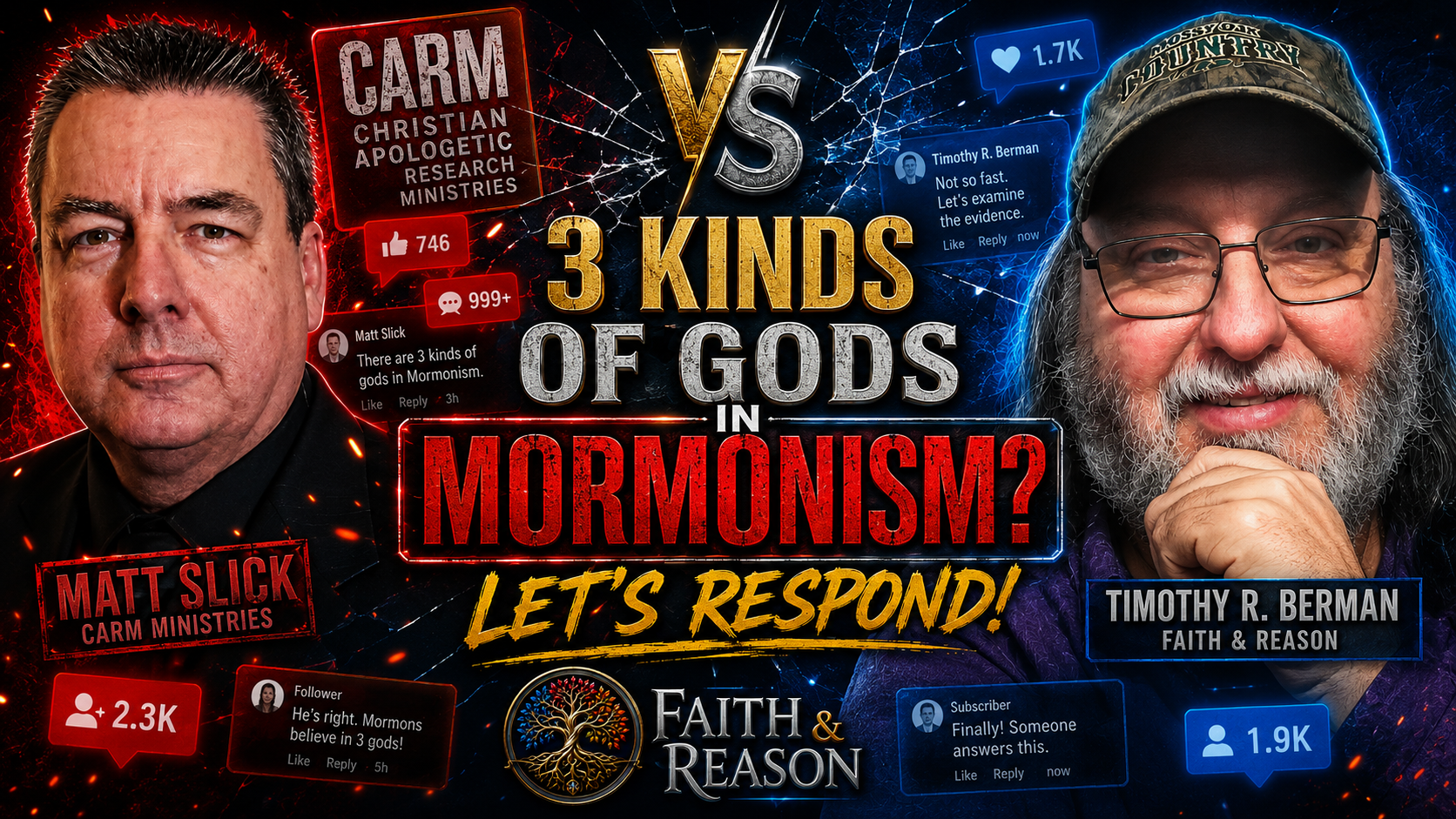
Does the LDS Faith Have 3 Kinds of God?

Does the LDS Faith Have 3 Kinds of God?

Are there three Gods within the LDS Faith, or is Matt Slick of the Christian Apologetics Research Ministry making three specific category errors? He appears to contend that Latter-day Saint theology contains three types of gods. Yet, his conclusion seems to depend entirely on misunderstandings, inaccuracies in reading LDS sources, and the imposition of post-Nicene metaphysics onto texts that do not utilize them.

When we scrutinize Slick's assertions, it becomes apparent that they stem from misrepresentations of key doctrinal points. The Latter-day Saint understanding of God emphasizes a singular divine nature, with a clear distinction between God the Father, Jesus Christ, and the Holy Ghost, who are unified in purpose but distinct in being. This understanding challenges Slick’s insistence on a concept of multiple gods existing in separate categories, which does not align with LDS beliefs as how we interpret our scriptures and teachings.

By examining the categories he uses and applying a proper lens through which to analyze LDS doctrine, one may ultimately see that Slick's arguments significantly falter. His framework seems to force the doctrine into a misunderstanding of the term 'God,' failing to account for the context and nuances within Latter-day Saint theology.

His claims not only misrepresent what Latter-day Saints uphold but also create contradictions within his argumentation regarding what he purports they teach. This is not merely a disagreement over religious interpretation; it represents a profound mischaracterization that undermines genuine discourse.

Today, I wish to respond to this critique with clarity, doctrinal precision, and integrity, standing firm in the belief that the truth of Latter-day Saint doctrine deserves to be presented honestly. It is vital that we engage with those who misunderstand or misrepresent our beliefs with a spirit of boldness and respect—exhorting and convincing the gainsayer (Titus 1:9) through proper correction and thoughtful rebuke (2 Timothy 3:16). By addressing these misunderstandings directly, we can foster a more accurate understanding of Latter-day Saint teachings and encourage meaningful dialogue that respects differences while seeking common ground.

Wednesday, May 20, 2026

Pressing Into the Profit of Prayer

Pressing Into the Profit of Prayer

Have you ever had someone challenge you regarding prayer? Maybe mock you for praying? Perchance you've had someone tell you that they no longer have faith in God because their prayers never were answered, and they questioned the existence of God.

The ancient skeptic in Job sneered, “What is the Almighty, that we should serve him? And what profit should we have if we pray to him?” (Job 21:15). Tozer notes that the tone was dripping with contempt, tossed aside “like Pilate, without waiting for a reply.” Yet Scripture and the lived testimony of the saints thunder back: there is profit in prayer—much every way.

Tozer writes, “An invitation to prayer is an invitation to omnipotence, for prayer engages the Omnipotent God and brings Him into our human affairs.” This statement is staggering and profound. It launches us into the reality that prayer transcends mere verbal expression; it allows us to interact with the divine authority of God Himself. Prayer is not a religious hobby; rather, it is the God-ordained means by which heaven bends low into human history. When we pray, we are not simply whispering into the void—we are summoning the God who parts seas, raises the dead, and renews the weary.

Perhaps the most compelling aspect of prayer is that it is not bound by the limitations of human understanding or experience. The act of prayer invites the supernatural into our mundane realities, connecting us with the Creator who desires to be intimately involved in our lives. How often do we overlook the opportunity to engage the infinite just because we cannot see immediate results? Tozer emphasizes this beautifully. “An invitation to prayer is an invitation to omnipotence, for prayer engages the Omnipotent God and brings Him into our human affairs.”

As Scripture reminds us, the anchor verse - Hebrews 11:6 — “Without faith it is impossible to please God, for whoever would approach him must believe that he exists and that he rewards those who seek him.” In times of doubt and uncertainty, this verse serves as a crucial reminder of the foundational belief that our faith ignites our relationship with God—the very essence that fuels our prayers and hopes.

In a world that still echoes Job’s question, we stand firm on the testimony of the ages. Tozer reminds us that “God Himself has supplied the answer, and the universal consensus of the ages has added an Amen.” The saints testify across time: prayer works because God works. Prayer profits because God is present. Prayer transforms because God responds.

Thursday, January 8, 2026

Episode 4: The Proving Ground

Episode 4: The Proving Ground

Welcome fellow travelers. This is Grace and Sobriety for Latter-day Saints on a path of recovery and living a sober life through Jesus Christ and His Gospel.

Does it ever feel like the moment you decide to get sober or fix your life, everything suddenly gets harder? That resistance isn't failure—it's actually proof that you're on the right path

In this episode, we’re looking at Abraham 3 to discover why God calls this life a 'proving ground.' We’re going to learn how to turn that intense pressure into the power you need to break your chains.

I want to share with you today how we’re going to prove that you are one of the 'noble and great ones.' Let's get into it and like, share, and subscribe - following this content and all other content.

Anchor Verse:

"And we will prove them herewith, to see if they will do all things whatsoever the Lord their God shall command them." — Abraham 3:25

In our previous episodes, we established our nothingness without God (Moses 1), claimed our identity as His children (Moses 1), and found the courage to seek a better way (Abraham 1).