Showing posts with label Christian Discipleship. Show all posts

Sunday, July 19, 2026

When You Don’t Know What to Do, Keep Your Eyes on God | 2 Chronicles 14–20; 26; 30

When You Don’t Know What to Do, Keep Your Eyes on God | 2 Chronicles 14–20; 26; 30

Come, Follow Me — July 20–26, 2026: “Our Eyes Are Upon Thee”

What do you do when the opposition is greater than your strength, the pressure is greater than your wisdom, and you honestly do not know what to do next?

This week’s Come, Follow Me study takes us into the lives of kings, prophets, reformers, worshippers, and ordinary families who faced that very question. Their stories reveal that peace does not come from pretending the battle is small. It comes from knowing where to turn when the battle is bigger than you.

Through the accounts of Asa, Micaiah, Jehoshaphat, Uzziah, and Hezekiah, 2 Chronicles invites us to examine where we place our trust, how we respond to correction, and whether our eyes remain fixed upon the Lord when fear, success, pride, or division threaten to pull them away. Each of these figures faced formidable challenges—be it external armies, internal strife, or the temptations of power—and their responses provide valuable lessons for our own lives.

Asa, for instance, shows how reliance on God in times of trouble can lead to unexpected victories, while Micaiah reminds us of the importance of courage in standing for truth, even in the face of overwhelming opposition. Jehoshaphat’s alliance-building and pursuit of divine guidance highlight the significance of seeking God's will in decision-making, especially when circumstances seem dire. Uzziah's rise to power illustrates the fine line between humility in success and the dangers of pride, reminding us that acknowledgment of our dependence on God is crucial. Lastly, Hezekiah's prayer in times of crisis demonstrates that sincere reliance on divine help can yield miraculous outcomes.

This week's study encourages us to reflect deeply on our own lives. When confronted with overwhelming pressure, do we allow our fears to overshadow our faith? Are we quick to seek advice from sources that may not align with our beliefs? Or do we, like these biblical figures, turn our attention steadfastly to God, trusting that He will guide us through our fiercest battles? Through these narratives, we learn that true peace comes from steadfast faith and a commitment to seek God's wisdom relentlessly, no matter how insurmountable the obstacles may appear.

Monday, June 1, 2026

From Surviving to Thriving: The Spiritual Awakening Every Christian in Recovery Needs

From Surviving to Thriving: The Spiritual Awakening Every Christian in Recovery Needs

If you’re not familiar with the early story of Alcoholics Anonymous, it’s often said that the ideas behind the Twelve Steps were shaped by the Oxford Group—a gathering of Christian men committed to honesty, confession, restitution, and surrender. Bill Wilson, one of AA’s founders, was deeply influenced by them. But today’s devotional isn’t about the origins of AA. It’s about a man named Rowland Hazard, whose struggle with alcoholism led him to seek help from the famed psychiatrist Carl Jung in the early 1930s.

After extensive treatment, Jung told Hazard something that sounds harsh but is deeply honest: his condition was hopeless from a medical standpoint. His only hope, Jung said, was a spiritual experience—a profound awakening that would transform him from the inside out. That realization eventually shaped the foundation of AA itself. Hazard’s spiritual awakening, experienced through the Oxford Group, was shared with Bill Wilson, and from that encounter the Twelve Steps were born.

Let’s sit with that for a moment. Because in my own journey—through recovery, sobriety, homelessness, fear, doubt, and a faith crisis—I had to face the same truth: everything was utterly hopeless until I had a spiritual awakening. Some call it “hitting bottom.” But I’ve come to see it as the moment the Holy Spirit reveals Christ to us in a way the intellect alone could never reach.

Today, many try to think their way into faith. They know about God but never come to know God Himself. And that brings us to the heart of today’s message: What does it mean to truly know God—and Jesus Christ whom He has sent? (John 17:3)

Our anchor verse is Isaiah 1:18–20, where God invites us to “come and reason together.”

Come now, let us argue it out, says the Lord: if your sins are like scarlet, will they become like snow? If they are red like crimson, will they become like wool? If you are willing and obedient, you shall eat the good of the land, but if you refuse and rebel, you shall be devoured by the sword, for the mouth of the Lord has spoken.

This is not an intellectual debate—it is an invitation to examine our hearts, our wounds, our failures, and our inability to save ourselves. It is a call to return, to be still, and to know that He is God.

Today, we explore what it means to know Christ, to know the Father, and to know who we truly are through a genuine spiritual awakening.

Wednesday, May 27, 2026

Learning to Love Myself Through God's Eyes

Learning to Love Myself Through God's Eyes

Learning to love myself was the first mountain I ever had to climb in recovery. Jesus said the greatest commandment is to love God with all our heart, soul, mind, and strength—and the second is like it: to love our neighbor as ourselves. I thought I loved God. I thought I loved others. But I had never learned how to love me. And when I finally faced that truth, I realized I didn’t just “not love myself”—I despised myself.

When I was drunk and alone, I’d curse myself. I’d repeat the harsh words spoken over me by others—especially family. Emotional abuse, degradation, bullying, name‑calling… all of it became the internal script I lived by. I believed I was worthless, stupid, manipulative, selfish, unlovable. And because I believed it, I lived it.

So I kept God at arm’s length. I kept people at arm’s length. I feared abandonment, rejection, and judgment. I feared giving God my whole heart because I assumed He would eventually reject me too. Shame became the lens through which I saw myself, others, and God.

But recovery forced me to confront the lies. It forced me to ask: Who does God say I am? And in that painful, holy unraveling, I began to learn to love God with what little I had. I began to see myself through His eyes. And only then could I begin to love others with sincerity, depth, and courage.

Anchor verse - Hebrews 1:3 - “He is the reflection of God’s glory and the exact imprint of God’s very being, and he sustains all things by his powerful word. When he had made purification for sins, he sat down at the right hand of the Majesty on high.”

Christ is the exact imprint of God’s being—and through Him, we learn who God is, who we are, and how deeply we are loved.

Monday, May 25, 2026

Set the Sail - Faith Rests Upon God's Character

Set the Sail - Faith Rests Upon God's Character

The destiny of one’s recovery is shaped by the idea of God a person carries. Traditional recovery thought teaches that newcomers enter a spiritual program where they are free to identify God “as they understand Him.” For some, this means the fellowship itself becomes a Higher Power; for others, it means any concept of a power greater than themselves.

Over time, a peculiar phrase emerged in recovery culture: “Your Higher Power can be anything — even a doorknob.” It is repeated so often that many assume it comes from the Big Book or the Twelve Steps and Twelve Traditions.

It does not.

Neither text suggests that an inanimate object can restore sanity, guide moral change, or receive a surrendered will. The “doorknob god” appears nowhere in AA’s foundational literature.

Anchor verse - Psalm 9:10: "Those who know your name put their trust in you, for you, O Lord, have not forsaken those who seek you.

The idea actually surfaced in the treatment centers of the 1970s and 1980s. As addiction treatment became professionalized — especially in secular or state‑funded programs — counselors avoided religious language to prevent the appearance of imposing faith on clients. To lower resistance, some staff used exaggerated examples: “Even a doorknob can be your Higher Power if it helps you get started.”

It was never meant to be literal. It was a strategy to reduce defensiveness.

But like many exaggerated teaching tools, it escaped its context. It became folklore. It became satire. Critics of 12‑step spirituality used it to mock the idea of a non‑religious Higher Power. Newcomers repeated it without understanding its origin. And eventually, it became a kind of shorthand for the early, clumsy attempts to describe surrender without demanding theology.

When Confession Breaks the Illusion: Walking in the Light of Real Recovery

When Confession Breaks the Illusion: Walking in the Light of Real Recovery

William James once wrote: “For him who confesses, shams are over and realities have begun; he has exteriorized his rottenness.”

Confession ends the exhausting work of pretending. It pulls what is hidden into the light—not to shame us, but to free us. In recovery, confession is not a one‑time event; it is a rhythm, a posture, a way of walking honestly before God and others. It invites us to step into authenticity, shedding the masks we often wear and revealing the true selves beneath.

When we consider the act of confession, it is crucial to understand that it goes far beyond simply admitting wrongdoings. It encompasses acknowledging our vulnerabilities, our fears, and our shortcomings. It is about facing the parts of ourselves that we might prefer to keep hidden or buried deep within. Confession invites us into a space of liberation, where we can experience the healing power of honesty, not just with ourselves, but with those around us.

Anchor verse - 1 John 1:9 - "If we confess our sins, he who is faithful and just will forgive us our sins and cleanse us from all unrighteousness.”

This divine reassurance underscores the importance of confession in our lives. This is never a one-and-done moment. Confessing our sins is an active part of our path and spiritual growth. There is a continuous invitation to engage in this practice, to reflect regularly on our actions and attitudes, and to communicate them with sincerity. The act of confession can take various forms: it might be through prayer, journaling, or discussions with trusted friends and mentors.

There is also a communal aspect to confession; it's about allowing others to bear witness to our journey of growth. This sharing fosters deeper connections, trust, and support within our communities. Confession can also serve as a catalyst for accountability, encouraging us to maintain our commitments to growth and change.

And there is more to confessing than we may fully understand. What are some of the ways we may confess? And what does it refer to when it says to confess our sins? What exactly are we confessing? Most of us may answer that we are to confess any wrongdoing on our part. And that is definitely an aspect of confessing.

But it may also refer to confessing our failures, our doubts, and our feelings of inadequacy. It may involve voicing the pain we carry and the burdens we bear, creating an opportunity for healing. Confession is a profound act of vulnerability that invites grace and understanding into our lives, not only from God but also from those around us who may offer support and encouragement. Through confession, we can truly experience the freedom that comes with honesty, forgiveness, and a renewed sense of purpose on our spiritual journey.

Today - we are going to take a look at how confession is the very courage to stop pretending. To step out of the idea that we need to fake it till we make it. And to see how this all ties into a twelve-step recovery program for Christians walking a path of recovery, desiring to thrive in their sobriety.

Friday, May 22, 2026

WEEKLY RECAP: WALKING IN TRUTH — A Sacred Sobriety Reflection

WEEKLY RECAP: WALKING IN TRUTH — A Sacred Sobriety Reflection

Our daily walk in recovery and thriving in sobriety provides a story. I love what the apostle Paul writes, "You yourselves are our letter, written on our hearts, known and read by all, and you show that you are a letter of Christ, prepared by us, written not with ink but with the Spirit of the living God, not on tablets of stone but on tablets that are human hearts." (2 Corinthians 3:2-3, NRSVUE). Our testimonies are living epistles. This is the reason I love what is said in the Celebrate Recovery rooms, 'He took my mess and turned it into a message and took my test and turned it into a testimony."

These stories are of struggle, of quiet faithfulness - and yet always a story of God's sovereign and divine grace in our moments of weakness (2 Corinthians 12:9). This past week, the devotional messages formed a single thread woven through four powerful themes.

  • Spiritual Discernment
  • Spiritual Direction
  • Mindful Prayer
  • Distinctiveness of a life transformed by Christ

Each one of these messages point us back to one central truth: Thriving in recovery and sobriety requires spiritual clarity, honest self-examination, and a heart anchored in Christ. And through the acrostics - we explored:

  • T.R.U.T.H
  • D.I.R.E.C.T.I.O.N
  • P.R.A.Y.E.R
  • H.O.L.Y

Hopefully you discovered a pathway that strengthens your heart, mind, and spirit; steadies the steps of anyone seeking lasting freedom.

Monday, May 18, 2026

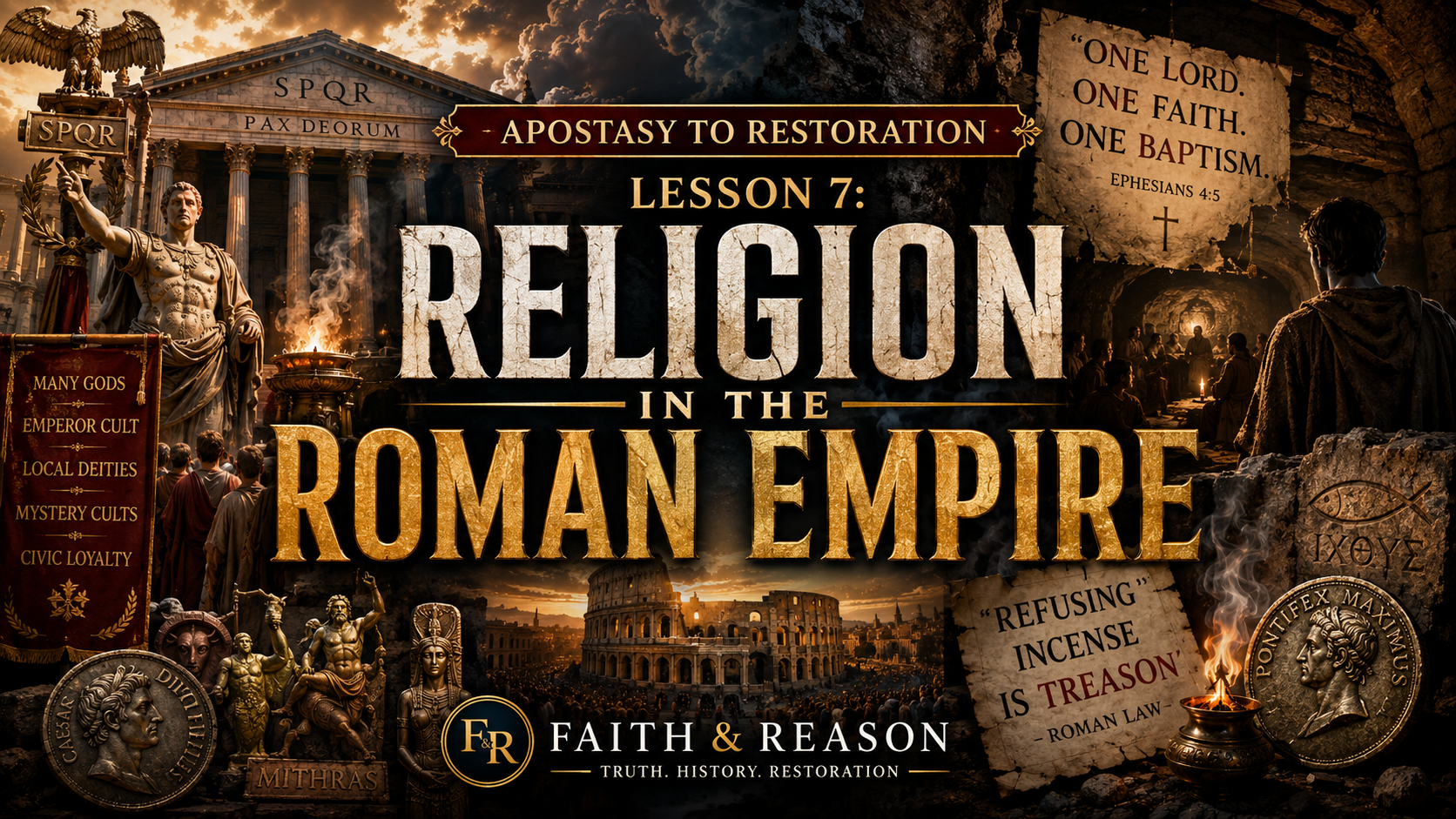
Apostasy to Restoration: Lesson 7: Religion in the Roman Empire

Apostasy to Restoration: Lesson 7: Religion in the Roman Empire

When T. Edgar Lyon first penned Lesson 7 of Apostasy to Restoration in 1960, he invited Latter-day Saints to step into a world where religion was not just a private conviction but a fundamental component of the machinery of empire. This bold assertion set the stage for a deeper exploration of the intricate interplay between faith, culture, and politics. Sixty years later, the landscape of scholarship has transformed dramatically, yet Lyon’s central insight remains strikingly relevant: to truly understand the need for a Restoration, we must first immerse ourselves in the complex milieu that shaped the early Christian Church.

This updated lesson builds upon Lyon’s foundational work, integrating modern archaeological discoveries, peer-reviewed historical research, and contemporary Latter-day Saint scholarship to form a more nuanced understanding of the context in which early Christianity emerged. What emerges from this scholarly synthesis is a clearer, richer, and more compelling picture of the Roman religious world—a world that was teeming with a pantheon of gods, replete with elaborate rituals, and governed by a political theology that made the act of Christian discipleship both radical and perilous.

In a society where loyalty to the state was intricately tied to acts of sacrifice and devotion, where citizens adeptly navigated multiple cults without a hint of contradiction, and where the pursuit of salvation was often sought through clandestine mystery rites and the favor of emperors, the Christian proclamation of “one Lord, one faith, one baptism” represented a profound challenge to the status quo—it was nothing less than a revolutionary stance. This declaration was, in essence, a radical reformation of the religious landscape, directly opposing the established norms that dictated the relationship between the individual, the divine, and the state.

Understanding that world is essential for grasping why the early Church fractured amidst various pressures and why a Restoration was not merely desirable but indeed inevitable. The tensions between emerging Christian beliefs and the entrenched systems of power were not just obstacles to be overcome; they underscored the urgent need for a return to core principles that could unify and reinvigorate the faith community. Lyon’s insights encourage us to reflect on our own circumstances in today’s religious environment, prompting critical questions about the nature of faith, the role of community, and the ongoing quest for spiritual authenticity in an increasingly complex world. As we navigate the remnants of an ancient tapestry interwoven with faith and politics, we find ourselves inspired to reconsider the implications of our shared history and the enduring quest for a true Restoration.

Wednesday, April 29, 2026

The Truth’s Most Powerful Ally: A Life That Speaks Louder Than Words

The Truth’s Most Powerful Ally: A Life That Speaks Louder Than Words

We live in a world overflowing with opinions, arguments, podcasts, and social media posts—yet we often find ourselves starving for authenticity. People tend to trust what they see far more than what they hear. You can win an argument but still lose a connection. You can defend the truth yet fail to embody it. Amid this tension, many of us who are in recovery, healing, or rebuilding our lives ask ourselves a deeper question: Does my life truly reflect the truth I claim to believe?

A.W. Tozer cuts through the noise with such piercing clarity when he says, “The most effective argument for Christianity is still the good lives of those who profess it.” It's not about eloquence or theology or debate. It's about a life transformed by Christ.

Scripture backs this up with sobering clarity: James 2:17 (NRSVUE) reminds us that “So faith by itself, if it has no works, is dead.”

For those navigating recovery, untangling from toxic relationships, or breaking free from codependency, this truth hits home. Transformation isn't some abstract idea—it’s something you can see. It shows in the way you set boundaries, the way you walk away from chaos, and the way you choose peace over control. These decisions become living sermons that nobody can overlook.

A transformed life isn’t just an addition to your faith; it’s tangible evidence of it. In recovery, this looks like opting for boundaries instead of people-pleasing, choosing truth over denial, and embracing surrender over control.

1 Peter 2:12 (NRSVUE) takes this even further: “Conduct yourselves honorably among the gentiles, so that… they may see your honorable deeds and glorify God…”

People might never pick up a Bible, but they will read your life. They draw conclusions about God based on what they observe in you.

Every small act of kindness, every moment of self-discipline, and every decision based in love turns into a testimony. It’s in these everyday choices that the authenticity of your faith shines the brightest. When someone sees genuine transformation, it offers hope that real change is indeed possible. They’re not just hearing the Gospel; they’re witnessing it in action through your life.

Anchor verse - Matthew 5:16: “In the same way, let your light shine before others, so that they may see your good works and give glory to your Father in heaven.” (NRSVUE)

So if you’ve battled with guilt, shame, or a crisis of faith, hear this loud and clear: God isn’t asking you to be perfect. He’s inviting you into a real transformation.

2 Corinthians 3:18 (NRSVUE) tells us: “And all of us… seeing the glory of the Lord as though reflected in a mirror, are being transformed into the same image from one degree of glory to another…”

This is a process—a journey of becoming. It’s a gradual reshaping of your life that others can't help but notice.

And even on days when your voice feels quiet, your life—anchored in Christ—becomes a testimony that resonates with undeniable clarity.

Engaging with others in their struggles, rather than offering empty platitudes, creates deep connections. The beautiful truth is that God doesn’t call you to perform truth; He calls you to be transformed by it. This transformation, evident in your actions and choices, becomes a beacon of hope to those around you who are seeking meaning and reassurance.

By choosing to embody love, grace, and perseverance—qualities that Christ offers—you not only nurture your own growth but also inspire others to embark on their own journeys toward healing and authenticity. Your life can stand as a powerful testament, gently guiding others out of darkness into a place where they can truly see and experience real change for themselves.

Sunday, April 26, 2026

Powerless Over the Storm — Not Powerless Over the Sail

Powerless Over the Storm — Not Powerless Over the Sail

Ever have one of those moments where clarity doesn’t arrive with fireworks, but with a quiet, unmistakable shift inside your chest—a soft Aha, a gentle epiphany that feels less like a thought and more like a whisper settling into your spirit? That happened to me as I was preparing for today's devotional message. I was sitting with A. W. Tozer’s The Set of the Sail, revisiting the opening chapter, when something in those pages caught me off guard. And then it hit me—clean, sharp, and humbling. How have I missed what the Third Step may truly be inviting us into?

For anyone unfamiliar, the Third Step in recovery says that we “made a decision to turn our will and our lives over to the care of God as we understood Him.” On the surface, it sounds simple enough—surrender your will, your autonomy, your desires. Let God take the helm. But beneath that simplicity lies the raw truth that brought many of us to recovery in the first place: we finally saw how far we had drifted, how powerless we had become, how our lives had unraveled into chaos, disorder, and ruin. And in that unraveling, we recognized our need for a power greater than ourselves to intervene.

But here’s the part we rarely talk about. That moment of surrender doesn’t usually feel holy. It doesn’t feel triumphant. It feels like waking up from a long, heavy fog—numb, disoriented, spiritually exhausted. Faith feels distant. Purpose feels fractured. And somewhere in the stillness of that inner ache, a question rises: Am I drifting? And the honest answer is yes. We have drifted. And that truth cuts through the noise of our anxious, chaotic thoughts with a clarity we can’t ignore. Because in that moment, we’re no longer moved by emotion—we’re moved by a deliberate, trembling desire to choose something different.

Tozer writes that the direction of a life is not determined by the strength of the wind, but by the set of the will. He echoes Ella Wheeler Wilcox’s line: “It is the set of the sails and not the gales which tells us the way to go.” That line stopped me. Because if we’re honest—with ourselves and with our Heavenly Father—when we’re standing in the middle of doubt, fear, anxiety, or spiritual fatigue, this truth matters more than we realize.

It matters because the confrontation of the Third Step is not merely about surrender. It is about resetting the sails of our recovery, our faith, and our lives. It is about choosing—sometimes with trembling hands—to turn the bow of our soul back toward the One who has been waiting to guide us all along.

Anchor Verse: "Now if you are unwilling to serve the Lord, choose this day whom you will serve, whether the gods your ancestors served in the region beyond the River or the gods of the Amorites in whose land you are living, but as for me and my household, we will serve the Lord." - Joshua 24:15, NRSVUE

I know—at first glance, this verse can feel like a cliché. It’s the kind of Scripture that ends up on wall art, coffee mugs, and Christian décor aisles. And for those who know the context, it might even raise a question: Why use Joshua 24:15 here? Why bring in a verse where Joshua is telling Israel to choose between the Lord and the gods of their ancestors or the gods of the Amorites?

But that’s exactly why I love this verse. Because Joshua isn’t simply telling Israel to “choose God.” He’s confronting them with a deeper truth: if you do not choose to serve the Lord, you will still serve something. You will serve the gods of your past, or the gods of the culture around you—but you will serve something.

And suddenly, the connection to the Third Step becomes painfully clear.

Wednesday, April 22, 2026

Solidarity in Our Suffering

Solidarity in Our Suffering

Every one of us knows what it feels like to wake up inside a prison we never saw ourselves enter. Not a prison of steel bars, but the kind built from fear, shame, distorted thinking, and the quiet suffering we carry alone. These are the prisons that don’t show up on a background check—but they shape our lives all the same.

And here’s the part we rarely admit to ourselves: most of the time, we don’t even realize we’re locked inside. We just feel the weight. The cycle. The hopelessness. Recovery calls this “your side of the street.” MRT calls it “recognizing your prison.” Scripture calls it remembering—remembering those in chains as though you were chained with them (Hebrews 13:3). Because the moment you recognize your own captivity is the moment you become capable of standing with someone else in theirs. Not with pity. Not with judgment. But with solidarity born from shared humanity and redeemed suffering.

I’ve lived in those invisible cells. I’ve counseled people trapped in them. And I’ve watched God use both literal and internal prisons to refine character, restore dignity, and reveal His mercy in ways comfort never could. So when I talk about suffering in solidarity, I’m not speaking as an observer—I’m speaking as someone who has been behind those walls and found Christ already waiting there. This devotional isn’t about theory. It’s about truth. It’s about recovery. It’s about the Gospel. And it’s about learning to see our own captivity clearly enough that we can walk beside others without superiority, without fear, and without pretending we’ve never been imprisoned ourselves.

What is the prison of your own suffering? For me, it was those moments where my life seemed to come undone - the rug pulled right out from underneath me. Locked in my own irrational thought process, false beliefs, and not understanding the reason I seemed to constantly be in this never-ending cycle of always finding myself in a place of brokenness, suffering, and hopelessness. There are moments in many individuals lives where they are in some form of a prison. And this prison may be a literal prison, or it may be a product of one’s circumstances. Whether this is a place of financial debt, broken relationship, physical limitations, disability, or injury, or any other constraining circumstance. 

Yet, the single most travesty within our Christian faith communities and fellowship is when fellow saints perceive those who are in some form of prison and are suffering - see them with a biased assumption that God has not favored them. That, they have committed some form of sin, or are spiritual rebellion. To some extent, there are those who have this idea that Christians suffering in their own prisons are lacking faith in God. 

However, let’s consider the Apostle Paul: he probably experienced similar judgments and perceptions. Specifically, when we read his epistles that were written while he was in prison and suffering for the cause of the Gospel. Early saints of the way may have seen his trouble as a sign of God’s own disfavor and wondered how someone with so much potential had fallen to such lowly depths. 

Now, consider the reality of what I am wanting to share with you today. Prisons today different from person to person - and are full of God’s beloved sons and daughters. Despite this reality, He uses these prison moments in profound and mighty ways. We see how he used Paul’s suffering and prison moments, Joseph of Egypt, John the Baptist, John the beloved disciple, and numerous other men within scripture. Most of these men were used by God in powerful ways and they have experienced imprisonment, captivity, or depth of loneliness and despair - and our Heavenly Father, in His tender mercies, used those moments. 

Monday, April 6, 2026

Elder Patrick Kearon: "About His Business" | Sandpaper People and the Refiner’s Fire

Elder Patrick Kearon: "About His Business" | Sandpaper People and the Refiner’s Fire

How often have we walked into our Sunday meetings looking for a sanctuary from the world that seems to be troubled, in a state of confusion, and quite volatile and toxic? And yet, we step into a place where one may frequently find something much more challenging: a room full of people who have a wide range of differences. It may be quite tempting to see these differences as hinderances or even obstacles to our own spiritual growth. However, what if such annoyances of our specific wards are actually the very tools God uses to encourage, edify, and strengthen us? And sometimes, these people seemed to rub us the wrong way - you know - sandpaper people.1

Wait...what? Sandpaper people? Yep, exactly - sandpaper people are those who may rub us the wrong way. You know, the ones that seemingly get under our skin sometimes? The ones we may want to avoid, even at church. And yet, you may be wondering - what is a sandpaper person? And furthermore, what purpose do they serve?

Sandpaper is designed to smooth out and refine surfaces. A sheet, or strip, of paper that is quite abrasive, depending on the grade, where it smooths out rough spots, removes rust or old paint. It is also used to prepare surfaces for painting, staining, and polishing. In essence, sandpaper's sole intention and purpose is to refine and smooth out the rough edges. And that is exactly what sandpaper do - they smooth out the rough edges and refine us in ways that help shape and transform us into whom our Heavenly Father has called us to become.

Isaiah 48:10 says, "See, I have refined you but not like silver; I have tested you in the furnace of adversity." And you may be wondering, what does Isaiah 48:10 and sandpaper people have to do with attending Church?

Here is the simple truth: God does not refine us in isolation, nor does He shape us only through peaceful, agreeable circumstances. Instead, our Heavenly Father refines us in the furnace of adversity - and sometimes, that furnace of adversity looks surprisingly ordinary. You know, the person singing loudly behind you during Sacrament meeting. The kids with an apparent case of ants in their pants and parents doing their best to help them practice reverence. Or the person who shows up in jeans and a shirt with no tie. People that somehow do not fit our mold or expectations. Let's face it - our wards consist of people full of personalities, preferences, quirks, and rough edges that collide with our own.

And this is an uncomfortable and beautiful reality.

Sandpaper people are part of God's refining fire where we are to come together in unity of faith, common consent, and edifying and strengthening one another in the faith. Not because they are problematic. Not because they may appear less spiritual. And certainly, not because they are annoying obstacles to our worship. Because Our Heavenly Father, in his infinite wisdom, places us in communities where our rough edges meet theirs - and in that friction, something holy happens. Something we may not ever choose, yet something we desperately need.

Elder Patrick Kearon opened up the Saturday Morning Session of General Conference with a message titled About His Business" regarding how our service is a choice, an offering to God and a blessing. He appears to reframe the local ward, not as a social club for the like-minded individuals. Instead, he provided insight on how this may be a divine place of fellowship. A place where the friction of serving people who are "very different to us" creates the heat necessary to forge Christlike virtues - charity, meekness, and forgiveness - that simply may not be developed in isolation. If you've ever struggled to find your place in a diverse congregation, you are not failing the test; you are finally in the right place.

I want to take a moment and walk with you as we bridge the gap between modern apostolic counsel and ancient scripture. To understand how The Body of Christ requires every different member to function - and the reason our growth depends on the person sitting three pews away.

Thursday, February 26, 2026

The Architecture of Grace: A Systematic Analysis of the Everlasting Covenant

The Architecture of Grace: A Systematic Analysis of the Everlasting Covenant

Jacob’s story is not the tale of a man who finally got his act together. It is the story of a God who refused to let go. From the well where Rebekah ran to serve a stranger, to the night Jacob wrestled until dawn, Genesis 24–33 reveals a God who enters the grit of human weakness and patiently reshapes a people who learn—slowly, painfully, beautifully—to let Him prevail. This is not ancient history; it is the architecture of grace still unfolding in every disciple who dares to surrender.

Every scene in this week’s Come, Follow Me block is a doorway into covenant transformation. A servant prays at a well and finds a woman whose kindness alters the future. Two brothers clash over a birthright that neither fully understands. A fugitive dreams of a ladder where heaven touches earth. A deceiver becomes Israel. A wounded family becomes whole again. These are not disconnected stories; they are covenant threads woven by a God who meets His children in deserts, dreams, and wrestles—and invites them into a life only He can build.

The New Testament echoes these moments at every turn: Christ offering living water at Jacob’s well, the Father running to embrace a prodigal son, the Savior calling His disciples to leave lesser things for eternal ones. The Book of Mormon, Doctrine and Covenants, and Pearl of Great Price amplify the same truth: God prevails when His children yield.

This study follows an expository and exegetical method—tracing themes of covenant, surrender, revelation, reconciliation, and divine guidance across the Old Testament, New Testament, Restoration scripture, and the teachings of modern prophets. It is expository, exegetical, devotional, and practical. It is written for individuals who want more than information—they want transformation.

If you’ve ever wrestled with God, waited for answers, feared reconciliation, or wondered whether He remembers you, Genesis 24–33 is your story. And the God who prevailed in Jacob’s life is ready to prevail in yours.

Tuesday, February 10, 2026

CFM Feb 9-15: Genesis 6-11; Moses 8 - “Noah Found Grace in the Eyes of the Lord”

CFM Feb 9-15: Genesis 6-11; Moses 8 - “Noah Found Grace in the Eyes of the Lord”

Every generation eventually reaches a moment when it looks around and whispers, “Something is wrong with the world.” In these times, violence feels all too normal, permeating the fabric of society and influencing our daily lives. The mockery of faith becomes a fashionable trend, with belief systems ridiculed and disregarded as obsolete or irrelevant. Covenant identity, once held as sacred and unbreakable, is now treated as merely optional, leading many to question their values and commitments.

Amidst this unsettling atmosphere, the quiet, steady voice of God seems drowned out by the cacophony of a culture sprinting toward self-destruction. The distractions and temptations of the modern world are many, each vying for our attention and allegiance, leaving little room for genuine reflection on our spiritual existence.

Genesis 6–11 is not ancient history. It’s a mirror reflecting our current realities. Within these verses, we can find resonating truths about the human condition and the inherent struggles we face in a world rife with chaos. The narratives captured in these chapters hold profound relevance today, illustrating the timeless nature of our challenges and the critical need for divine intervention amidst suffering and despair.

Moses 8 is not merely a prelude to the Flood; it functions as a prophetic commentary on what true discipleship can look like when the world is collapsing around you. This text invites readers to consider their own paths and the steadfastness required to remain faithful in the face of overwhelming adversity. The examples set forth serve as reminders that unwavering dedication to one’s beliefs can be both a source of strength and a beacon of hope in dark times.

Noah’s story is not merely a story about a simple boat; it is an embodiment of a God who passionately refuses to give up on His children. The narrative illustrates the depths of divine love and commitment, showing that even when humanity falters, God’s covenant remains steadfast. It’s about a covenant that refuses to die despite the floods of life that threaten to engulf us. It’s about grace that finds us, even when the world is drowning in despair, offering a lifeline steeped in hope, redemption, and the promise of a new beginning. This grace reminds us that no matter how far we stray, we are never beyond the reach of divine mercy and love.

Friday, January 16, 2026

Exaltation, Eternal Life, and the Biblical Promise: A Response to Common Misreadings of Scripture

Exaltation, Eternal Life, and the Biblical Promise: A Response to Common Misreadings of Scripture

Every so often, a post circulates on Facebook claiming to “defend biblical truth” while warning Christians about supposed “Mormon distortions” of Scripture. These posts often sound confident, even authoritative—but confidence is not the same as accuracy. And when Scripture is handled carelessly, God’s people are left with fear instead of clarity, suspicion instead of understanding, and slogans instead of Scripture.

You deserve better than that. You deserve context, exegesis, and the whole counsel of God. Engaging with Scripture requires a dedication to understanding its original intent, cultural background, and the intricate layers of meaning that inform its teachings. It is crucial that we approach biblical texts with a framework that seeks the truth, not merely to validate preconceived notions or biases.

This article is not about defending a denomination. It’s about defending the Bible from misuse, the gospel from reduction, and the promises of God from being shrunk down to fit someone’s theological anxieties. When individuals take snippets of Scripture out of context, or rely on misinterpretations to make sweeping claims about others, it creates a barrier to genuine dialogue and understanding. Instead of fostering unity and exploring our shared beliefs in a respectful manner, it often leads to division and an atmosphere of mistrust.

In exploring differing theological perspectives, we must strive for empathy and open-mindedness. By learning to articulate our own beliefs while honestly engaging with the beliefs of others, we can cultivate a deeper comprehension of the richness of Christian doctrine. This journey is not merely academic; it is a spiritual pursuit that invites us to reflect on our convictions and be willing to grow in our faith.

Ultimately, a robust understanding of Scripture encourages believers to embrace the fullness of God’s word, appreciate the diversity within the body of Christ, and engage with one another as fellow travelers seeking truth, rather than adversaries in a theological battleground. We are called to love and uplift one another, striving for a deep-seated comprehension of the message that binds us together.

Tuesday, January 6, 2026

EPISODE 4 — Finding Dry Ground: God’s Order in Your Chaos | GENESIS 1:9–13

EPISODE 4 — Finding Dry Ground: God’s Order in Your Chaos | GENESIS 1:9–13

Welcome fellow travelers to our devotional series Daily Exodus - Disciplines of Deliverance for the Sacred Sobriety channel.

Some of us are drowning in the same waters God already commanded to move. We’re praying for deliverance while standing in the very place where God intends to plant us.

Today, we’re stepping into Day 3 of Creation — the moment God gathers the waters and reveals dry ground. This is the pattern of deliverance. Not escape. Not avoidance. But God creating a place for your feet to stand.

If you’re navigating recovery, fear, doubt, or a faith crisis, this episode is for you. God is not just separating your chaos — He is forming stability beneath you. Let’s walk this out together.

Day 3 is the first moment in Scripture where something solid appears.

  • Not light.
  • Not boundaries.

But ground — a place to stand, a place to grow, a place to begin again.

Friday, January 2, 2026

Day 2: The Divine Separation

Day 2: The Divine Separation

“Then God said, ‘Let there be light’; and there was light. God saw that the light was good; and God separated the light from the darkness. God called the light ‘day,’ and the darkness He called ‘night.’ And there was evening and there was morning, one day.”

~ Genesis 1:3-5, NASB ~

Supporting Scripture: 1 John 1:5-7, 2 Corinthians 6:14

The first act of God upon the chaos of the soul is not to bring peace, but to bring Light. And the immediate result of Light is conflict. We often pray for peace, but God answers with Light, because there can be no true peace where darkness is allowed to mingle with the day.

Notice the sequence: God commands the Light, and immediately He performs a separation. "God separated the light from the darkness." He did not blend them. He did not create a twilight zone where we can comfortably hold onto a little bit of our old habits while professing a new life. He divided them.

This is the crisis of genuine recovery and the covenantal life. We want the comfort of the Light—the relief of forgiveness, the clarity of a sober mind—but we resent the severity of the Separation. We want to be children of the day without entirely leaving the night. We try to negotiate a "gray area" where we can keep our pet sins, our resentments, and our small compromises, thinking they are harmless.

But God is the Great Divider. His Light is intrusive. It is penetrating. It reveals things we would rather keep hidden in the "formless and void" places of our hearts. When God speaks "Let there be light" into an addicted soul, He is declaring war on the shadows that have enslaved it.

It is often spoken of as the "crisis of the will." This is that crisis. You cannot walk in the Light and have fellowship with the darkness (1 John 1:6). It is an impossibility. The moment you claim the Light, you must accept the Separation.

Thursday, January 1, 2026

Day 1: The Place of Beginning

Day 1: The Place of Beginning

And the earth was a formless and desolate emptiness, and darkness was over the surface of the deep … Then God said, 'Let there be light'; and there was light."
~ Genesis 1:2-3, NASB ~

The beginning of genuine Christian discipleship and recovery is not a desire to be better; it is the admission of total ruin. One that comes by way of godly sorrow and contrition of spirit. A deep brokenness of human will, mind, and spirit. We come to ask God - come asking, begging, Him to help us tidy up the ruin of our lives, to help us organize the chaos into something manageable. For His grace to help us manage and cope, or deal, with the ruins of our lives.

God is not interested in helping us to either cope, manage, or deal with how we've shipwrecked our lives. He desires, and intends, to create something entirely new out of the void we find ourselves in. Each of us needs to come to the place of spiritual depravity. A place of spiritual bondage and desolation. A place where we awaken to the awful state of our own conditions - our own powerless and inability to manage our lives. It is this "formless and desolate emptiness" of our own soul and admit that we are powerless to light a fire that purges and cleanses us.

As long as you believe you have a spark of your own life left to fan into flame, you are not ready for God's creative power to work in your heart, mind, and spirit. The darkness over the surface of the deep is not a problem for us to solve through our own willpower; it is a condition that can only be broken by the invading voice of God - the very spirit of Truth.

The Spirit of God was "hovering," waiting. He waits over the chaos of your addiction, your broken promises, and your moral bankruptcy. He does not panic at the sight of your desolation. He will not act until you stop attempting to be the creator of your own restoration.

Recovery is not renovation of our lives. Nor is it a reformation of our lives. It is not a renovation or reformation project we undertake. Recovery is a resurrection of the corruptible and desolate soul that needs to be put to death and buried in covenant with Christ. Only then are we risen up in a newness of life through Christ. We are to stop attempting to explain the darkness or negotiate with the chaos. Stand still in the midst of your absolute ability and allow the Father, through Christ, by the gift and power of the Holy Spirit, to speak the very word that separates who you were from who He is making you. Let Him command the light you need to separate from the darkness and step into His glory.

Download the Google Doc

Day 1: The Place of Beginnings

Wednesday, January 1, 2025

"Let Us Keep to the Point: A Call to Absolute Surrender"

Scripture Reference: Philippians 1:20-21

“I eagerly expect and hope that I will in no way be ashamed, but will have sufficient courage so that now as always Christ will be exalted in my body, whether by life or by death. For to me, to live is Christ and to die is gain.”


Introduction: The Call to Surrender

The Christian life is one of surrender—complete and wholehearted devotion to Christ. In Philippians 1:20, the Apostle Paul expresses a bold and fearless determination to honor Christ, whether in life or death. He keeps to the point: that his life’s purpose is to glorify God through absolute surrender and unwavering faith.

But surrender is easier said than done. It challenges our pride, our fears, and even our sense of control. Oswald Chambers, in My Utmost for His Highest, writes that the key to such a life is not reasoning or debate but the surrender of our will. He warns us against overthinking or justifying our resistance to God’s call and instead urges us to yield fully to Him, trusting that God knows exactly what He is asking of us.

Today, we’ll reflect on Paul’s words and consider what it means to give our utmost for His highest.


1. Absolute Surrender: The Heart of the Matter

Paul’s declaration in Philippians 1:20-21 is a testament to his complete submission to God’s will. His ultimate desire is to exalt Christ, no matter the cost. This kind of surrender demands a decisive action—a willingness to lay aside our own desires, fears, and self-centered concerns in favor of God’s plan.

Chambers challenges us to identify the specific “point” where God is calling us to surrender. This could be a sinful habit, a personal ambition, a relationship, or even an area of ministry we are reluctant to embrace. Surrender is not partial; it is absolute and irrevocable.

Scripture for Reflection

  • Luke 9:23: “Whoever wants to be my disciple must deny themselves and take up their cross daily and follow me.”
  • Romans 12:1: “Therefore, I urge you, brothers and sisters, in view of God’s mercy, to offer your bodies as a living sacrifice, holy and pleasing to God—this is your true and proper worship.”

Reflective Question: What is the “point” God is asking you to surrender completely to Him?


2. Fearless Courage: Honoring Christ in All Things

Paul’s surrender is fueled by fearless courage. He writes, “I eagerly expect and hope that I will in no way be ashamed, but will have sufficient courage so that now as always Christ will be exalted in my body” (Philippians 1:20). This courage comes from knowing that his life is no longer his own—it belongs fully to Christ.

Fear often holds us back from full surrender. We worry about what others will think, how our decisions will impact those around us, or what sacrifices we’ll be required to make. But as Chambers reminds us, these considerations often mask an over-concern for ourselves. True courage comes when we trust God’s wisdom over our own reasoning, knowing that He is sovereign and good.

Scripture for Reflection

  • Joshua 1:9: “Be strong and courageous. Do not be afraid; do not be discouraged, for the Lord your God will be with you wherever you go.”
  • 2 Timothy 1:7: “For the Spirit God gave us does not make us timid, but gives us power, love, and self-discipline.”

Reflective Question: What fears are holding you back from fully trusting God? How can you embrace courage through faith in His promises?


3. God’s Timing and the Crisis of Surrender

Chambers points out that God often brings us to a providential crisis when we resist His gentler invitations to surrender. These crises force us to decide—to fully yield to Him or to resist and walk away. The crisis becomes a “Great Divide,” marking a turning point in our spiritual journey.

Consider the story of the rich young ruler in Matthew 19:16-22. Jesus asked him to surrender his wealth and follow Him, but the man walked away sorrowfully because he was unwilling to make the sacrifice. How often do we face similar moments of decision, clinging to what we value most instead of laying it at Jesus’ feet?

Scripture for Reflection

  • Matthew 6:33: “But seek first his kingdom and his righteousness, and all these things will be given to you as well.”
  • John 12:24: “Very truly I tell you, unless a kernel of wheat falls to the ground and dies, it remains only a single seed. But if it dies, it produces many seeds.”

Reflective Question: Are you facing a “crisis of surrender” in your life? What decision is God asking you to make?


4. Living a Life of Undeterred Faith

Paul’s determination to live for Christ is unwavering. He writes, “For to me, to live is Christ and to die is gain” (Philippians 1:21). This declaration reflects a profound truth: when we fully surrender to Christ, our lives become about Him, not us.

This undeterred faith requires daily commitment. It’s not a one-time decision but a continuous choice to live for Christ in every situation. Whether we face trials, persecution, or the mundane challenges of daily life, our focus must remain on honoring God.

Scripture for Reflection

  • Galatians 2:20: “I have been crucified with Christ and I no longer live, but Christ lives in me. The life I now live in the body, I live by faith in the Son of God, who loved me and gave himself for me.”
  • Hebrews 12:1-2: “Let us throw off everything that hinders and the sin that so easily entangles. And let us run with perseverance the race marked out for us, fixing our eyes on Jesus, the pioneer and perfecter of faith.”

Reflective Question: How can you live with undeterred faith, keeping Christ at the center of your life?


5. Trusting God’s Sovereignty in Obedience

One of the most difficult aspects of surrender is trusting that God knows what He’s doing. Chambers writes, “We tell God He does not know what our obedience will mean.” How often do we try to negotiate with God, as though He doesn’t fully understand the implications of His call?

True surrender means trusting God’s sovereignty and wisdom, even when we don’t see the full picture. It means saying, “Yes, Lord,” with confidence that His plans are for our good and His glory.

Scripture for Reflection

  • Proverbs 3:5-6: “Trust in the Lord with all your heart and lean not on your own understanding; in all your ways submit to him, and he will make your paths straight.”
  • Isaiah 55:8-9: “For my thoughts are not your thoughts, neither are your ways my ways,” declares the Lord. “As the heavens are higher than the earth, so are my ways higher than your ways and my thoughts than your thoughts.”

Reflective Question: In what areas of your life do you struggle to trust God’s sovereignty?


6. The Joy of Surrender

While surrender may feel like a loss, it ultimately leads to the greatest gain. When we yield to Christ, we experience the joy of walking in His will, the peace of knowing we’re aligned with His purpose, and the strength that comes from His presence.

Paul’s life is a testament to the joy found in surrender. Despite facing imprisonment, persecution, and hardship, he rejoiced in Christ. He understood that surrender wasn’t about loss but about living fully for the glory of God.

Scripture for Reflection

  • Psalm 16:11: “You make known to me the path of life; you will fill me with joy in your presence, with eternal pleasures at your right hand.”
  • John 15:10-11: “If you keep my commands, you will remain in my love, just as I have kept my Father’s commands and remain in his love. I have told you this so that my joy may be in you and that your joy may be complete.”

Reflective Question: How has surrendering to Christ brought joy and peace into your life?


Conclusion: Let Us Keep to the Point

Paul’s example and Chambers’ challenge remind us to “keep to the point.” The Christian life is not about convenience, comfort, or compromise—it’s about giving our utmost for His highest. This requires absolute surrender, fearless courage, and undeterred faith, trusting that God’s plans are good and His grace is sufficient.

If God is calling you to surrender something today, don’t delay. Don’t debate or rationalize. Trust Him fully, knowing that He is faithful and that the joy of walking in His will far outweighs any sacrifice.


Closing Prayer

Heavenly Father,
Thank You for calling us to a life of surrender. Help us to lay aside our fears, pride, and self-centeredness so that we can honor You in all things. Give us the courage to trust Your plans and the faith to follow wherever You lead. May we live with undeterred devotion, offering our utmost for Your highest. In Jesus’ name, Amen.


Reflective Questions for the Journey

  1. What is God asking you to surrender in this season of your life?
  2. How can you cultivate fearless courage to follow Christ, even when it’s hard?
  3. Are there areas where you struggle to trust God’s sovereignty? How can you surrender those to Him today?
  4. How has surrendering to Christ brought transformation, peace, or joy into your life?

"Let Us Keep to the Point: A Call to Absolute Surrender"

Scripture Reference: Philippians 1:20-21

“I eagerly expect and hope that I will in no way be ashamed, but will have sufficient courage so that now as always Christ will be exalted in my body, whether by life or by death. For to me, to live is Christ and to die is gain.”


Introduction: The Call to Surrender

The Christian life is one of surrender—complete and wholehearted devotion to Christ. In Philippians 1:20, the Apostle Paul expresses a bold and fearless determination to honor Christ, whether in life or death. He keeps to the point: that his life’s purpose is to glorify God through absolute surrender and unwavering faith.

But surrender is easier said than done. It challenges our pride, our fears, and even our sense of control. Oswald Chambers, in My Utmost for His Highest, writes that the key to such a life is not reasoning or debate but the surrender of our will. He warns us against overthinking or justifying our resistance to God’s call and instead urges us to yield fully to Him, trusting that God knows exactly what He is asking of us.

Today, we’ll reflect on Paul’s words and consider what it means to give our utmost for His highest.


1. Absolute Surrender: The Heart of the Matter

Paul’s declaration in Philippians 1:20-21 is a testament to his complete submission to God’s will. His ultimate desire is to exalt Christ, no matter the cost. This kind of surrender demands a decisive action—a willingness to lay aside our own desires, fears, and self-centered concerns in favor of God’s plan.

Chambers challenges us to identify the specific “point” where God is calling us to surrender. This could be a sinful habit, a personal ambition, a relationship, or even an area of ministry we are reluctant to embrace. Surrender is not partial; it is absolute and irrevocable.

Scripture for Reflection

  • Luke 9:23: “Whoever wants to be my disciple must deny themselves and take up their cross daily and follow me.”
  • Romans 12:1: “Therefore, I urge you, brothers and sisters, in view of God’s mercy, to offer your bodies as a living sacrifice, holy and pleasing to God—this is your true and proper worship.”

Reflective Question: What is the “point” God is asking you to surrender completely to Him?


2. Fearless Courage: Honoring Christ in All Things

Paul’s surrender is fueled by fearless courage. He writes, “I eagerly expect and hope that I will in no way be ashamed, but will have sufficient courage so that now as always Christ will be exalted in my body” (Philippians 1:20). This courage comes from knowing that his life is no longer his own—it belongs fully to Christ.

Fear often holds us back from full surrender. We worry about what others will think, how our decisions will impact those around us, or what sacrifices we’ll be required to make. But as Chambers reminds us, these considerations often mask an over-concern for ourselves. True courage comes when we trust God’s wisdom over our own reasoning, knowing that He is sovereign and good.

Scripture for Reflection

  • Joshua 1:9: “Be strong and courageous. Do not be afraid; do not be discouraged, for the Lord your God will be with you wherever you go.”
  • 2 Timothy 1:7: “For the Spirit God gave us does not make us timid, but gives us power, love, and self-discipline.”

Reflective Question: What fears are holding you back from fully trusting God? How can you embrace courage through faith in His promises?


3. God’s Timing and the Crisis of Surrender

Chambers points out that God often brings us to a providential crisis when we resist His gentler invitations to surrender. These crises force us to decide—to fully yield to Him or to resist and walk away. The crisis becomes a “Great Divide,” marking a turning point in our spiritual journey.

Consider the story of the rich young ruler in Matthew 19:16-22. Jesus asked him to surrender his wealth and follow Him, but the man walked away sorrowfully because he was unwilling to make the sacrifice. How often do we face similar moments of decision, clinging to what we value most instead of laying it at Jesus’ feet?

Scripture for Reflection

  • Matthew 6:33: “But seek first his kingdom and his righteousness, and all these things will be given to you as well.”
  • John 12:24: “Very truly I tell you, unless a kernel of wheat falls to the ground and dies, it remains only a single seed. But if it dies, it produces many seeds.”

Reflective Question: Are you facing a “crisis of surrender” in your life? What decision is God asking you to make?


4. Living a Life of Undeterred Faith

Paul’s determination to live for Christ is unwavering. He writes, “For to me, to live is Christ and to die is gain” (Philippians 1:21). This declaration reflects a profound truth: when we fully surrender to Christ, our lives become about Him, not us.

This undeterred faith requires daily commitment. It’s not a one-time decision but a continuous choice to live for Christ in every situation. Whether we face trials, persecution, or the mundane challenges of daily life, our focus must remain on honoring God.

Scripture for Reflection

  • Galatians 2:20: “I have been crucified with Christ and I no longer live, but Christ lives in me. The life I now live in the body, I live by faith in the Son of God, who loved me and gave himself for me.”
  • Hebrews 12:1-2: “Let us throw off everything that hinders and the sin that so easily entangles. And let us run with perseverance the race marked out for us, fixing our eyes on Jesus, the pioneer and perfecter of faith.”

Reflective Question: How can you live with undeterred faith, keeping Christ at the center of your life?


5. Trusting God’s Sovereignty in Obedience

One of the most difficult aspects of surrender is trusting that God knows what He’s doing. Chambers writes, “We tell God He does not know what our obedience will mean.” How often do we try to negotiate with God, as though He doesn’t fully understand the implications of His call?

True surrender means trusting God’s sovereignty and wisdom, even when we don’t see the full picture. It means saying, “Yes, Lord,” with confidence that His plans are for our good and His glory.

Scripture for Reflection

  • Proverbs 3:5-6: “Trust in the Lord with all your heart and lean not on your own understanding; in all your ways submit to him, and he will make your paths straight.”
  • Isaiah 55:8-9: “For my thoughts are not your thoughts, neither are your ways my ways,” declares the Lord. “As the heavens are higher than the earth, so are my ways higher than your ways and my thoughts than your thoughts.”

Reflective Question: In what areas of your life do you struggle to trust God’s sovereignty?


6. The Joy of Surrender

While surrender may feel like a loss, it ultimately leads to the greatest gain. When we yield to Christ, we experience the joy of walking in His will, the peace of knowing we’re aligned with His purpose, and the strength that comes from His presence.

Paul’s life is a testament to the joy found in surrender. Despite facing imprisonment, persecution, and hardship, he rejoiced in Christ. He understood that surrender wasn’t about loss but about living fully for the glory of God.

Scripture for Reflection

  • Psalm 16:11: “You make known to me the path of life; you will fill me with joy in your presence, with eternal pleasures at your right hand.”
  • John 15:10-11: “If you keep my commands, you will remain in my love, just as I have kept my Father’s commands and remain in his love. I have told you this so that my joy may be in you and that your joy may be complete.”

Reflective Question: How has surrendering to Christ brought joy and peace into your life?


Conclusion: Let Us Keep to the Point

Paul’s example and Chambers’ challenge remind us to “keep to the point.” The Christian life is not about convenience, comfort, or compromise—it’s about giving our utmost for His highest. This requires absolute surrender, fearless courage, and undeterred faith, trusting that God’s plans are good and His grace is sufficient.

If God is calling you to surrender something today, don’t delay. Don’t debate or rationalize. Trust Him fully, knowing that He is faithful and that the joy of walking in His will far outweighs any sacrifice.


Closing Prayer

Heavenly Father,
Thank You for calling us to a life of surrender. Help us to lay aside our fears, pride, and self-centeredness so that we can honor You in all things. Give us the courage to trust Your plans and the faith to follow wherever You lead. May we live with undeterred devotion, offering our utmost for Your highest. In Jesus’ name, Amen.


Reflective Questions for the Journey

  1. What is God asking you to surrender in this season of your life?
  2. How can you cultivate fearless courage to follow Christ, even when it’s hard?
  3. Are there areas where you struggle to trust God’s sovereignty? How can you surrender those to Him today?
  4. How has surrendering to Christ brought transformation, peace, or joy into your life?

Tuesday, December 17, 2024

Finding True Joy: Pursuing Purpose Over Happiness

Key Verse: “But seek first the kingdom of God and His righteousness, and all these things will be added to you.” – Matthew 6:33


Introduction: The Illusion of Chasing Happiness

As men in recovery, we often fall into the trap of chasing happiness as if it’s a prize we can earn or a state we can permanently capture. We think, “If I just get sober, land the right job, find the right relationship, or reach this goal, I’ll finally be happy.” But what happens when we achieve those milestones and still feel empty? Or when life throws challenge our way, and happiness feels like it’s nowhere to be found?

Happiness, as the world defines it, is fleeting. It comes and goes with circumstances, moods, and events. When we pursue happiness for its own sake, we often end up feeling emptier and more dissatisfied. Why? Because happiness was never meant to be our ultimate goal. Instead, God calls us to pursue something far greater: purpose, integrity, and His will for our lives.

When we align our lives with God’s purpose, we discover a deeper joy—a joy that isn’t dependent on circumstances but flows from living a life of meaning and faith.


The Problem with Pursuing Happiness Alone

The Bible warns us about seeking fulfillment in the wrong places. Ecclesiastes 2:10-11 recounts King Solomon’s own struggle with chasing worldly happiness:

“I denied myself nothing my eyes desired; I refused my heart no pleasure. My heart took delight in all my labor, and this was the reward for all my toil. Yet when I surveyed all that my hands had done and what I had toiled to achieve, everything was meaningless, a chasing after the wind; nothing was gained under the sun.”

Solomon had it all—wealth, power, pleasure—but in the end, he realized it left him empty. This is the trap many of us fall into when we make happiness our ultimate goal. Whether it’s through alcohol, substances, material success, or relationships, we attempt to fill a void that only God can truly satisfy.

Happiness is not a destination we can reach or a state we can permanently maintain. It’s a by-product of living a meaningful, God-centered life. When we focus on values that reflect God’s character—honesty, love, service, and obedience to His will—we find something far more enduring than happiness: joy.


Choosing Purpose Over Happiness

So, if happiness isn’t the goal, what is? The Apostle Paul offers an answer in Philippians 4:11-13:

“I have learned to be content whatever the circumstances. I know what it is to be in need, and I know what it is to have plenty. I have learned the secret of being content in any and every situation, whether well fed or hungry, whether living in plenty or in want. I can do all this through Him who gives me strength.”

Paul’s contentment didn’t come from his external circumstances. He experienced hardship, persecution, and suffering, yet he found joy in fulfilling God’s purpose for his life. Paul knew that true satisfaction comes from living in alignment with God’s will.

The Eleventh Step in recovery echoes this biblical truth: “We pray only for knowledge of God’s will for us and the power to carry that out.” Instead of chasing happiness, we learn to focus on discovering and fulfilling God’s purpose for our lives. When we seek His will, we find:

  1. Integrity – Living honestly and authentically.
  2. Service – Helping others and contributing to their well-being.
  3. Faith – Trusting God even in difficulties.
  4. Relationships – Building meaningful, loving connections.

When we pursue these values, we experience an inner joy that remains steady even when life is hard. As Jesus said in Matthew 6:33:

“But seek first the kingdom of God and His righteousness, and all these things will be added to you.”

When we prioritize God’s kingdom and His righteousness, everything else falls into place. We no longer need to chase fleeting happiness because we’re rooted in something eternal.


The Joy of Living with Meaning

Happiness is about external circumstances, but joy is about internal alignment. Joy comes from knowing we are living with integrity, serving others, and walking in God’s will. Even on difficult days, when we’re not feeling particularly happy, we can still have a sense of peace and fulfillment.

James 1:2-4 reminds us:

“Consider it pure joy, my brothers and sisters, whenever you face trials of many kinds, because you know that the testing of your faith produces perseverance. Let perseverance finish its work so that you may be mature and complete, not lacking anything.”

This passage challenges us to view even life’s difficulties as opportunities for growth. When we face trials with faith, God uses them to strengthen us, deepen our character, and draw us closer to Him. The result is not fleeting happiness but lasting joy and spiritual maturity.


Practical Steps to Pursue Purpose

Here are four practical steps to shift your focus from chasing happiness to pursuing God’s purpose for your life:

  1. Pray for God’s Guidance
    Each day, ask God to reveal His will for you. Pray for the strength to carry it out, even when it’s difficult. Remember the Eleventh Step: “We pray only for knowledge of God’s will for us and the power to carry that out.”

    • Reflect on Proverbs 3:5-6: “Trust in the Lord with all your heart and lean not on your own understanding; in all your ways submit to Him, and He will make your paths straight.”
  2. Live With Integrity
    Make choices that align with your faith and values. Be honest with yourself and others, even when it’s hard. Integrity builds a foundation of trust and self-respect.

    • Reflect on Psalm 15:2: “The one whose walk is blameless, who does what is righteous, who speaks the truth from their heart.”
  3. Serve Others
    Look for ways to contribute to the well-being of those around you. Acts of service shift our focus from ourselves to others and bring a deep sense of purpose.

    • Reflect on Galatians 5:13: “Serve one another humbly in love.”
  4. Accept Life’s Ups and Downs
    Learn to embrace life’s challenges with faith. Trust that God is working in your circumstances for your good. Even when you’re not “happy,” you can have peace knowing you’re fulfilling His purpose.

    • Reflect on Romans 8:28: “And we know that in all things God works for the good of those who love Him, who have been called according to His purpose.”

Reflective Questions

Take some time to reflect on the following questions:

  1. Have you ever chased happiness as a goal? How did it leave you feeling?
  2. What values or priorities are you focusing on right now? Are they aligned with God’s will?
  3. How can you seek God’s purpose for your life this week?
  4. Who in your life can you serve or encourage as a way of living out your purpose?
  5. Can you think of a time when you felt joy, even in the midst of difficulties? What made that possible?

Feel free to write down your answers in a journal, share them with a trusted friend, or leave a comment below. I’d love to hear your thoughts and insights!


Call to Action: Seek God’s Purpose Today

Brothers, true joy isn’t found in chasing happiness—it’s found in seeking God’s will and living a life of purpose. This week, I encourage you to take one small step toward discovering and fulfilling God’s purpose for your life:

  • Spend time in prayer, asking God to show you His will.
  • Practice honesty and integrity in your daily interactions. 
  • Look for one opportunity to serve someone else.
  • Accept difficulties with faith and trust in God’s goodness. 

If this message resonated with you, leave a comment below and share your thoughts. How have you found joy in living with purpose? What helps you stay focused on God’s will rather than chasing temporary happiness? 

Let’s grow together as men who pursue faith, integrity, and service—living lives that truly matter. God bless you on your journey!


Subscribe | Follow | Donate